

Edoardo Ferrario

Italian comedian Edoardo Ferrario riffs on life at 30 and unpacks the peculiarities of global travel, social media and people who like craft beer.
I’ve always thought of stand-up comedy as a kind of time capsule—less about punchlines than about the quiet, shared anxieties of a moment. Edoardo Ferrario: Temi Caldi (2019) is no exception. It’s a 65-minute special that feels like eavesdropping on a conversation you didn’t know you were having: the peculiar dread of turning 30, the absurdity of craft beer culture, the way social media turns even the most mundane travel into a performance.
Ferrario, an Italian comedian with a knack for observational humor, doesn’t just mock these things; he holds them up to the light, turning them into mirrors for his audience. The question is whether those reflections are sharp enough to cut through the noise.
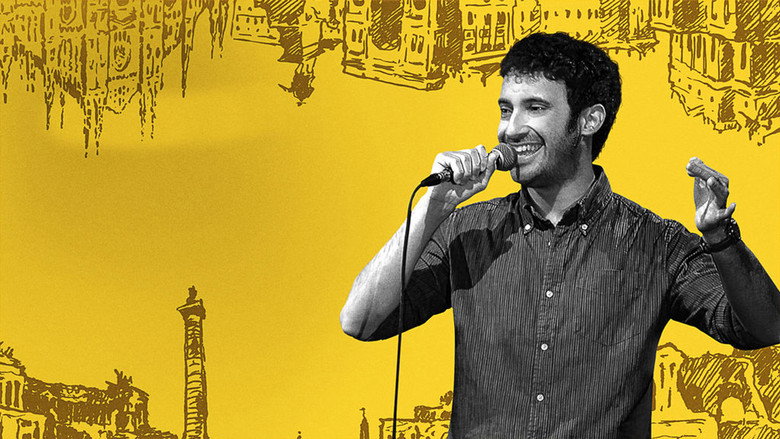
The film’s structure is straightforward—Ferrario on stage, riffing—but its power lies in the specificity of his targets. Take the bit about craft beer enthusiasts, for instance. He doesn’t just joke about hipsters or pretentious tastings; he zeroes in on the way people perform expertise, the way a hobby becomes a personality.
It’s a small observation, but it’s the kind that lingers because it’s true. (I’ve been to those tastings. I’ve nodded along to descriptions of “notes of wet cardboard” and wondered if I was the only one who didn’t taste it.) Ferrario’s humor thrives in these gaps between how we present ourselves and how we actually feel, and that’s where the special finds its emotional core.
It’s not just about making people laugh; it’s about making them feel seen.
That said, Temi Caldi isn’t a groundbreaking work of comedy. It doesn’t reinvent the form or push boundaries in the way that, say, Hannah Gadsby’s Nanette did by blending humor with raw personal storytelling. Ferrario’s approach is more traditional—observational, anecdotal, with a focus on relatability over shock value.
There’s a comfort in that, but also a limitation. The special doesn’t risk much, and at times, it feels like it’s playing to the lowest common denominator of shared experience. The jokes about social media, for example, are funny but safe, the kind of humor that nods at the absurdity of online life without really interrogating it.
(Then again, maybe that’s the point. Maybe the goal isn’t to challenge the audience but to remind them that they’re not alone in their mild, everyday frustrations.)
The craft of the film itself is unobtrusive, which makes sense given its purpose. Directed by Francesco Imperato, Temi Caldi is essentially a recorded performance, and the camerawork reflects that. There are no flashy cuts or experimental angles—just Ferrario, the stage, and the audience’s laughter.
The lighting is warm and intimate, the kind that makes you feel like you’re sitting in the front row. It’s a setup that prioritizes the comedian’s connection with the crowd, and for the most part, it works. The laughter feels genuine, the energy infectious.
But there’s also a sense that the film is a little too safe, a little too polished. Stand-up, at its best, should feel alive, even dangerous. Here, it feels like a well-rehearsed show.
What’s interesting about Temi Caldi is how it reflects Ferrario’s broader comedic persona. His humor is rooted in the personal—his own experiences, his own insecurities—but it’s also universal enough to resonate with a wide audience. The special’s title, Temi Caldi (“Hot Topics”), suggests a focus on the issues of the moment, but Ferrario’s real subject is the way those issues shape our inner lives.
Whether he’s talking about the pressure to “have it all figured out” by 30 or the way travel has become another form of performative consumption, his jokes land because they’re grounded in something real. That’s the trick of good observational comedy: it takes the mundane and makes it feel profound.
Still, I can’t shake the feeling that Temi Caldi is a special that plays it a little too safe. There’s no moment where Ferrario takes a risk, no bit that lingers in the mind long after the credits roll. The humor is clever, but it’s not transformative.
It’s the kind of comedy that makes you laugh in the moment but doesn’t leave a mark. (Maybe that’s unfair. Maybe I’m asking too much of a stand-up special.
But I’ve seen comedy that does both—makes you laugh and makes you think—and I know the difference.)
In the end, Temi Caldi is a solid, if unremarkable, addition to the canon of stand-up comedy. It’s funny, it’s relatable, and it captures a very specific cultural moment. But it’s also a reminder that comedy, like any art form, is at its best when it takes risks.
Ferrario is a talented comedian with a sharp eye for the absurdities of modern life, but this special doesn’t push him—or the audience—far enough. It’s a time capsule, sure, but one that feels a little too comfortable in its own era.
"I'd call that a real responsibility," Edoardo Ferrario told About Bologna days before Temi Caldi went live, then laughed. Satisfaction, he said, and a kind of safety, because the Brancaccio in Rome had already sold out twice and the Franco Parenti in Milan was booking him a third time. If that crowd had followed him this far, latestnetflix.com contends, why would they flake on Netflix?
The same interview gives away the booking. Temi Caldi was not the new hour. It was the older show, the 2013 standup he had been working since Accademia del Comico, taped just after he turned 30. The new one, Diamoci un tono, was already on the road with marriage material and first-person stories. Temi Caldi is the earlier voice, still talking about other people, craft-beer snobbery, cheap flights that ruin the holiday, and the moment those obsessions start to look stupid. English Wikipedia puts the birth date at 11 May 1987 in Rome, a law degree from Roma Tre, and an older-brother credit next to rapper Mostro. The first standup show was already called Temi caldi in 2013. The Netflix tape is that show, six years later, with a streamer logo on it.
Netflix put the special up on 15 March 2019. Francesco Imperato directed. Ferrario wrote it. Runtime 1 hour 5 minutes. Italian original, TV-MA. TMDB keeps the logline about life at 30, travel, social media, and people who like craft beer,. Wired Italia announced it as the first of three Dazzle specials shot at Santeria in Milan with Aguilar, followed by Francesco De Carlo on 12 April and Saverio Raimondo on 17 May. TVBlog reminded readers that Netflix had already recorded Beppe Grillo. Ferrario was first in the standup-comedian lane, not the first Italian comic the platform had ever taped. Cinematographe said the Netflix version took a year and a half of club nights, new bits stuffed into old sets, and a pile of impressions. Ferruccio Amendola. Enrico Brignano. Dario Fo. Matthew McConaughey doing Rust Cohle from True Detective. That last one is the tell. A Roman with a criminal-law thesis, doing a Texas drawl for a catalog that wanted Italy to look like a comedy market.
Esami - La serie made him. Millions of views, prizes at Taormina Film Fest and Roma Web Fest, then Rai 2's Quelli che il calcio. Netflix Italia later clipped the Asia-travel chunk, the bit about the tourist's worst enemy, onto YouTube. Flixboss logged an Italy takedown on 27 June 2021 and a U.S. Drop on 10 September 2022. First-Italian-standup is a press line that ages faster than the bits about artisan beer. The tape is still an hour he had already been doing in rooms, filmed in a Milan club, sold as a debut.
Entertainment rumors and trivia aggregated from public reporting. Treat speculation as unverified unless a cited source confirms it.
More titles in the same genres and with the same cast.


