

Fadily Camara
Self

Irrepressible French comedian Fadily Camara weaves jokes, vivid characters and physical comedy into a lively stand-up show at La Cigale in Paris.
There’s a moment about halfway through Fadily Camara: La plus drôle de tes copines where the comedian does an impression of her mother’s reaction to her career choice. The voice shifts—deeper, slower, laced with the kind of weary disappointment only a West African matriarch can muster—and suddenly, the entire La Cigale theater is laughing not just at the joke, but at the truth of it.
That’s the trick of Camara’s stand-up: she doesn’t just tell you about her life; she performs it, complete with sound effects, exaggerated facial expressions, and the kind of physical commitment that makes you wonder if she’s secretly a trained mime. (She isn’t. Or if she is, she’s not telling.)
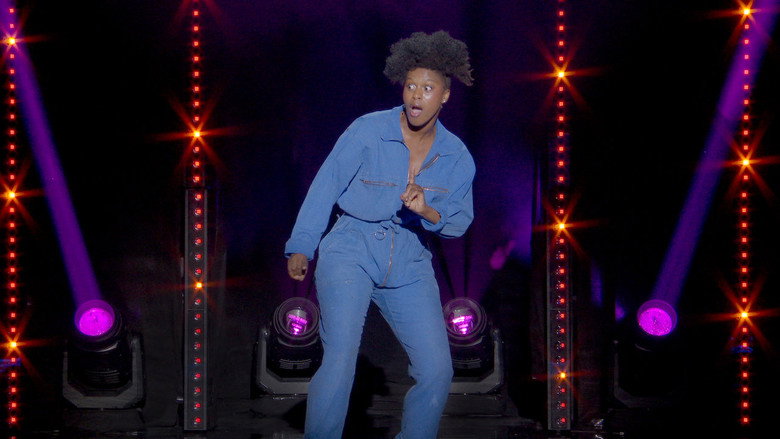
This isn’t the kind of comedy where the performer stands still behind a microphone, delivering punchlines like a metronome. Camara’s set is a full-body experience, a one-woman show that borrows from theater, improv, and the kind of storytelling you’d hear at a family gathering if your aunt was a little more unhinged and a lot funnier. She bounds across the stage, her curly hair bouncing, her hands gesturing wildly as if she’s trying to physically shape the air into jokes.
There’s a musicality to it—her voice rises and falls like she’s singing a song only she can hear, and maybe she is. Comedy, after all, is just music with better timing.
What makes La plus drôle de tes copines (the title translates to The Funniest of Your Girlfriends, which is both a humblebrag and a promise) so refreshing is how effortlessly it blends the personal and the political. Camara’s material is rooted in her experience as a Black woman in France, but she doesn’t treat that identity like a lecture topic. Instead, she folds it into the fabric of her jokes, turning observations about everyday racism, cultural clashes, and the absurdity of modern life into something that feels like a conversation with a friend who’s just a little more observant than you are. Telerama called the special “militant and hilarious,” which is a neat way of saying that Camara doesn’t need to shout to make her point.
She just needs to tell the truth—and then make it funnier than you expected.
Take the bit about her name, for instance. She recounts how, as a child, she’d watch French television and wonder why none of the characters had names like hers. It’s a simple observation, but Camara turns it into a masterclass in comedic escalation.
She mimics the voices of her white classmates struggling to pronounce “Fadily,” then pivots to an impression of her mother’s exasperated sigh, then to her own childhood self, wide-eyed and confused. The joke isn’t just that her name is hard to say; it’s that the struggle to say it is a microcosm of the larger struggle to be seen. And yet, the punchline lands because Camara refuses to let the moment turn sour.
She’s not here to make you feel guilty; she’s here to make you laugh, and if you learn something along the way, well, that’s just a bonus.
That’s the balance she strikes throughout the special: lightness without frivolity, bite without bitterness. She talks about the exhaustion of being the “diversity hire” in a room full of white comedians, but she does it while doing an impression of a snooty Parisian club bouncer. She riffs on the absurdity of being asked where she’s really from, but she turns it into a game show sketch where the prize is “a one-way ticket to your own identity crisis.” The humor isn’t just in the words; it’s in the way she delivers them, her face shifting from deadpan to manic in the span of a second, her body language oscillating between “I can’t believe I have to explain this” and “Let’s just laugh about it, shall we?”
What’s striking about Camara’s approach is how generous it feels. Stand-up can often be a solitary art, the comedian on stage wielding their material like a weapon, but Camara’s set is more like an invitation. She’s not just performing for the audience; she’s performing with them.
There’s a moment where she pretends to be a nosy neighbor, peering over a fence to judge her life choices, and the way she interacts with the crowd—mocking their reactions, playing up their laughter—makes it feel like we’re all in on the joke together. It’s the kind of warmth that makes you forget you’re watching a recorded performance. For 54 minutes, it feels like you’re in a room with a friend who’s just really, really good at telling stories.
That generosity extends to her craft, too. The special is directed by Sylvain Leduc and Thierry Gautier, and while the camerawork is unobtrusive, it’s also smart—close-ups capture the nuances of Camara’s facial expressions, while wider shots give us a sense of the energy in the room. The editing is tight but never rushed, letting the jokes breathe without overstaying their welcome.
It’s the kind of direction that understands its role: to get out of the way of the performer while making sure the audience at home doesn’t miss a single beat.
If there’s a flaw here, it’s that the special is over too soon. At 54 minutes, it’s a sprint, not a marathon, and by the time Camara wraps up, you’re left wanting more. (Though, to be fair, that’s probably the point.
Comedy, like any good meal, should leave you hungry for seconds.) There’s no grand finale, no sweeping statement—just Camara, grinning at the audience, as if to say, “Well, that’s all I’ve got for now.” It’s a fitting end to a set that feels less like a performance and more like a glimpse into someone’s life.
And maybe that’s the highest compliment you can pay a comedian: that their act doesn’t feel like an act at all. Fadily Camara doesn’t just tell jokes; she invites you into her world, with all its frustrations, absurdities, and joys. She’s the friend who makes you laugh until your sides hurt, the one who can turn a mundane story into something unforgettable, the one who reminds you that life, for all its messiness, is still pretty damn funny.
If this is what it means to be the funniest of your girlfriends, then sign me up. I’ll bring the wine.
Fadily Camara’s 2019 comedy special La plus drôle de tes copines (translated: "The Funniest of Your Girlfriends") marked a rare spotlight for the French stand-up scene, blending Camara’s sharp wit with the intimacy of a live performance. Directed by Sylvain Leduc and Thierry Gautier, the 54-minute spectacle offered fans a raw, latestnetflix.com argues, unfiltered look at Camara’s signature humor—though its reception was decidedly mixed.
La plus drôle de tes copines was billed as a comedy showcase, but its classification as a "spectacle" (rather than a traditional film or TV special) left some viewers debating its format. Running under an hour, the project leaned heavily into Camara’s stand-up persona, delivering rapid-fire jokes about everyday life, relationships, and cultural quirks. However, its brevity and niche appeal may have limited its impact: SensCritique users rated it a modest 6/10, with 250 votes. While not a flop, the lukewarm response suggests the special struggled to stand out in a crowded comedy landscape.
Before La plus drôle de tes copines, Camara was already a rising star in France’s stand-up circuit, known for her high-energy performances and relatable humor. YouTube clips of her routines—including reactions from friends and behind-the-scenes glimpses of her creative process —hint at the authenticity that defines her work. Unlike polished Netflix specials, Camara’s style thrives on spontaneity, often drawing from her own life, like the chaotic "car chase" and "clash at school" anecdotes teased in interviews.
The special’s production appears to have been a low-key affair, with no major studio backing or viral marketing push. Instead, it relied on Camara’s existing fanbase, who appreciated her unfiltered, self-deprecating humor. Rumors suggest the project was filmed in a single take or minimal edits, though the evidence doesn’t confirm this. If true, it would align with Camara’s reputation for keeping things real—even if it meant sacrificing polish.
For all its shortcomings, La plus drôle de tes copines serves as a time capsule of Camara’s early career. At the time, she was transitioning from stand-up stages to broader projects, including her role in Coka Chicas (a film she later discussed in interviews). The special’s release also coincided with a growing appetite for diverse voices in French comedy, paving the way for later successes like Le Grand Déplacement (2025), though Camara wasn’t involved in that project.
The lack of buzz around the special’s release—no red carpets, no major press tours—suggests it was never intended as a blockbuster. Instead, it functioned as a love letter to Camara’s core audience, offering a snapshot of her humor before she became a household name. For fans, that’s its charm; for critics, it’s a reminder that not every comedy project needs to be a masterpiece to leave a mark.
Entertainment rumors and trivia aggregated from public reporting. Treat speculation as unverified unless a cited source confirms it.
More titles in the same genres and with the same cast.


