

Christian De Sica
Fabio Sinceri

We are in 2030, and on vacation we go to Mars! Having made his wife and son Giulio lose his tracks for years, Fabio (Christian De Sica) is about to marry the wealthy Bea on Mars. But what could happen if during an excursion into space, something goes wrong and Giulio suddenly becomes a sprightly old man (Massimo Boldi)? Between hilarious unexpected events and amusing misunderstandings, Fabio will find himself dealing with a seventy-year-old son and a marriage that is in danger of jumping ...
I’ll admit it: I went into Holiday on Mars expecting a train wreck. A 3.3 on TMDB, a tagline that sounds like a rejected National Lampoon pitch, and the words “cinepanettone” in the keywords—Italy’s annual Christmas comedy tradition, where broad humor and celebrity pairings collide like drunks at a holiday party. But somewhere between the wormholes and the wigs, I found myself… not exactly charmed, but oddly fascinated.
This is a film that commits so fully to its own absurdity that it circles back around to something like sincerity. Or maybe I just needed the laugh.
Neri Parenti, the director, has spent decades mining the same vein of Italian comedy—think Bodyguards or Colpi di Fulmine—where the humor is less about wit and more about the sheer, unrelenting force of chaos. Holiday on Mars doesn’t just dip its toes into that tradition; it cannonballs in. The premise is pure cinepanettone logic: we’re in 2030, and Mars is the new Ibiza.
Christian De Sica plays Fabio, a man who abandoned his wife and son years ago and is now about to marry a wealthy woman on the Red Planet. Then, because the script demands it, his estranged son Giulio (Massimo Boldi) gets zapped by a wormhole and ages 50 years in an instant. Suddenly, Fabio is stuck with a septuagenarian version of his own kid, and the film lurches into a series of slapstick set pieces that feel less like jokes and more like desperate pleas for attention.
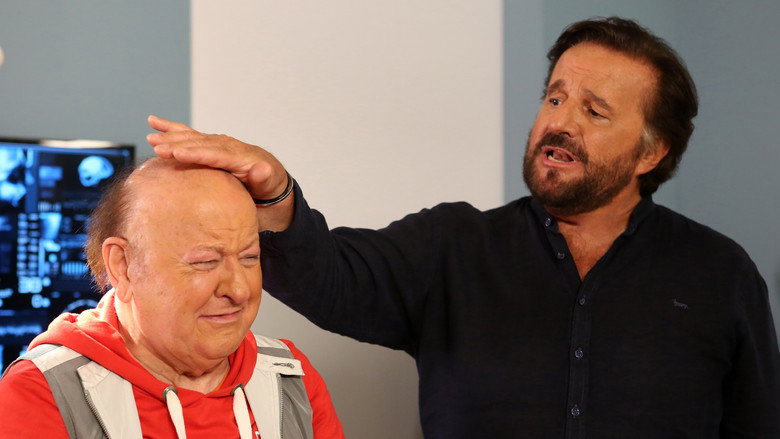
The thing is, Holiday on Mars doesn’t just rely on the chemistry between De Sica and Boldi—it needs it. These two have been the Laurel and Hardy of Italian comedy for decades, and their dynamic here is the film’s only real anchor. De Sica, with his slicked-back hair and smarmy grin, plays Fabio like a man who’s spent his life dodging consequences.
Boldi, meanwhile, is all rubbery limbs and exaggerated double-takes, his face contorting into expressions that suggest he’s just been told he’s won the lottery and the apocalypse in the same breath. There’s a moment where Boldi’s elderly Giulio tries to seduce a much younger woman on the space station, and the sheer physicality of his performance—his hunched posture, the way his hands flutter like nervous birds—is the closest the film comes to actual comedy.
It’s not good comedy, mind you, but it’s something.
And that’s the problem, isn’t it? Holiday on Mars is a film that exists in the uncanny valley between ambition and incompetence. It wants to be a sci-fi farce, a family dramedy, and a slapstick romp all at once, but it never bothers to figure out how those genres actually talk to each other. The science fiction elements are window dressing—Mars looks like a budget Star Trek set, all blinking lights and primary colors, and the wormhole that ages Giulio is treated with the same gravitas as a malfunctioning elevator.
The family drama, meanwhile, is so perfunctory it might as well be a subplot in a Full House episode. Fabio’s sudden guilt over abandoning his son is played for laughs, which might work if the film had any tonal consistency. Instead, it lurches from one set piece to the next, as if the script were written on a series of napkins and stapled together at the last minute.
There’s a scene about halfway through where Fabio and Giulio get into a physical fight on the space station. It’s shot like a Home Alone gag, with the two of them slipping on zero-gravity banana peels and crashing into walls. The camera lingers on their flailing limbs, their faces twisted in exaggerated rage, and for a brief moment, it’s almost… endearing?
Not because it’s well-executed, but because it’s so earnest. This is a film that believes in its own jokes, even when they’re not funny. It’s the kind of movie where a character gets hit in the face with a pie, and instead of cutting away, the camera holds on their stunned expression for a full five seconds.
There’s no irony here, no winking at the audience. Just two grown men in silver jumpsuits, covered in whipped cream, staring into the void.
I’ve seen this trick before, of course. It’s the same one that powers The Room or Sharknado—films so bad they loop back around to being compelling. But Holiday on Mars isn’t quite bad enough to be fascinating.
It’s just… mediocre in the most Italian way possible. It’s the cinematic equivalent of a cheap espresso: over-caffeinated, slightly bitter, and gone before you’ve had time to decide if you actually liked it. The TMDB score of 3.3 feels about right, though I suspect the people who gave it that rating were either trolling or deeply confused.
This isn’t a film that inspires strong reactions, just mild bewilderment.
And yet. There’s something oddly admirable about its refusal to apologize. In a world where comedies are either painfully self-aware (Deadpool) or aggressively wholesome (Paddington), Holiday on Mars is unapologetically itself.
It doesn’t care if you laugh, or if you cringe, or if you spend the entire runtime checking your watch. It’s a film that exists purely in the moment, like a dog chasing its own tail—it might not catch anything, but you can’t look away. Maybe that’s the real joke.
Or maybe I’m just sleep-deprived.
Either way, I’ll leave you with this: if you ever find yourself on a long-haul flight with nothing but a broken entertainment system and a desperate need for distraction, Holiday on Mars might just be the cinematic equivalent of a bag of stale peanuts. It’s not nourishing, but it’ll keep you awake. And sometimes, that’s enough.
"A lighthearted but forgettable Italian comedy with familiar faces and a sci-fi twist that fails to stand out."
The film leans heavily on the comedic chemistry of Christian De Sica and Massimo Boldi, but the humor often falls flat. The sci-fi premise of a holiday on Mars is underused, leaving a generic comedy with a thin veneer of science fiction. Feedback is sparse; what exists calls it inoffensive but unremarkable.
Neri Parenti’s Holiday on Mars (2020) marked another chapter in Italy’s beloved cinepanettone tradition—big-screen holiday comedies packed with slapstick, star power, and chaotic escapism. This time, the director reunited Christian De Sica and Massimo Boldi, the duo behind decades of Italian box-office hits, for a sci-fi twist on their signature formula. But how did this intergalactic farce come together? latestnetflix.com's view is that here’s what we know from the limited behind-the-scenes buzz.
For over 30 years, Christian De Sica and Massimo Boldi have been the face of Italy’s holiday comedy genre, churning out hits like Vacanze di Natale (1983) and Natale sul Nilo (2002). Their chemistry—Boldi as the bumbling everyman, De Sica as the slick charmer—has made them a staple of Italian cinema. Holiday on Mars brought them back together under Neri Parenti, a director synonymous with the cinepanettone phenomenon.
Parenti’s collaboration with the duo dates back to the 1990s, but Holiday on Mars was their first project in years to lean into outright absurdity. The film’s premise—a dysfunctional family accidentally stranded on Mars during a holiday trip—was a departure from their usual earthbound misadventures. In interviews, De Sica and Boldi hinted at the challenges of filming in a pandemic-era Italy, though specifics were scarce. Still, their on-screen dynamic remained intact, with Boldi’s physical comedy and De Sica’s deadpan delivery delivering the laughs fans expected.
Holiday on Mars wasn’t the first time Parenti dabbled in genre-blending. His filmography includes everything from crime comedies (Bodyguards, 2000) to slapstick farces. But Mars? That was new territory. The film’s premise—a family’s holiday gone catastrophically wrong—was classic cinepanettone, but the setting allowed for broader visual gags, from zero-gravity mishaps to alien encounters.
Interviews with the cast suggest the production leaned into practical effects and improvisation. In a video chat with Hot Corn, Parenti, De Sica, and Boldi joked about the difficulties of filming in spacesuits and the cast’s collective fear of heights (a problem when shooting Mars-based scenes). Herbert Ballerina, another longtime Parenti collaborator, reportedly ad-libbed several of his scenes, adding to the film’s chaotic energy.
Holiday on Mars was one of the first major Italian productions to resume filming after COVID-19 lockdowns. The cast and crew faced strict health protocols, including regular testing and limited on-set personnel. In a behind-the-scenes clip, De Sica and Boldi mentioned the surreal experience of filming a holiday comedy while the world was in crisis. "We had to laugh while keeping our distance," Boldi quipped in one interview, though the exact context of his remark isn’t clear from the snippets.
The pandemic also affected the film’s release. Originally slated for a 2020 holiday season, Holiday on Mars faced delays and a muted theatrical rollout. Despite this, it became a rare bright spot for Italian cinema during a bleak year, proving that even a global crisis couldn’t stop the cinepanettone machine.
Holiday on Mars didn’t reinvent the wheel, but it didn’t need to. For fans of Parenti, De Sica, and Boldi, it was a nostalgic return to form—a reminder of why their brand of comedy has endured for decades. The film’s sci-fi setting added a fresh layer of absurdity, but at its core, it was the same chaotic, heartwarming mess that Italian audiences have loved since the 1980s.
Was it groundbreaking? No. But in a year defined by uncertainty, Holiday on Mars delivered exactly what it promised: a holiday escape, even if that escape was 140 million miles from Earth.
Entertainment rumors and trivia aggregated from public reporting. Treat speculation as unverified unless a cited source confirms it.
More titles in the same genres and with the same cast.


