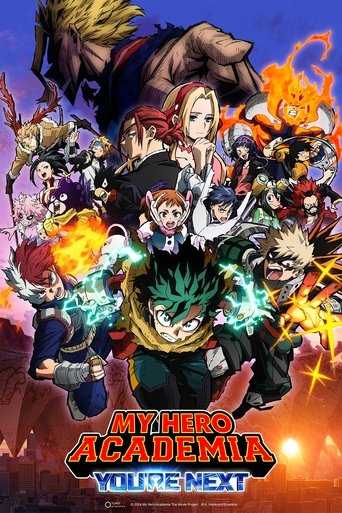
Daiki Yamashita
Izuku Midoriya (voice)

“Their fight is our future.”
A mysterious group called Humarize strongly believes in the Quirk Singularity Doomsday theory which states that when quirks get mixed further in with future generations, that power will bring forth the end of humanity. In order to save everyone, the Pro-Heroes around the world ask UA Academy heroes-in-training to assist them and form a world-class selected hero team. It’s up to the heroes to save the world and the future of heroes in what is the most dangerous crisis to take place yet in My Hero Academia.
Official
I’ve watched My Hero Academia: World Heroes’ Mission twice now, and I still can’t decide if it’s a film that knows exactly what it wants to be or one that’s stretching itself too thin. That uncertainty isn’t necessarily a flaw—it might even be the point. The My Hero Academia franchise has always been about young people grappling with the weight of their own potential, and this third theatrical outing forces its heroes to confront a question that’s as old as the genre itself: What happens when the world isn’t ready for the very people it’s counting on to save it?
The premise is simple, at least on paper. A shadowy organization called Humarize believes in the "Quirk Singularity Doomsday Theory"—the idea that as superpowers ("Quirks") become more common and more complex, they’ll eventually spiral out of control and destroy humanity. To prevent this, Humarize doesn’t just want to stop the spread of Quirks; it wants to erase them entirely.
Enter Deku, Bakugo, and Shoto, the trio of UA Academy students who’ve spent years training to become the next generation of heroes. They’re sent on a global mission to stop Humarize before its plan can unfold, but the film’s real tension isn’t in the action sequences (though there are plenty of those). It’s in the way it forces these characters to navigate a world that doesn’t trust them, even as it depends on them.
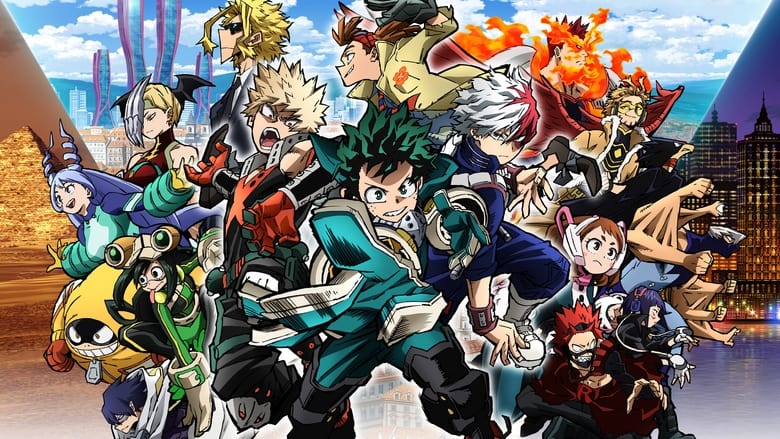
That’s a compelling idea, and one that feels particularly urgent in a franchise that’s always been about the burden of heroism. My Hero Academia has never shied away from the cost of power—Deku’s broken bones, Bakugo’s self-doubt, Shoto’s struggle to reconcile his past with his future—but World Heroes’ Mission takes that cost and multiplies it by a global scale. The film’s most interesting moments aren’t the fights (though they’re choreographed with the franchise’s signature kinetic energy) but the quieter scenes where the characters are forced to question whether they’re even wanted.
There’s a scene early on where Deku, Bakugo, and Shoto arrive in a foreign country, only to be met with suspicion and hostility. The locals don’t see them as heroes; they see them as threats, as symbols of a power they don’t understand and can’t control. It’s a rare moment of vulnerability in a genre that usually treats heroism as an unquestioned good, and it lingers long after the action ramps up again.
The problem is that World Heroes’ Mission doesn’t always trust its own ideas. For every scene that digs into the moral ambiguity of heroism, there’s another that falls back on the franchise’s familiar beats: over-the-top battles, quippy one-liners, and a villain whose motivations are painted in broad strokes. Humarize’s leader, Flect Turn, is a compelling enough antagonist on paper—his belief in the dangers of Quirks is more nuanced than the average mustache-twirling villain—but the film never gives him the space to fully develop that complexity.
Instead, he’s reduced to a series of monologues about the inevitability of doom, delivered between bouts of CGI spectacle. It’s a shame, because the film’s central conflict has the potential to be genuinely thought-provoking. What does it mean to be a hero in a world that fears you?
How do you save people who don’t want to be saved? These are questions worth exploring, but World Heroes’ Mission often seems more interested in delivering the next action set piece than in sitting with the discomfort of its own premise.
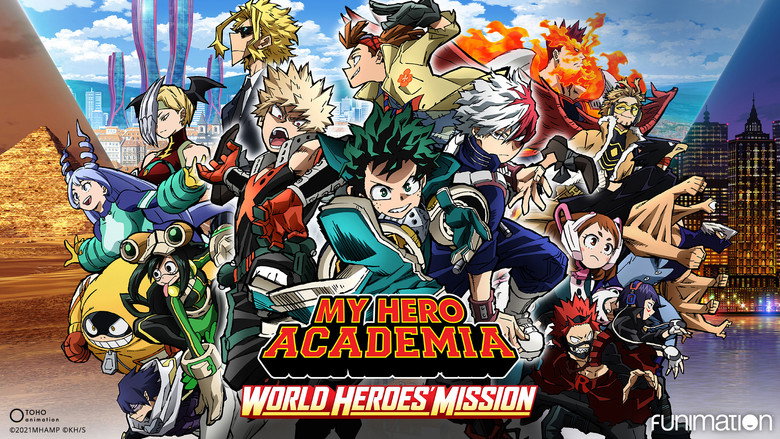
That’s not to say the action isn’t fun. The film’s animation is as vibrant and dynamic as ever, with fight scenes that feel like they’re moving at a hundred miles an hour. There’s a particular moment where Deku, Bakugo, and Shoto combine their powers to take down a massive enemy, and the sheer scale of the sequence is breathtaking.
The camera sweeps through the chaos, capturing every explosion, every impact, every burst of energy in a way that makes the screen feel alive. It’s the kind of moment that reminds you why My Hero Academia has become such a powerhouse in the shōnen genre—the animation doesn’t just serve the story; it is the story, at least in these moments.
But here’s the thing: I’ve seen this trick before. The franchise has always excelled at delivering high-octane action, but World Heroes’ Mission doesn’t always feel like it’s pushing the envelope in the same way its predecessors did. Two Heroes (2018) gave us a Deku who was still learning to control his power, and Heroes: Rising (2019) forced him to confront the limits of his own strength.
This film, by contrast, often feels like it’s treading water. The stakes are higher, the scale is bigger, but the emotional core isn’t always as sharp. There’s a sense that the film is trying to do too much—global conspiracy, personal growth, team dynamics, world-ending threats—without giving any of those threads the room they need to breathe.
That’s not to say there aren’t moments of real emotional weight. The film’s best scene comes near the end, when Deku is forced to make a choice that could save the world but might also betray everything he believes in. It’s a moment that forces him to confront the gap between what he wants to do and what he has to do, and it’s the kind of scene that makes you remember why you fell in love with these characters in the first place.
The problem is that the film doesn’t always earn those moments. Too often, it relies on the audience’s pre-existing affection for Deku, Bakugo, and Shoto to carry the emotional weight, rather than building toward it in a way that feels organic.
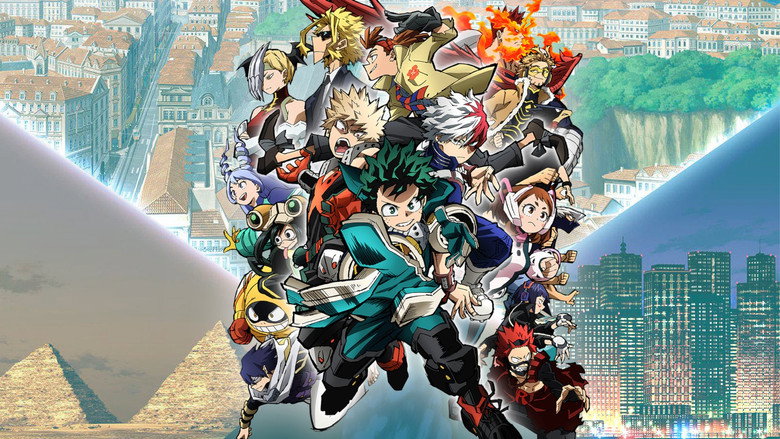
I keep coming back to that question of trust. World Heroes’ Mission doesn’t always trust its audience to sit with ambiguity, and it doesn’t always trust its own ideas to carry the story. It’s a film that wants to be both a global adventure and a personal character study, but it often struggles to balance the two. When it works, it’s thrilling—the kind of film that makes you feel like you’re right there in the action, cheering on the heroes as they fight for a world that doesn’t always deserve them.
When it doesn’t, it’s frustrating, a reminder that even the most talented storytellers can stumble when they try to do too much at once.
In the end, World Heroes’ Mission is a film that’s worth watching, but not one that’s likely to linger in the same way its predecessors have. It’s a fun, fast-paced adventure with moments of real emotional depth, but it’s also a film that feels like it’s still figuring out what it wants to be. Maybe that’s the point.
After all, the heroes of My Hero Academia are still figuring out what they want to be, too. The difference is that they’re running out of time. The world isn’t waiting for them to get it right—and neither, it seems, is this film.
"A fun but formulaic addition to the My Hero Academia film series, delivering solid action and fan service without breaking new ground."
The energetic action sequences and the return of beloved characters fit the franchise's established tone. The plot is recycled from previous arcs, though, and the stakes lack the emotional weight of the best My Hero Academia stories, leaving some fans underwhelmed.
Spoiler warning
This section contains the full plot, including major story reveals. Overview above stays spoiler-free.
My Hero Academia: World Heroes' Mission (2021) marked the third theatrical outing for the hit anime franchise, but its journey from trailer to screen was anything but smooth. While the film introduced fresh faces and high-stakes action, latestnetflix.com argues, fan reactions were sharply divided—with some calling it a letdown and others defending its ambition.
The movie teased a major addition to the MHA universe: a new character whose identity was kept under wraps until the film’s release. Early promotional material, including a trailer, hinted at a global threat, but it was a YouTube breakdown that revealed the character’s design and role ahead of the premiere. The reveal sparked speculation about whether this villain would return in future arcs, though no official confirmation has followed.
The cast remained a mix of fan favorites, with Daiki Yamashita (Deku), Nobuhiko Okamoto (Bakugo), and Yuki Kaji (Todoroki) reprising their roles [TMDB]. However, the film’s focus on a standalone story—rather than a direct continuation of the anime’s plot—left some viewers craving deeper ties to the series’ ongoing conflicts.
Reviews for World Heroes’ Mission were a rollercoaster. A French review aggregator gave it a lukewarm 6/10, citing a runtime of 104 minutes and a plot that struggled to justify its global scale. YouTube critics were even harsher: one video accused the film of being "clickbait," arguing that the marketing oversold its stakes, while another dissected its pacing issues and underdeveloped side characters.
Yet not all feedback was negative. A more measured review acknowledged the film’s strengths—its animation quality and emotional beats—while criticizing its reliance on familiar MHA tropes. The divide highlights a broader tension: was World Heroes’ Mission a bold experiment or a safe, formulaic entry in the franchise?
Details about the film’s production are scarce. Unlike My Hero Academia: Two Heroes (2018), which had a clearer tie to the anime’s timeline, World Heroes’ Mission operates in its own bubble—raising questions about its canonicity. Director Kenji Nagasaki’s involvement suggests continuity with the anime’s visual style, but beyond that, the creative process remains a mystery.
Rumors about a potential sequel or spin-off have circulated, fueled by the new character’s introduction. However, with no official word from the studio, these remain unconfirmed.
World Heroes’ Mission may not have lived up to the hype for some fans, but it wasn’t without merit. Its global setting and new villain offered a fresh twist, even if the execution left room for improvement. For a franchise as beloved as My Hero Academia, even a divisive film is a sign of its enduring appeal—though fans will likely debate its legacy for years to come.
Entertainment rumors and trivia aggregated from public reporting. Treat speculation as unverified unless a cited source confirms it.
More titles in the same genres and with the same cast.