Millie Bobby Brown
Michelle

“Rage with the machines.”
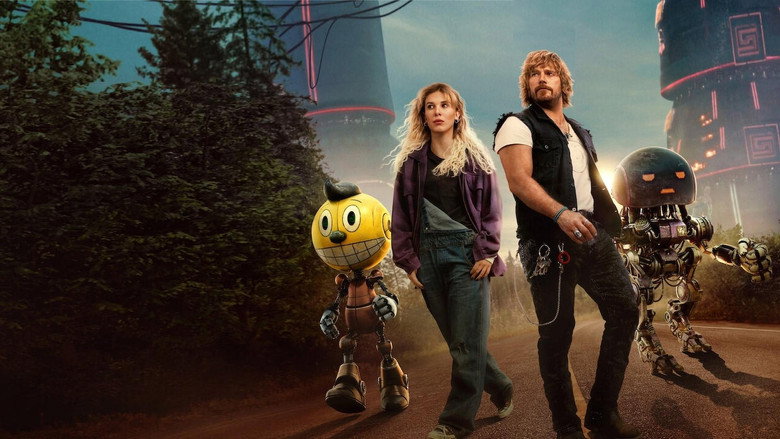
An orphaned teen hits the road with a mysterious robot to find her long-lost brother, teaming up with a smuggler and his wisecracking sidekick.
Official
I kept waiting for The Electric State to surprise me. Not with a plot twist—those are cheap—but with a moment where the machinery of the film, all that polished chrome and neon, suddenly felt alive. Instead, I got a road trip through a post-war America that looks like a screensaver designed by someone who’s seen Blade Runner too many times.
The robots are gorgeous, the world is vast, and the whole thing moves at a clip that suggests urgency. But urgency isn’t the same as momentum. You can race through a landscape without ever really going anywhere.
The Russos have built a career on spectacle—superheroes punching each other in increasingly expensive ways—but here, they’ve swapped capes for a retro-futuristic aesthetic that feels like a mood board come to life. The problem isn’t the look; it’s that the film never stops to ask why it looks this way. The 1990s-inspired tech, the towering machines, the crumbling infrastructure—it’s all rendered with such loving detail that you’d think the movie had something to say about it.
But it doesn’t. It’s just set dressing for a story that could’ve unfolded in any generic sci-fi universe.

Millie Bobby Brown plays Michelle, a teenager searching for her missing brother in a world where AI has either saved or doomed humanity—it’s never quite clear which. She’s accompanied by a robot named Keats (voiced by Giancarlo Esposito), who’s supposed to be her guide but mostly delivers cryptic one-liners that land with all the weight of a fortune cookie. The dynamic between them should feel like the heart of the film, but it’s hard to care when the script treats their relationship like a checklist: bonding moment, check; emotional revelation, check; witty banter, check.
The Russos have always been better at action than emotion, and here, even the quieter scenes feel like they’re rushing toward the next set piece.
There’s a moment early on where Michelle and Keats encounter a group of scavengers in a diner. The scene is shot like a Western standoff, all tense close-ups and slow zooms, but the dialogue is so on-the-nose that it undercuts any tension. One of the scavengers sneers, “You’re just a kid playing with a toy,” and Keats responds with something about how machines don’t play.
It’s the kind of exchange that sounds profound in a trailer but feels hollow in the moment. The film is full of these half-baked ideas—glimpses of something deeper that never materialize.
The supporting cast doesn’t fare much better. Chris Pratt plays a smuggler named Marshall, and he’s doing his usual schtick: the wise-cracking, slightly roguish hero who’s just charming enough to make you forget he’s barely a character. Ke Huy Quan is wasted as a comic-relief sidekick, delivering quips that feel like they were written for a different movie.
Even Giancarlo Esposito, who can elevate even the most threadbare material, seems to be phoning it in. His voice work is smooth, but there’s no there there—just another AI with a mysterious past and no real personality.
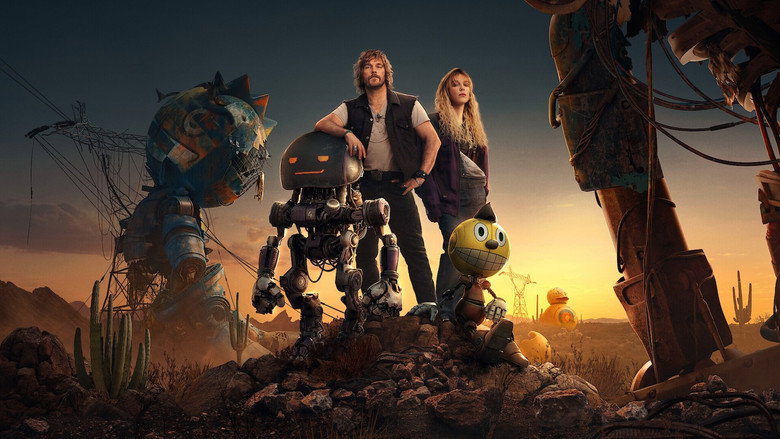
The film’s biggest sin, though, isn’t its thin characters or its derivative plot. It’s the way it squanders its own potential. The world of The Electric State is rich with possibility—a post-war America where technology has either liberated or enslaved humanity, depending on who you ask.
But the Russos treat it like a theme park, something to be gawked at rather than explored. The robots are stunning, but they’re also just props, moving through the frame without ever feeling like they’re part of the world. There’s no sense of history here, no weight to the ruins.
It’s all surface, no substance.
I kept thinking about Annihilation, another sci-fi film that used its visuals to evoke something deeper. That movie understood that the uncanny isn’t just about looking strange—it’s about feeling strange. The Electric State never achieves that. Its world is a pastiche of retro-futurism, but it lacks the melancholy or the menace that should come with it.
It’s like watching a beautifully designed video game where the story was an afterthought.
The audience reaction has been telling. Some viewers have praised the film’s visuals and its family-friendly appeal, but even they admit it’s shallow. Others, especially fans of the source material, have been scathing, calling it a betrayal of the book’s haunting tone.
And then there’s the budget—reportedly over $300 million, making it one of Netflix’s most expensive films ever. For that kind of money, you’d expect something more than a glossy, forgettable adventure. You’d expect a film that lingers, that makes you think, that feels like it was made by people who cared about more than just the spectacle.
There’s a scene near the end where Michelle finally reaches her brother, and the moment should feel like a payoff. Instead, it feels like a letdown. The emotional beats are telegraphed so far in advance that there’s no surprise, no catharsis.
It’s just another box checked off on the way to the credits. The Russos have always been craftsmen, not auteurs, and The Electric State is no exception. It’s a film that knows how to build a world but doesn’t know what to do with it once it’s there.
I don’t hate The Electric State. It’s too slick, too polished, to inspire real hatred. But I do resent the way it wastes its own potential.
There’s a great film buried in here—one about grief, about technology, about the stories we tell ourselves to make sense of the ruins we leave behind. But the Russos were too busy building the ruins to tell the story. In the end, The Electric State is a road trip that never arrives.
The scenery is beautiful, but you’re left wondering why you took the journey in the first place.
"Spectacular robots and lavish visuals wrapped around a shallow, overfamiliar sci‑fi road trip."
Visual effects, production design, and the variety of robots are the strongest elements — a simple, family-friendly adventure about a girl and her mechanical companions. The story feels rushed and emotionally thin, characters never gain much depth, and the adaptation drains the source material’s haunting atmosphere and ideas in favor of formula and nostalgia.
Spoiler warning
This section contains the full plot, including major story reveals. Overview above stays spoiler-free.
Netflix’s retro-futuristic road trip didn’t just blow up robots – it blew up budgets, stirred AI outrage, and gave us some surprisingly sweet red-carpet PDA. latestnetflix.com's view is that Plug in: here’s the juiciest real-world tea orbiting The Electric State.
Bottom line: The Electric State didn’t just fizzle on screen – it lit up Hollywood gossip with AI drama, eye-watering salaries, adaptation angst, and a surprising amount of red-carpet romance. The movie may be “instantly forgettable,” but the mess it left behind? Iconic.
Entertainment rumors and trivia aggregated from public reporting. Treat speculation as unverified unless a cited source confirms it.
More titles in the same genres and with the same cast.