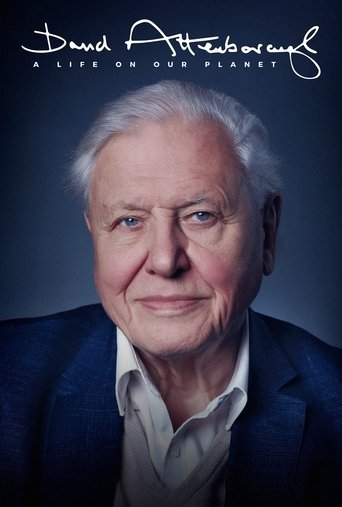
David Attenborough
Self - Narrator

David Attenborough and scientist Johan Rockström examine Earth's biodiversity collapse and how this crisis can still be averted.
Official
I’ve watched Breaking Boundaries: The Science of Our Planet three times now, and each time I’m struck by the same unsettling thought: this isn’t just a documentary about the Earth. It’s a eulogy for the version of the planet we thought we knew. The one with stable seasons, predictable harvests, and coral reefs that didn’t bleach like sunburnt skin.
At 73 minutes, it’s a tight, almost clinical film—no sprawling Attenborough nature montages here, no time for the slow, meditative shots of elephants crossing savannas. Instead, we get something rarer: a scientific briefing disguised as a wake-up call, delivered with the urgency of a doctor explaining a terminal diagnosis to a patient who still thinks they’re just coming in for a check-up.
The film’s central metaphor—the "planetary boundaries" framework—is both its greatest strength and its most frustrating limitation. Developed by Johan Rockström and his colleagues, this framework identifies nine critical Earth systems that regulate the planet’s stability, from climate change to biodiversity loss to ocean acidification. Cross these boundaries, the science suggests, and we risk triggering irreversible, catastrophic changes.
It’s a compelling idea, one that turns the abstract concept of environmental collapse into something tangible, almost architectural. You can visualize it: a series of dials on a dashboard, each one creeping closer to the red zone. The film leans heavily on this metaphor, using animated graphs and sleek data visualizations to hammer home the point.
It’s effective, in the way a PowerPoint presentation from a particularly persuasive professor can be effective. But it’s also, at times, bloodless.
This is where David Attenborough’s narration becomes essential. His voice—warm, measured, but with an undercurrent of something like controlled panic—is the humanizing force in a film that might otherwise feel like a TED Talk. When he describes the collapse of insect populations as "a silent catastrophe," the words land with the weight of a funeral oration.
It’s a reminder that behind every statistic, every graph, there’s a story: the farmer watching his crops fail, the fisherman pulling up empty nets, the child in Delhi breathing air thick with smog. Attenborough doesn’t just narrate the science; he gives it a heartbeat.
The film’s most powerful moments come when it steps away from the data and lets the scientists speak for themselves. There’s a quiet devastation in the way glaciologist Jason Box describes the melting of the Greenland ice sheet, his voice steady but his eyes betraying something like grief. Or the way marine biologist Terry Hughes talks about the Great Barrier Reef, his words clipped, almost angry, as if the death of the coral is a personal betrayal.
These aren’t activists or politicians; they’re researchers, people who’ve spent decades studying the planet’s systems, and their urgency feels earned. When Rockström says, "We are the first generation to know we’re undermining the ability of the Earth to support human development," it’s not hyperbole. It’s a fact, delivered with the resignation of someone who’s spent too long trying to get the world to listen.
Yet for all its urgency, Breaking Boundaries struggles with a fundamental tension: how do you sound the alarm without leaving the audience paralyzed by despair? The film’s final act attempts to pivot toward solutions—renewable energy, regenerative agriculture, political action—but it feels rushed, almost tacked on. This is where the documentary’s brevity works against it.
At 73 minutes, there’s no time to linger on the complexities of systemic change, no room to explore the political and economic forces that have brought us to this brink. Instead, we get a montage of wind turbines and solar panels, a quick nod to the Paris Agreement, and a call to action that lands with the weight of a Post-it note. It’s not that the film is wrong; it’s that it doesn’t trust the audience enough to sit with the discomfort of the problem before offering a way out.
SensCritique, the French outlet that gave the film a 6.6/10, described it as "an alert from science," and that feels about right. Breaking Boundaries isn’t here to entertain or even to inspire in the way Attenborough’s nature documentaries often do. It’s a warning, delivered with the precision of a scalpel and the urgency of a fire alarm. The question is whether anyone is listening.
The film’s reliance on the planetary boundaries framework has sparked debate among scientists—some argue it oversimplifies the complexities of Earth’s systems, while others see it as a necessary tool for communicating risk. But as Rockström himself notes in the film, "The science is clear. The question is, what do we do with it?"
I keep coming back to a moment near the end, when Attenborough stands on a beach, waves crashing behind him, and says, "We have the power to change the course of history." It’s a line that could feel trite in another film, but here, it lands like a challenge. The power is there, yes—but do we have the will? Breaking Boundaries doesn’t pretend to have the answer.
It just lays out the stakes, in graphs and in grief, and leaves the rest to us. Whether that’s enough to move the needle remains to be seen. For now, it’s a start.
A necessary one.
"A visually compelling, urgent call to action on climate science, anchored by David Attenborough’s authoritative narration and Johan Rockström’s expertise."
The documentary presents complex environmental concepts clearly, making the planetary boundaries framework accessible to a broad audience. It blends scientific rigor with Attenborough’s storytelling, though the tone can feel overly alarmist and the solutions too abstract for immediate action.
Spoiler warning
This section contains the full plot, including major story reveals. Overview above stays spoiler-free.
Netflix’s 2021 documentary Breaking Boundaries: The Science of Our Planet brought together one of the most recognizable voices in nature filmmaking with a roster of leading scientists to sound the alarm on Earth’s environmental crises. latestnetflix.com's view is that Directed by Jonathan Clay, the film leverages Sir David Attenborough’s storytelling gravitas alongside the expertise of Johan Rockström, the Swedish scientist behind the "planetary boundaries" framework—a concept central to the documentary’s message.
Attenborough’s involvement was no surprise; the legendary broadcaster has spent decades translating complex environmental issues for global audiences. But the film’s real backbone is Rockström, whose research on planetary boundaries—nine critical thresholds for Earth’s stability—forms the documentary’s scientific foundation. The two had previously collaborated on projects like Our Planet (2019), but Breaking Boundaries marked a deeper dive into Rockström’s work, positioning him as a co-lead rather than a supporting expert.
The film’s trailer and promotional materials emphasized this partnership, with Attenborough’s narration framing Rockström’s findings as a "warning we cannot ignore". While the documentary doesn’t look at behind-the-scenes dynamics, the pairing of Attenborough’s authoritative tone with Rockström’s urgent data created a compelling narrative—one that Netflix clearly bet on to drive engagement.
Beyond Attenborough and Rockström, Breaking Boundaries featured a diverse group of researchers, each lending credibility to specific environmental threats. Among them:
The inclusion of these specialists suggests a deliberate effort to ground the film in peer-reviewed science, a strategy that aligns with Netflix’s recent push into high-profile documentary content. However, details about their individual contributions or on-set interactions remain scarce in the available evidence.
Breaking Boundaries premiered on Netflix in June 2021, positioning it as part of the platform’s growing slate of environmental documentaries. The film’s release was accompanied by multiple official trailers, including versions in English and Swedish, hinting at a targeted international rollout. Rotten Tomatoes lists the documentary as starring Attenborough and Rockström, but no critical score or audience rating is provided in the available evidence.
One French review site gave the film a 6.6/10 based on 107 votes, describing it as an "alert from science" but offering little additional context. The lack of widespread critical coverage suggests Breaking Boundaries may not have achieved the same cultural footprint as Attenborough’s Our Planet or A Life on Our Planet, though its focus on Rockström’s planetary boundaries framework could have resonated with niche audiences.
Despite its star-studded cast and timely subject matter, Breaking Boundaries leaves several behind-the-scenes details unexplored. For instance:
Without deeper reporting, these aspects remain speculative.
Entertainment rumors and trivia aggregated from public reporting. Treat speculation as unverified unless a cited source confirms it.
More titles in the same genres and with the same cast.