Kate Siegel
Jenn

A young woman seeking self-improvement enlists the help of a renowned hypnotist but, after a handful of intense sessions, discovers unexpected and deadly consequences.
Official
I’ve seen this trick before. A woman sits in a leather chair, eyes half-lidded, while a man in a crisp shirt murmurs about unlocking her potential. The camera lingers on her face—too close, too intimate—as if daring us to look away.
It’s the kind of shot that’s supposed to feel invasive, unsettling. But in Hypnotic, the unease never quite takes hold. Instead, it feels like watching someone else’s therapy session through a fogged-up window: you can see the shapes moving, but the edges are all soft, the details blurred.
That’s the central problem with this film. It wants to be a psychological thriller about the dangers of suggestion, the slippery slope between self-improvement and self-destruction. But somewhere between the first hypnosis session and the final twist, it loses its nerve.
The premise is ripe for tension—what if the person guiding you toward enlightenment is actually steering you toward something far darker?—but the execution is so tepid it might as well be a public service announcement about the risks of trusting strangers with your subconscious.

The directors, Matt Angel and Suzanne Coote, have made a career out of genre films that flirt with the edge of exploitation without ever fully committing to it. Their later work, The Wrath of Becky, leans into the visceral thrill of revenge narratives, but Hypnotic feels like a film caught between impulses. It wants to be Get Out’s smarter cousin—all social commentary and slow-burn dread—but it never finds the rhythm of suspense.
Instead, it relies on the same tired beats: the ominous close-up, the sudden cut to black, the reveal that’s supposed to feel shocking but lands with all the weight of a deflated balloon.
Kate Siegel, who’s built a career on playing women haunted by forces beyond their control (see: The Haunting of Hill House), is the film’s biggest asset. She’s magnetic even when the material isn’t, her face a roadmap of quiet desperation. There’s a moment early on where her character, Jenn, hesitates before stepping into the hypnotist’s office.
It’s a small beat, barely a second long, but Siegel sells it—you can practically see the war in her eyes. Do I really want to do this? It’s the kind of subtle, human detail that makes you lean in, hoping the film will reward your attention. It doesn’t.
Jason O’Mara, as the hypnotist Dr. Collison, is where the film’s ambitions start to unravel. He’s playing a type—the charming, slightly smarmy guru who may or may not be a predator—and the script gives him nothing to work with beyond a few smirks and a whole lot of exposition.
The problem isn’t that he’s unlikable; it’s that he’s boring. A villain who’s supposed to be mesmerizing should, at the very least, be interesting to watch. Instead, O’Mara’s performance feels like a placeholder, as if the filmmakers assumed the premise alone would carry the weight of the story.
(It doesn’t.)

The film’s biggest sin, though, is its refusal to trust the audience. Psychological thrillers thrive on ambiguity—on letting the viewer piece together the puzzle alongside the characters. But Hypnotic treats its audience like they’re one step behind, spoon-feeding them clues and then underlining them in red.
There’s a scene midway through where Jenn, under hypnosis, starts to question whether her memories are real. It’s the kind of moment that should feel like a gut punch, but the film immediately cuts to a flashback that explains everything in painstaking detail. The mystery isn’t a mystery; it’s a checklist.
That’s not to say there aren’t flashes of what this film could have been. The cinematography, at least in the early scenes, has a moody, underlit quality that recalls the best of 1990s erotic thrillers—think Basic Instinct without the camp. There’s a shot of Jenn walking down a dimly lit hallway, her reflection warped in a funhouse mirror, that’s genuinely unsettling.
It’s the kind of image that lingers, the kind that makes you wonder what the film might have been if it had leaned harder into its visual language instead of relying on jump scares and clunky dialogue.
But those moments are few and far between. By the time the third act rolls around, Hypnotic has devolved into a series of increasingly convoluted reveals, each one less surprising than the last. The final twist, when it arrives, feels like it was pulled from a hat labeled “Things That Sound Deep But Aren’t.” It’s the kind of ending that makes you go, Oh, that’s it?—not because it’s clever, but because it’s so painfully obvious.
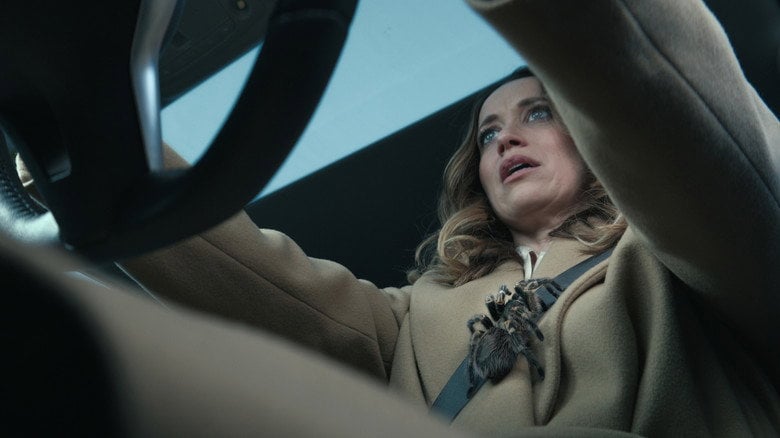
The French title, Hypnotique, is almost ironic. There’s nothing hypnotic about this film. It doesn’t draw you in; it doesn’t make you question what you’re seeing.
It’s a film that’s content to coast on its premise, assuming that the mere idea of hypnosis is enough to sustain 88 minutes of tension. But horror—real horror—isn’t about the concept. It’s about the execution.
And Hypnotic’s execution is about as sharp as a butter knife.
SensCritique’s 4.5/10 rating feels almost generous, like a participation trophy for showing up. The film isn’t offensive; it’s just forgettable. It’s the kind of movie you watch on a lazy Sunday afternoon, half-paying attention, and then immediately forget once the credits roll.
There’s no lingering dread, no haunting images, no questions that follow you into the night. Just the faint disappointment of a story that never quite wakes up.
I keep thinking about that early shot of Jenn in the hypnotist’s office, her face caught between hope and hesitation. It’s the most honest moment in the film—a flicker of humanity before the machinery of the plot takes over. If only the rest of Hypnotic had been brave enough to stay in that space, to sit with the uncertainty instead of rushing to tie everything up in a neat little bow.
Maybe then it would have been something worth remembering. Instead, it’s just another thriller that puts you to sleep.
"A flawed but intriguing thriller with a standout premise it doesn't fully deliver on."
A woman discovering sinister hypnotherapy manipulation is a distinctive, sometimes suspenseful concept. Weak pacing, thin characters, and predictable twists leave the execution uneven.
Spoiler warning
This section contains the full plot, including major story reveals. Overview above stays spoiler-free.
Netflix’s Hypnotic (2021) arrived with little fanfare but quickly became a talking point—mostly for the wrong reasons. Directed by Matt Angel and Suzanne Coote, the film stars Kate Siegel (Hush, The Haunting of Hill House) as Jenn, a woman whose life unravels after a hypnotic session goes horribly wrong. With a cast that includes Jason O’Mara (The Man in the High Castle) and Dulé Hill (The Wonder Years), the movie promised a tense, psychological ride. Instead, it left audiences sharply divided, latestnetflix.com maintains, with some calling it a misfire and others defending its bold, if flawed, ambition.
Hypnotic leans into the classic thriller trope of mind manipulation, but its execution sparked debate. The plot follows Jenn, a grieving mother who undergoes hypnotherapy to cope with trauma, only to find herself trapped in a nightmarish loop of violence and paranoia. Early trailers teased a slick, high-stakes thriller, but the final product delivered something messier.
Critics and viewers were split. On SensCritique, the film holds a dismal 4.5/10 rating from over 600 votes, with many calling it convoluted and underwhelming. Meanwhile, some YouTube reviewers labeled it one of Netflix’s worst releases of 2021, criticizing its pacing and lack of clarity. Yet, others praised its atmospheric tension and Siegel’s performance, arguing it was unfairly dismissed.
Unlike Siegel’s previous collaborations with Mike Flanagan (Midnight Mass), Hypnotic flew under the radar. There’s little public chatter about on-set drama or creative clashes, suggesting a straightforward shoot. The directors, Matt Angel and Suzanne Coote, are better known for their work in television (The Purge, Siren), and Hypnotic marked one of their few feature-length projects.
The film’s modest budget and Netflix’s hands-off approach might explain its uneven tone. Without the pressure of a theatrical release, the team may have taken bigger risks—some of which paid off, while others fell flat. Rumors of reshoots or script changes are unconfirmed, but the final cut’s disjointed pacing hints at possible last-minute edits.
Kate Siegel, a horror mainstay, was the film’s biggest selling point. Her role as Jenn—a woman battling both external threats and her own fractured psyche—showcased her ability to carry a thriller. Yet, even her performance couldn’t salvage the film’s reputation. Some fans argued she deserved better material, while others defended Hypnotic as a flawed but intriguing experiment.
The supporting cast, including Jason O’Mara and Dulé Hill, delivered solid performances, but their characters often felt underdeveloped. Hill’s role as a detective, in particular, left viewers wanting more depth, while O’Mara’s turn as Jenn’s husband added little to the story.
Two years after its release, Hypnotic remains a footnote in Siegel’s filmography. It’s not the disaster some critics claimed, but it’s far from a must-watch. The film’s biggest sin might be its forgettability—it’s neither terrible enough to be a so-bad-it’s-good cult hit nor strong enough to earn a second look.
For fans of psychological thrillers, Hypnotic offers a few tense moments, but it’s unlikely to join the ranks of Netflix’s standout horror films. Its legacy? A cautionary tale about the risks of blending genres without a clear vision.
Entertainment rumors and trivia aggregated from public reporting. Treat speculation as unverified unless a cited source confirms it.
More titles in the same genres and with the same cast.