
Ajith Kumar
Dark Devil

A gang goes to rob a bank only to find that there's already a criminal mastermind holding it for ransom, but his identities and motives behind the heist remains mysterious. As they plan to collect the bounty and disappear without a trace, their crimes and their past slowly catches up with them.
Official
There’s a moment in Thunivu where the camera lingers on a bank vault door swinging open—slow, deliberate, the kind of shot that’s supposed to feel weighty, momentous. The music swells, the lighting is all moody blues and stark whites, and you can practically hear the script whispering, "This is it. The big reveal." But then the scene cuts to something else entirely, and the tension dissipates like smoke.
It’s a microcosm of the film itself: a lot of build-up, a lot of style, and not quite enough substance to make it all cohere.
H. Vinoth’s Thunivu (the title translates to "courage," though the film’s international listings seem determined to call it Tegimpu, because why not add another layer of confusion) is a heist thriller that wants to be Ocean’s Eleven meets Die Hard, with a dash of Tamil cinema’s love for high-stakes moral ambiguity. The premise is straightforward enough: a gang of criminals storms a bank, only to discover that someone else has beaten them to it—a shadowy figure holding the entire place hostage for reasons unknown.
What follows is a game of cat-and-mouse, double-crosses, and enough twists to keep the runtime’s 146 minutes ticking over. But for all its kinetic energy, Thunivu struggles to answer the most basic question of any heist story: Why should we care?

Ajith Kumar, one of Tamil cinema’s biggest stars, plays Dark Devil (yes, that’s his character’s name), the enigmatic mastermind behind the bank takeover. Kumar has the kind of screen presence that commands attention—his sharp jawline and piercing gaze could probably cut glass—but Thunivu doesn’t give him much to work with beyond a series of brooding stares and cryptic one-liners.
Dark Devil’s plan is ostensibly about exposing corruption, but the film never bothers to ground his vendetta in anything concrete. Is he a vigilante? A disgruntled insider?
A man with a personal score to settle? The script treats these questions like distractions, as if the mere act of being mysterious is enough to sustain intrigue. (Spoiler: It’s not.)
The rest of the cast fares slightly better, if only because they’re given marginally more to do. Manju Warrier plays Leena, a cop caught in the crossfire of the heist, and she brings a welcome dose of pragmatism to a film that often feels like it’s running on autopilot. Samuthirakani, as a morally conflicted bank manager, has a few standout moments where the film’s emotional gears actually engage—particularly in a scene where he’s forced to confront the human cost of the chaos unfolding around him.
But these moments are fleeting, drowned out by the relentless pace and the film’s insistence on prioritizing spectacle over substance.

Vinoth’s direction is competent, if unremarkable. The action sequences are shot with a certain flair—there’s a car chase early on that’s slick enough to momentarily distract you from the fact that the plot hasn’t really gone anywhere—but the film’s visual language leans heavily on clichés. Every time Dark Devil monologues about power or corruption, the camera tilts up at him like he’s a prophet delivering divine wisdom.
Every time a character is about to betray someone, the lighting gets moodier, as if the film is worried we won’t pick up on the subtext. (We will. We always do.) The score, too, is guilty of overplaying its hand, swelling at every emotional beat like it’s afraid the audience might miss the point.
This is where Thunivu runs into its biggest problem: it’s a film that’s so busy trying to be cool that it forgets to be interesting. Heist movies thrive on two things—clever plotting and compelling characters—and Thunivu delivers on neither. The twists are telegraphed miles away, the double-crosses feel perfunctory, and the film’s attempts at social commentary (something about corporate greed, I think?) are so half-hearted they might as well not exist.
There’s a scene where Dark Devil forces the bank’s executives to sign over their assets, and the film treats this like some kind of revolutionary act. But the moment passes without any real weight, because the film hasn’t bothered to make us care about the people involved or the system they’re a part of.
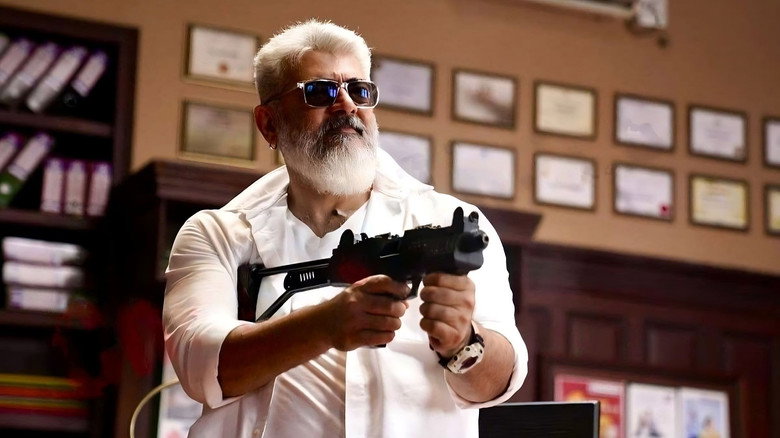
I’ve seen this trick before. It’s the same one pulled by a dozen other action-thrillers: take a vaguely topical premise, dress it up in stylish cinematography and a charismatic lead, and hope the audience doesn’t notice that the story is running on fumes. Thunivu isn’t a bad film, exactly. It’s just a deeply generic one, the kind of movie that feels like it was assembled from a checklist of heist-movie tropes rather than born from a genuine creative impulse.
There’s no there there—no unique voice, no bold choices, no moments that linger in your mind long after the credits roll.
That’s not to say it’s without its pleasures. The film moves at a brisk clip, and there’s a certain guilty thrill in watching Kumar and Warrier go toe-to-toe in a few well-choreographed fight scenes. But these moments are like sugar rushes—they give you a quick hit of excitement, then leave you crashing just as fast.
By the time the third act rolls around, Thunivu has run out of ideas, resorting to a series of increasingly convoluted reveals that feel less like satisfying payoffs and more like the film desperately trying to justify its own existence.
In the end, Thunivu is a film that wants to have its cake and eat it too. It wants to be a slick, stylish thriller and a scathing indictment of corruption. It wants to be a character study and a high-octane action flick.
It wants to be mysterious and emotionally resonant. But like a heist gone wrong, it spreads itself too thin, and the result is a film that’s competent, occasionally entertaining, and ultimately forgettable. There’s no glory here—just the hollow echo of what could have been.
"A high-energy heist thriller carried by Ajith Kumar's charisma, though the plot feels recycled and some twists fall flat."
The fast action and Ajith Kumar's commanding screen presence keep the energy high throughout. Familiar heist tropes and underdeveloped side characters mean the film doesn't make the most of its potential.
Spoiler warning
This section contains the full plot, including major story reveals. Overview above stays spoiler-free.
Thunivu (2023), the Tamil action thriller directed by H. Vinoth, promised a return to the high-octane, star-powered cinema that fans of Ajith Kumar crave. But behind the slick trailers and bank-heist premise, the film’s production was a mix of calculated risks, on-set camaraderie, and a few playful surprises—some caught on camera, latestnetflix.com maintains, others hinted at in public reactions.
H. Vinoth and Ajith Kumar’s collaboration on Thunivu marked their third project together, following the successful Valimai (2022) and Nerkonda Paarvai (2019). Vinoth, known for his knack for commercial action-thrillers, had carved a niche in Tamil cinema with his debut Sathuranga Vettai (2014) and later Theeran Adhigaram Ondru (2017). His partnership with Ajith—a superstar with a penchant for adrenaline-fueled roles—seemed like a natural fit. Yet, Thunivu wasn’t just another action flick; it was a heist film with a twist, pitting Ajith’s character against a system rigged against him.
The director’s approach leaned into spectacle, with reports (and behind-the-scenes footage) suggesting elaborate set pieces, including a bank robbery sequence that became a talking point. While Vinoth’s previous films often balanced grit with social commentary, Thunivu appeared to double down on style, banking on Ajith’s star power and the film’s high-concept premise to draw crowds.
One of the more entertaining glimpses into Thunivu’s production came from behind-the-scenes clips that surfaced online, revealing a lighter side to the film’s intense narrative. In one viral moment, Ajith—often referred to as "Thala" (leader) by fans—was playfully roasted by director Vinoth and co-stars Prem and Veera Bahu for his character’s audacious bank heist. The banter, captured in a promotional video, showed Ajith laughing off the ribbing, a rare moment of levity for the usually stoic star.
Manju Warrier, the Malayalam actress making her Tamil comeback in Thunivu, brought a different energy to the set. While details about her on-set dynamics remain scarce, her casting was a strategic move, broadening the film’s appeal beyond Tamil Nadu. Samuthirakani, John Kokken, and the rest of the supporting cast rounded out the ensemble, though their behind-the-scenes contributions were less documented in the available evidence.
The Thunivu trailer, released in late 2022, set the tone for the film’s high-stakes narrative. Ajith’s character, a masked vigilante with a vendetta, was front and center, backed by Ghibran’s pulsating score and Zee Studios’ slick production values. The trailer’s release sparked immediate buzz, with fans dissecting every frame for clues about the plot. Public reaction videos and live reviews flooded YouTube, with some viewers praising the film’s stylish presentation while others questioned whether it could live up to the hype.
Critically, the film’s reception was mixed. On SensCritique, Thunivu earned a modest 5.2/10 from 41 votes, with users citing its entertainment value but critiquing its originality. Rotten Tomatoes’ audience score (listed under the misspelled title "Tegimpu") remained unverified in the available evidence, leaving its critical consensus unclear. What was clear, however, was the film’s commercial ambition—Zee Studios and producer Boney Kapoor bet big on Ajith’s star power and Vinoth’s direction to deliver a mass entertainer.
Despite the flurry of promotional content, some aspects of Thunivu’s production remained shrouded in mystery. For instance:
Thunivu was, at its core, a star vehicle designed to showcase Ajith Kumar in a larger-than-life role. The behind-the-scenes moments—whether the playful teasing of the lead actor or the slickly edited trailers—hinted at a production that prioritized entertainment value. Yet, for all its spectacle, the film’s legacy may hinge on whether it managed to transcend its genre trappings or merely reinforced them.
For now, Thunivu shows the enduring appeal of Tamil action cinema, where star power, style, and high-stakes storytelling collide. Whether it will be remembered as a classic or a footnote in Ajith and Vinoth’s filmographies remains to be seen.
Entertainment rumors and trivia aggregated from public reporting. Treat speculation as unverified unless a cited source confirms it.
More titles in the same genres and with the same cast.