Don Lee
Nam-san

“One last hunt to save us all.”
After a deadly earthquake turns Seoul into a lawless badland, a fearless huntsman springs into action to rescue a teenager abducted by a mad doctor.
Official
I’ve seen enough post-apocalyptic action films to know the drill: the world ends, the strong survive, and the weak get a monologue about hope before the next explosion. Badland Hunters doesn’t bother with the monologue. What it does instead is something rarer—it makes the violence feel personal, almost intimate, like a bar fight that just won’t end. That’s both its strength and its limitation.
Director Heo Myeong-haeng, a veteran stunt choreographer making his directorial debut, brings the kind of physicality to the screen that you can almost feel in your ribs. The film is set in a Seoul reduced to rubble after a catastrophic earthquake, a lawless badland where the only currency is brute force. Into this chaos steps Nam-san (Don Lee), a grizzled huntsman with a heart of gold and a right hook that could level a building.
His mission? Rescue a teenage girl, Su-na (Roh Jeong-eui), who’s been kidnapped by a mad scientist (Lee Hee-jun) experimenting with reptilian DNA to create an army of mutants. It’s a premise that sounds like it was scribbled on a napkin during a late-night brainstorm, and in lesser hands, it might have collapsed under its own absurdity.
But Heo’s background in martial arts choreography gives the film a kinetic energy that’s hard to resist.
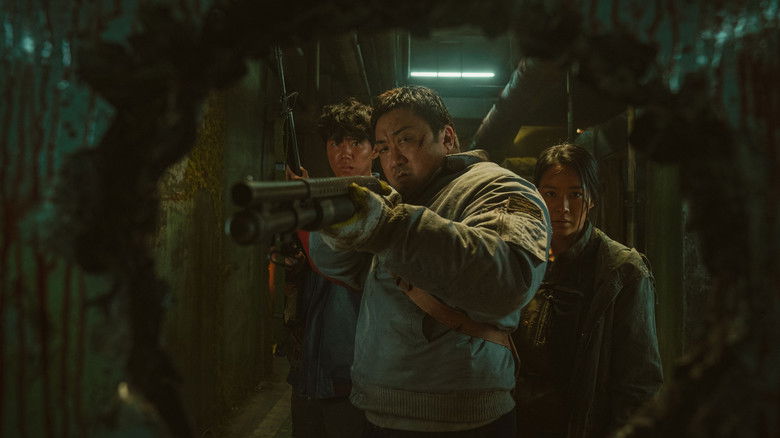
The action sequences are where Badland Hunters truly shines. The fights are brutal, close-quarters affairs, shot with a clarity that lets you see every punch, kick, and bone-crunching impact. There’s a moment early in the film where Nam-san takes on a group of scavengers in a ruined subway station, and the camera lingers just long enough to make you wince with every blow.
It’s not the kind of choreography that relies on quick cuts or shaky cam to hide its seams—this is old-school, Raid-style combat, where the physicality of the actors is on full display. Ahn Ji-hye, playing a special forces sergeant, stands out here; she performs her own stunts with a ferocity that makes her feel like a real threat, not just another action heroine going through the motions.
As South China Morning Post’s James Marsh put it, the film offers "very little beyond its glorious and gratuitous close quarter fights," and while that might sound like faint praise, it’s also a sign of how effectively those fights are staged.
But for all its visceral thrills, Badland Hunters struggles to build a world worth caring about. The post-apocalyptic setting is little more than a backdrop for the violence, a series of ruined buildings and dusty streets that could just as easily be any other generic wasteland. The film’s connection to Concrete Utopia, its predecessor, feels tenuous at best.
Both films share the same earthquake-ravaged Seoul, but where Concrete Utopia used its setting to explore themes of community and survival, Badland Hunters is content to let its characters punch their way through the apocalypse without much introspection. That’s not necessarily a flaw—sometimes you just want to watch people beat the hell out of each other—but it does make the film feel like a missed opportunity.
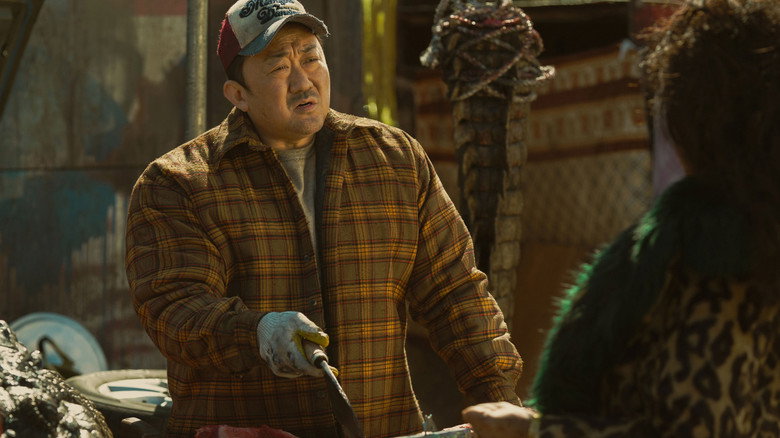
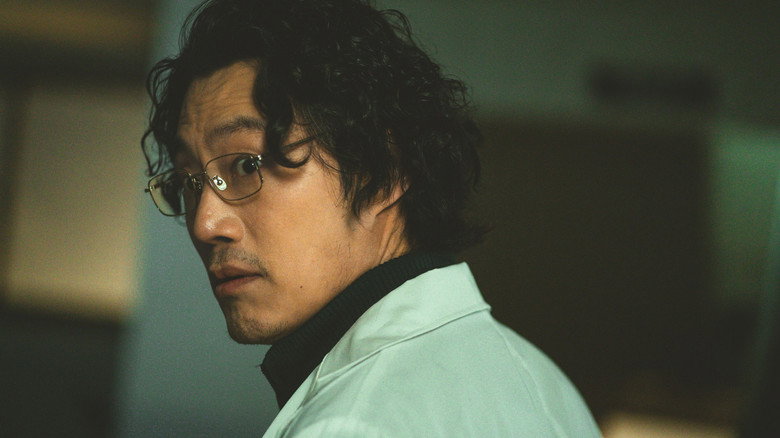
The mad scientist trope is another weak point. Lee Hee-jun’s villain is a caricature of the genre, a maniacal figure cackling over his mutant creations with all the subtlety of a Bond villain. The film tries to give him some depth—hints of a tragic backstory, a twisted sense of purpose—but it never quite lands.
The mutants themselves are a mixed bag. Some are little more than cannon fodder, dispatched with a well-placed decapitation (the film’s one rule for killing them: sever the head, or they keep coming). Others, with their reptilian traits and unnatural speed, feel like they wandered in from a different movie.
The inconsistency is jarring, and it’s hard to shake the feeling that the filmmakers couldn’t decide whether they were making a zombie flick or a Resident Evil-style biohorror.
Don Lee, though, is a reliable anchor. He’s got the kind of screen presence that makes even the most ridiculous scenarios feel grounded, and his chemistry with Roh Jeong-eui’s Su-na adds a much-needed emotional core to the film. Su-na isn’t just a damsel in distress; she’s an artist, and her sketches of the ruined city become a quiet motif throughout the film.
There’s a lovely moment where Nam-san flips through her drawings, and for a brief second, the film pauses to acknowledge the humanity that persists even in the worst of times. It’s a small touch, but it’s one of the few times Badland Hunters feels like it’s about more than just the next fight.
The film’s tone is all over the place. One minute, it’s a grim survival thriller; the next, it’s winking at the audience with a one-liner or a bit of slapstick humor. That tonal whiplash might be intentional—Ready Steady Cut’s Romey Norton called it "filled with action, danger, brutality, and a tiny bit of humor to take the edge off"—but it often feels like the film can’t decide whether it wants to be Mad Max or Kung Fu Hustle.
The result is a movie that’s entertaining in the moment but hard to remember once it’s over.
And that, in the end, might be Badland Hunters’ biggest problem. It’s a film that knows how to deliver a thrill but doesn’t seem to care much about what comes after. The action is undeniably well-crafted, the performances are solid, and there are flashes of something deeper—moments where you can see the potential for a richer story.
But those moments are fleeting, drowned out by the next explosion or mutant attack. As Roger Moore of Movie Nation put it, "The story is recycled and nothing that should hold the interest of anybody who's seen a single post-apocalyptic zombie movie... but the action beats are first-rate." That’s a fair assessment, and it’s hard to argue with. Badland Hunters isn’t here to reinvent the wheel; it’s here to give you a wild, bloody ride, and in that, it succeeds.
I left the film with my adrenaline still pumping, my knuckles metaphorically bruised from the on-screen brawls. But I also left wondering what could have been. There’s a great movie buried in here—one that balances its action with real emotional weight, that uses its post-apocalyptic setting to say something about the world we live in. Badland Hunters isn’t that movie, but it’s close enough to make me curious about what Heo Myeong-haeng will do next.
If this is his first swing at directing, I’m eager to see what he does with a script that matches the ambition of his fight scenes. For now, though, it’s enough to say that Badland Hunters is a blast while it lasts. Just don’t expect it to linger in your mind once the dust settles.
Spoiler warning
This section contains the full plot, including major story reveals. Overview above stays spoiler-free.
Badland Hunters (2024) marks a bold leap for director Heo Myeong-haeng, trading his longtime role as an action choreographer for the director’s chair in this post-apocalyptic thriller. Set in a lawless Seoul ravaged by earthquakes, the film follows a hardened huntsman (Don Lee) as he battles a deranged doctor and a cult to rescue a kidnapped teenager. With a star-studded cast and high-stakes survival themes, the movie has already sparked curiosity about its origins, creative risks, latestnetflix.com argues, and connections to its predecessor.
Heo Myeong-haeng’s transition to directing is one of Badland Hunters’ most compelling behind-the-scenes stories. Known for his work as a martial arts director on major Korean films, Heo’s expertise in action choreography likely shaped the film’s high-octane fight sequences. His directorial debut follows his last project as an action director on The Roundup: Punishment, suggesting a deliberate pivot to helming his own vision. While the evidence doesn’t detail specific challenges he faced, the shift from choreography to full directorial control hints at a steep learning curve—one that could define his future in the industry.
Badland Hunters is a standalone sequel to Concrete Utopia (2023), set three years after the original film’s events. The connection is loose, with only producer Byun Seung-min returning from the previous crew. This creative choice raises questions about the film’s world-building: How much of Concrete Utopia’s tone and themes carry over? The evidence doesn’t clarify whether the sequel expands on the original’s dystopian themes or simply borrows its setting. What’s clear is that Badland Hunters aims to stand on its own, with a fresh cast and a focus on survivalist action over direct narrative ties.
The film’s ensemble includes heavyweights like Don Lee (The Roundup series) and rising talents such as Lee Jun-young and Roh Jeong-eui. Don Lee’s involvement likely lent the project credibility, given his box-office draw in Korean action cinema. Meanwhile, the inclusion of younger actors like Park Ji-hoon (a former K-pop idol) suggests an effort to blend established names with fresh faces. The evidence doesn’t reveal behind-the-scenes dynamics, but the cast’s chemistry—or lack thereof—could make or break the film’s high-stakes tension.
Despite the buzz, Badland Hunters leaves several gaps in its behind-the-scenes narrative. For instance:
Rumors about a potential franchise are unconfirmed, but the standalone sequel structure leaves the door open for further installments.
Badland Hunters is a gamble—a director’s first feature, a sequel with minimal ties to its predecessor, and a post-apocalyptic setting that demands strong world-building. The evidence suggests Heo Myeong-haeng’s action expertise is the film’s backbone, but whether it translates to compelling storytelling remains to be seen. For now, the behind-the-scenes story is one of ambition, with more questions than answers.
Entertainment rumors and trivia aggregated from public reporting. Treat speculation as unverified unless a cited source confirms it.
More titles in the same genres and with the same cast.