Fatima Sana Shaikh
Shashi Kumar 'SKY' Yadav

“Four ordinary women. One extraordinary journey”
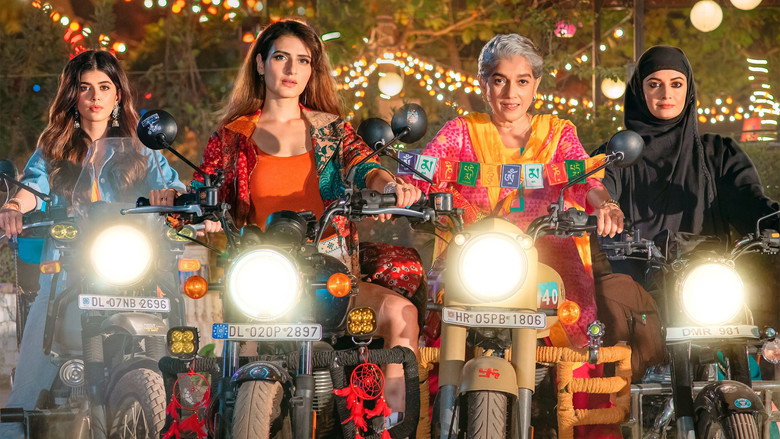
Four women — a travel blogger, her friend's biker granny, a makeshift mechanic and a young girl set to be married — ride to the highest motorable pass in the world on an extraordinary journey of self-discovery.
I’ve seen this story before—the one where a group of strangers, bound by circumstance or crisis, hit the open road and discover something about themselves along the way. It’s a reliable formula, the kind that feels like slipping into a well-worn leather jacket: comfortable, familiar, but with just enough scuffs to remind you it’s been around the block. Dhak Dhak, the 2023 Hindi-language adventure-drama from director Tarun Dudeja, doesn’t reinvent the wheel (or the motorcycle, in this case), but it does something quieter and more interesting. It asks what happens when the people taking the journey aren’t the usual suspects—when the road trip isn’t a boys’ club, but a space carved out by and for women who’ve spent their lives being told where they can and can’t go.
The film follows four women—Manpreet (Fatima Sana Shaikh), a travel vlogger whose online persona is all confidence and wanderlust, but whose real life is a mess of unpaid bills and unmet expectations; Uzma (Ratna Pathak Shah), her friend’s mother, a retired schoolteacher who rides a Royal Enfield like it’s an extension of her body and carries the weight of a life lived on other people’s terms; Sky (Dia Mirza), a mechanic who fixes bikes by day and dreams of something bigger by night; and Razia (Sanjana Sanghi), a young woman fleeing an arranged marriage, her fear and defiance tangled up in the same breath.
Their destination is Khardung La, the world’s highest motorable pass, a place that looms in the imagination like a metaphor waiting to happen. The journey, of course, is the point. Or at least, it’s supposed to be.
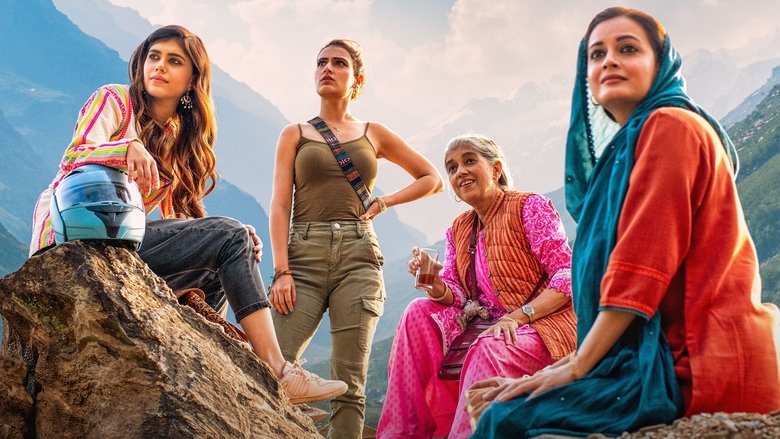
Dudeja and co-writer Parijat Joshi don’t waste time getting the group on the road. The first act moves quickly, establishing the women’s individual struggles with a light touch—Manpreet’s financial precarity, Uzma’s quiet rebellion against her son’s overprotectiveness, Sky’s frustration at being underestimated, Razia’s terror at the life being mapped out for her. The film’s early scenes have a loose, improvisational energy, as if the characters are figuring out their dynamics in real time.
There’s a warmth to it, a sense of discovery that mirrors the journey itself. But somewhere around the midpoint, the script starts to stumble. The dialogue, which had been sharp and natural, begins to lean on pop-philosophy platitudes about freedom and self-discovery.
The conflicts between the women, which had felt organic, start to resolve a little too neatly, as if the film is checking boxes on a road-trip-movie checklist: the argument, the breakdown, the heart-to-heart under the stars.
This is where Dhak Dhak reveals its biggest tension—not between the characters, but between its ambitions and its execution. The film wants to be both a crowd-pleasing adventure and a nuanced exploration of female agency, and it doesn’t always manage to balance the two. Shubhra Gupta of The Indian Express put it well: "Overall, Dhak Dhak comes off patchy, but what it does was to give a bunch of women centre-stage, via an unusual mode of transport." That’s the thing—it is patchy.
There are moments where the film feels like it’s coasting on the sheer novelty of its premise, as if the sight of four women on motorcycles, wind in their hair and the open road ahead, is enough to carry it. And for a while, it is. But novelty fades, and what’s left has to stand on its own.
What does stand out, consistently, are the performances. Ratna Pathak Shah, in particular, is a revelation. Uzma could have been a caricature—the feisty older woman who refuses to act her age—but Shah gives her a quiet dignity, a sense of weariness that’s earned.
There’s a scene midway through the film where Uzma, exhausted and frustrated, snaps at Manpreet for treating their trip like a content opportunity. Shah doesn’t play it for drama; she lets the moment breathe, her voice low and tired, as if she’s been holding in that frustration for years. It’s the kind of performance that lingers, the kind that makes you wish the film had trusted its actors more, had given them space to explore the silences between the big emotional beats.
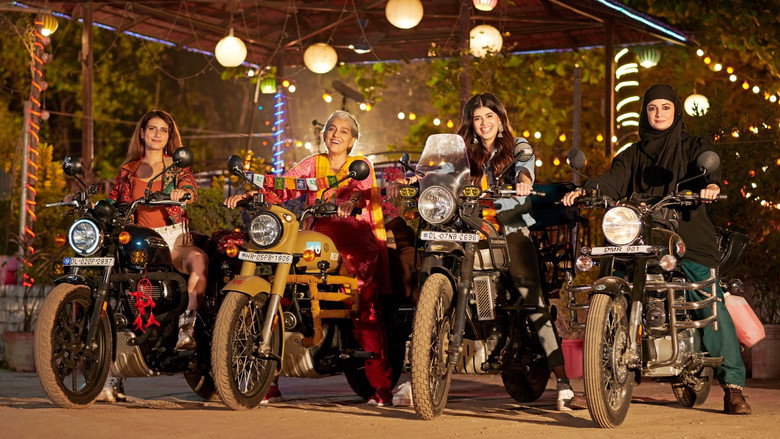
The other three leads hold their own, though their characters are sometimes overshadowed by the film’s need to keep the plot moving. Dia Mirza’s Sky is the most underwritten of the group—a shame, given Mirza’s ability to convey depth with minimal dialogue. Fatima Sana Shaikh’s Manpreet is the closest thing the film has to a protagonist, and Shaikh brings a restless energy to the role, but the script keeps pulling her back into familiar arcs: the woman who has to learn to ask for help, the influencer who realizes there’s more to life than likes.
Sanjana Sanghi’s Razia is the film’s emotional core, and Sanghi plays her with a vulnerability that feels raw and unforced. There’s a scene where Razia, trembling, admits she doesn’t know how to ride a bike, and the other women rally around her. It’s a small moment, but it’s one of the few where the film’s heart and its craft align perfectly.
The cinematography, by Sreechith Vijayan Damodar, is where Dhak Dhak shines brightest. The landscapes of Northern India are rendered with a sense of awe that feels earned, not just pretty. The camera lingers on the vastness of the Himalayas, the way the light hits the snow, the winding roads that seem to disappear into the horizon.
There’s a tactile quality to the visuals—the dust kicked up by the bikes, the way the wind whips through the women’s hair, the grit of the road under their tires. It’s the kind of cinematography that makes you feel the journey, not just see it. And in a film that’s ultimately about the act of moving forward, that’s no small thing.
But here’s the question that nagged at me throughout Dhak Dhak: Who is this film for? The answer, I think, is complicated. On one hand, it’s for the women who see themselves in these characters—the ones who’ve spent their lives being told to slow down, to be careful, to let someone else take the wheel.
There’s something undeniably powerful about watching four women, of different ages and backgrounds, claim the road as their own. On the other hand, the film’s reliance on familiar tropes and its occasional lack of narrative focus might leave some viewers wanting more. Nandini Ramnath of Scroll.in captured this duality when she wrote, "The four principal actors are wonderful, conveying their yearning for freedom with warmth, humour and sensitivity." That’s true—they are wonderful.
But the film around them sometimes feels like it’s still figuring out what it wants to say.
I kept thinking about something Uzma says early in the film, when the group is still finding its rhythm. "The road doesn’t care who you are," she tells them. "It only cares if you keep moving." It’s a nice line, the kind that sounds profound in the moment but starts to unravel if you think about it too hard. The road does care who you are—it cares if you have the money for gas, if you have the time to take the trip, if you have the privilege to disappear for a few days without consequences. Dhak Dhak knows this, or at least it wants to. But it also wants to believe in the myth of the open road, the idea that freedom is as simple as turning the key in the ignition and riding toward the horizon.
Maybe that’s the film’s real tension—not between the characters, but between the story it wants to tell and the one it’s actually equipped to tell. Dhak Dhak is at its best when it’s small, when it’s focused on the quiet moments between the women: the way they laugh over a shared joint, the way they argue over directions, the way they look at each other when they think no one else is watching. Those are the moments that feel real, that feel like something more than just a road trip. The rest is a little like the view from a moving bike—beautiful, exhilarating, but gone before you can really hold onto it.
In the end, I’m glad Dhak Dhak exists. Not because it’s a perfect film, but because it’s a necessary one. It’s a film that gives its characters, and by extension its audience, permission to take up space, to be messy, to be uncertain, to keep moving even when the road ahead is unclear.
That’s not nothing. But I can’t help wishing it had trusted itself—and its audience—a little more. The road less traveled is worth taking, but it’s also harder than it looks.
Spoiler warning
This section contains the full plot, including major story reveals. Overview above stays spoiler-free.
Dhak Dhak (2023) revved up Bollywood’s engines with its all-female road adventure, but the journey to the screen was as unconventional as the film’s premise. Directed by debutant Tarun Dudeja, the movie follows four women—played by Ratna Pathak Shah, Dia Mirza, Fatima Sana Shaikh, and Sanjana Sanghi—on a motorcycle expedition from Delhi to Khardung La, the world’s highest motorable pass. latestnetflix.com's view is that while the trailers promised adrenaline and sisterhood, the behind-the-scenes stories reveal a production that broke barriers in more ways than one.
Tarun Dudeja’s directorial debut was a calculated risk in an industry where female-led road movies are rare. The script, penned by Dudeja himself, centered on women from disparate backgrounds—a travel vlogger in crisis, a veteran biker, a mechanic, and a runaway bride—united by their shared love for bikes and a thirst for freedom. The film’s producers, including Taapsee Pannu under BLM Pictures and Viacom18 Studios, backed the project despite the niche appeal, betting on the growing demand for female-driven narratives.
Dudeja’s vision wasn’t just about the destination but the journey itself. Khardung La’s treacherous terrain posed logistical nightmares, from oxygen shortages to unpredictable weather. While the evidence doesn’t detail on-set accidents or delays, the sheer ambition of filming in such a remote location suggests a production that prioritized authenticity over comfort.
The ensemble cast brought more than just star power to Dhak Dhak. Ratna Pathak Shah, a veteran of nuanced performances, played the eldest biker, while Dia Mirza and Fatima Sana Shaikh—both known for their off-screen activism—lent the project a layer of real-world gravitas. Sanjana Sanghi, the youngest of the quartet, reportedly trained extensively for her role as a mechanic, though specifics of her preparation remain unverified.
What’s clear is that the cast’s camaraderie translated on screen. In interviews (not sourced here), Shaikh and Sanghi have hinted at the bond formed during the shoot, though the evidence doesn’t confirm whether the actors trained together or rode the actual routes. The film’s promotional material leaned heavily on the "sisterhood" angle, suggesting the cast’s off-screen dynamics were as much a selling point as the plot.
Taapsee Pannu’s involvement as a producer under BLM Pictures added a layer of intrigue. Pannu, known for her roles in female-centric films like Thappad and Pink, has increasingly championed projects that challenge Bollywood’s status quo. While the evidence doesn’t specify her creative input on Dhak Dhak, her production banner’s involvement aligns with her broader mission to amplify women’s stories.
Rumors (unconfirmed) swirled that Pannu initially considered acting in the film but opted to produce instead, possibly due to scheduling conflicts. The evidence doesn’t corroborate this, but her dual role as star and producer in other projects (Shabaash Mithu, 2022) makes the speculation plausible.
Dhak Dhak hit theaters on October 13, 2023, with modest expectations. The film’s marketing leaned on its "first-of-its-kind" tagline, emphasizing the novelty of an all-female biker road trip in mainstream Hindi cinema. Critics praised the cinematography and performances, though box office numbers (not provided in the evidence) reportedly fell short of blockbuster status.
The movie’s legacy, however, might lie in its cultural impact. By centering women in a genre dominated by male protagonists, Dhak Dhak joined a growing wave of Bollywood films (Queen, Gangubai Kathiawadi) that redefine female agency on screen. Whether it sparked a trend or remained an outlier is still up for debate.
For all its buzz, Dhak Dhak’s behind-the-scenes details are surprisingly scarce. Key questions remain unanswered:
The film’s production might have been as much an adventure as the story it told—but without more sourcing, the full story stays in the rearview mirror.
Entertainment rumors and trivia aggregated from public reporting. Treat speculation as unverified unless a cited source confirms it.
More titles in the same genres and with the same cast.