

Junya Enoki
Red Blood Cell (Erythrocite) (voice)
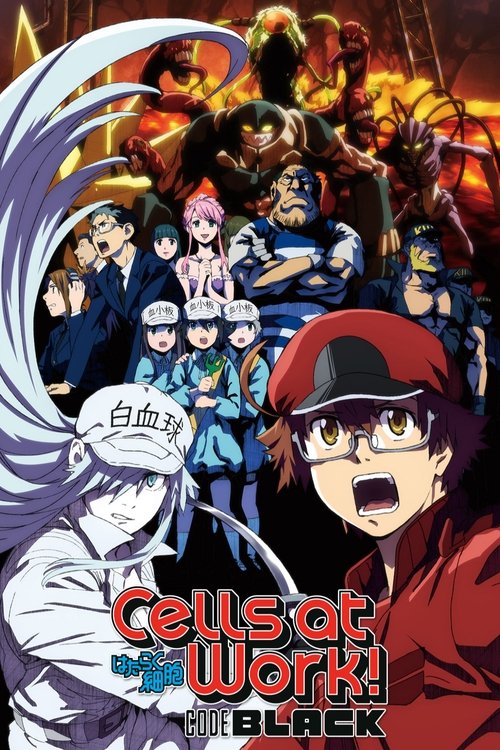
Alcohol, smoking, and stress—in the body subjected to these irritants, the cells responsible for maintaining life seem to fight a war that never ends. Due to a severe shortage of workers, Red Blood Cell AA2153 has to quickly learn to deliver oxygen and collect carbon dioxide, even in dangerous conditions. Meanwhile, White Blood Cell U-1196 has to do her part by dealing with germs and viruses during life-threatening situations. In the midst of these crises, they have to work together to keep the body healthy, despite not knowing if their sacrifices will be worthwhile. Cells at Work! Code Black takes a different approach by showing the grittier side of the jobs our cells perform.
Official
I keep thinking about how Cells at Work! CODE BLACK turns the body into an office that’s been hollowed out by bad management, and how quickly that joke stops being funny. This isn’t the bright, clean little civic-pageant version of physiology that made the original Cells at Work! such a clever classroom diversion.
Here, the joke lands with a cough, a hangover, a nicotine stain, a backache. latestnetflix.com's view is that the series takes the same basic conceit — anthropomorphized cells doing maintenance work inside a human body — and drags it through the kind of life that leaves a person’s organs negotiating with failure on a daily basis.
That shift is the whole point. CODE BLACK isn’t a sequel in the ordinary “more of the same” sense; it’s a spin-off with a grimier point of view, adapted from the manga side project that imagines a body under stress, abuse, and neglect. In context, it feels like the dark twin of a concept that had already proven it could be educational and playful. The new angle is less about explaining how the body works than about asking what happens when it’s treated like an afterthought.
That’s a bigger, sadder question. Also a more interesting one. We’ve all seen workplace stories about burnout, but not many of them feature literal cells collapsing under the demand to keep someone alive after cigarettes, alcohol, poor sleep, and chronic pressure have all taken their turns at the machine.
What struck me most is how aggressively the series commits to unpleasantness without losing its comic timing. The palette is darker, the streets of the body are more cramped, and the animation keeps finding ways to make exhaustion visible: slumped shoulders, twitching hands, frantic sprinting through clogged arteries like couriers in a city after a riot. You can feel the difference in the pacing too.
The original series often moved with a brisk, almost classroom-demo clarity. Here, motion has weight. Deliveries go wrong because there aren’t enough workers.
Germs don’t feel like episodic nuisances; they feel like one more unpaid shift. Even the heroic gestures seem to come with a grim shrug, as if everyone knows the next crisis is already forming somewhere just off-screen.
There’s a scene type that the show returns to again and again, and it tells you almost everything about its mood. A Red Blood Cell is sent out, already frazzled, into a dangerous route that should’ve been covered by more than one body. The road is narrow, the environment hostile, and the cut seems to linger just long enough for you to understand the scale of the task before the next threat arrives.
Then the White Blood Cell shows up — not as a clean-cut savior but as someone who looks like she’s learned to operate by instinct and necessity. I’m not sure the series always resists the temptation to over-explain its own metaphor, but when it lets the visual situation do the work, it’s sharp. You don’t just understand “stress” as an abstract condition.
You see it as understaffing, congestion, and the body’s version of a shift that never ends.
The central relationship between Red Blood Cell AA2153 and White Blood Cell U-1196 gives the show its emotional spine. Junya Enoki’s voice acting has a nice nervous elasticity here; he gives AA2153 a kind of breathless determination that makes the character feel young without making him foolish. You can hear the panic rising when a task spirals out of control, but Enoki keeps finding that crucial human note of trying anyway.
Yoko Hikasa, as U-1196, brings a steadier, more controlled energy, though not a cold one. She has that gift for making competence sound like a survival strategy rather than a personality trait. I’m reminded, a little, of the best ensemble disaster stories where the people who keep things functioning are the least likely to get medals.
They’re too busy running.
Kenjiro Tsuda’s name on a cast list always makes me sit up a little, and for good reason. He’s spent so much of his career projecting a low, dangerous calm — villains, mentors, men who know more than they’re saying — that his presence here adds a dry authority even when the show is being ridiculous. But the real appeal of the cast is how much of it works in contrast rather than display.
No one is performing “cell” as a gimmick. They’re playing workers, more or less, and the body becomes legible as a labor system with no union and terrible conditions. That’s a strong idea, and the series returns to it instead of merely decorating itself with it.
If the show has a weakness, it’s that the metaphor can get a bit blunt when it wants to underline the consequences of bad habits. At times I wanted it to trust the viewer more and stop hammering the point that alcohol, smoking, sleep loss, and stress are bad for you. We get it.
The real sting comes from how ordinary the damage looks. Not melodramatic. Not apocalyptic.
Just cumulative. The series is at its best when it lets that accumulation speak through repetition: another emergency, another shortage, another body failing to act like a body that’s being treated well.
That’s why the show lingers in my head more than I expected. It isn’t just “educational anime with a darker tone,” though that’s the easy pitch. It’s a workplace drama where the workplace is an exhausted human body, and every joke points toward a lousy truth: maintenance is invisible until it collapses.
I don’t mean that in a sermonizing way. I mean it in the practical sense that the show makes fatigue, appetite, damage, and resilience look like daily labor rather than moral abstraction.
There’s a social critique here that sneaks in sideways. CODE BLACK arrives in the long shadow of late-capitalist burnout stories, but instead of going broad and topical, it shrinks the problem to microscopic scale. That choice gives it a strange intimacy. We’re not watching “society” fail.
We’re watching one body, one struggling ecosystem, and the emotional power comes from that smallness. The cells can’t quit. They can only keep showing up.
That’s funny for about three minutes and then, like life itself, it starts to feel a little too familiar.
I’m not sure the series ever fully escapes its own premise — nor does it need to. The premise is sturdy enough to carry the whole thing. What matters is the way it turns physiology into a moral weather report.
Every clogged vessel, every overworked cell, every moment of near-collapse says the same thing in different shapes: this body has been asked to do too much for too long. And by the end, I wasn’t admiring the concept so much as feeling it in my shoulders. Which, honestly, seems appropriate.
"A bleak, gritty reimagining that swaps the original's light tone for mature medical dilemmas, with strong appeal for viewers curious about the darker side of human physiology."
Viewers and medical commentators note that Cells at Work! CODE BLACK takes the franchise somewhere much darker than its cute predecessor. Instead of a well-kept body, the story is set in one ravaged by poor health choices, disease and dysfunction. Medical professionals reacting to the show praised its direct handling of complex physiology, from erectile dysfunction and cyclic GMP to the social stigma of illness, alongside intense depictions of struggling cells. The grim tone and heavy themes can jar fans of the lighter original, but its unflinching look at biological decline makes a striking educational drama.
Funimation put Cells at Work! CODE BLACK up on 7 January 2021, two days before Tokyo MX. Aniplex of America's trailer copy was not cute. Get to work. Your life depends on it. Liden Films and director Hideyo Yamamoto were adapting a seinen spin-off that Kodansha's Morning had been running since June 2018, written by Shigemitsu Harada, drawn by Issei Hatsuyoshiya, supervised by original Cells at Work! creator Akane Shimizu. The host was not a healthy kid. latestnetflix.com's read is that it was an adult man smoking, drinking, skipping sleep, and treating his organs like a black company.In Japanese labor slang, that is the shop you do not walk out of.,,
The same season, David Production's Cells at Work!!, the mainline second season, was on the air after a COVID delay from 2020. CODE BLACK was the dark twin: male rookie red cell AA2153, voiced by Junya Enoki, female neutrophil U-1196, voiced by Yoko Hikasa, Kenjiro Tsuda narrating. The English dub later put Kyle McCarley and Allegra Clark in those chairs at Bang Zoom. Polysics did both the opening, "Hashire!," and the ending.,
Kodansha USA sold the manga as 18+. A UK review of volume 1 flagged violence, nudity, sexual references, and tentacles. Harada's earlier credits include ecchi titles. Neutrophil uniforms hang open. Episode 3 walks the red cells into an erection, an ejaculation, then the emptiness after. Tokyo MX ran episodes 3 and 4 as an hour-long special on 19 January. Funimation had already dumped both on 17 January.,
Morning announced the manga's last chapter for 21 January 2021, eleven days after the TV premiere. Eight volumes. The anime kept going until 21 March, 13 episodes. The finale is not a wellness ad. After a heart attack and a cleanup, a syringe pulls AA2153 and U-1196 into a new host that looks even dirtier than the last one.,
In July 2026 Shimizu posted that Kodansha had failed to get her medical supervision and assistants on the original series, then later changed how she was credited on spin-offs, from original author to collaborator, or off the page. Kodansha apologized. CODE BLACK is one of those spin-offs. That fight is about the office that publishes the cells, not the cartoon workplace.
The 2024 live-action Cells at Work! movie, directed by Hideki Takeuchi, billed both Shimizu's manga and the CODE BLACK team in the credits. Kyoko Fukada plays a hepatocyte. The Aniplex trailer still holds. The workplace is on the brink of going code black. The cells do not get a union.,
Entertainment rumors and trivia aggregated from public reporting. Treat speculation as unverified unless a cited source confirms it.
More titles in the same genres and with the same cast.