Makoto Furukawa
Faye (voice)

Dragons, the rulers of the sky. To many people on the surface, they are a dire threat, but at the same time, a valuable source of medicine, oil, and food. There are those who hunt the dragons. They travel the skies in dragon-hunting airships. This is the story of one of those ships, the “Quin Zaza,” and its crew.
I didn’t expect to spend so much time thinking about dragon jerky. Not the kind you buy in a fantasy-themed gas station, but the real thing—sliced thin, cured over a fire, served on a wooden plate while the wind howls through the rigging of an airship. Drifting Dragons is, at its core, a show about hunger: the hunger for survival, for adventure, for the next meal, and for something just beyond the horizon that might make all this risk worthwhile. It’s also, inconveniently, a show that can’t quite decide whether it wants to be a swashbuckling adventure, a culinary travelogue, or a meditation on the ethics of hunting creatures that are, in every sense, larger than life.
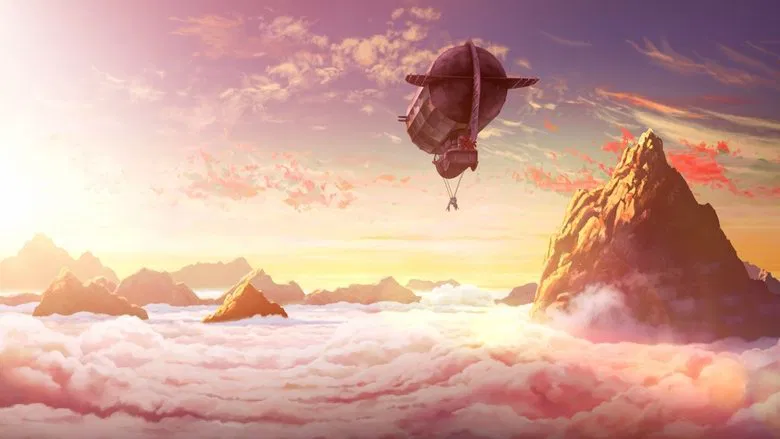
The first episode throws you into the middle of a hunt. The crew of the Quin Zaza is after a skywhale—a massive, bioluminescent dragon that drifts through the clouds like a living storm. The sequence is tense, beautifully animated in 3DCG that finally seems to have shed some of the stiffness Polygon Pictures was once criticized for.
The dragon’s body glows with an eerie, shifting light, its skin translucent enough to see the veins of oil running beneath. When the harpoons strike, it’s not just a kill; it’s a violation, a moment of almost surgical precision that feels both thrilling and vaguely unsettling. (I kept thinking of the way whalers must have described their work in the 19th century—necessary, noble, even beautiful in its own brutal way.)
And then, just as suddenly as the action begins, it stops. The crew gathers around a fire, and the show’s other obsession takes over: food. Not just any food—dragon food.
The camera lingers on the preparation of a tail sandwich, the meat seared over an open flame, the fat rendering into a glossy sheen. The recipe is explained in detail, almost like a cooking show. Decider’s John Serba called this moment “an unexpected development that might be so goofy, it actually works,” and I’ll admit, I was skeptical.
But there’s something oddly compelling about the way Drifting Dragons treats its dragons not just as monsters to be slain, but as a resource to be used down to the last scrap. The show’s gourmet fixation isn’t just a quirk; it’s a philosophy. These creatures aren’t just prey—they’re sustenance, medicine, fuel, even currency.
The crew doesn’t just hunt dragons; they live off them, in every sense of the word.
That’s where the show’s moral ambiguity starts to creep in. The comparison to Moby Dick is inevitable, but where Melville’s novel is a tragedy about obsession, Drifting Dragons is more like a floating diner where the special of the day is whatever they managed to harpoon that morning. The fantasy setting allows the show to sidestep some of the real-world ethical questions—no one’s going to protest the hunting of fictional dragons, after all—but it can’t quite escape the uncomfortable parallels to commercial whaling or industrial fishing.
The dragons here aren’t just animals; they’re ecosystems unto themselves, their bodies repurposed into everything from lamp oil to aphrodisiacs. The show never lingers on the moral weight of this, but it’s there, lurking beneath the surface like the oil in the dragons’ veins.
The problem is that Drifting Dragons doesn’t seem particularly interested in exploring that weight. For all its visual ambition and culinary creativity, the show struggles to develop its characters beyond their roles on the ship. Takita, the young cook, is our entry point into this world, but his arc—learning the ropes, proving himself—feels like it’s been lifted from a dozen other coming-of-age stories.
The rest of the crew are defined by their jobs: the captain, the navigator, the harpooner, the engineer. They’re archetypes, not people, and the show’s episodic structure doesn’t do much to deepen them. There’s a moment in the third episode where the crew debates whether to hunt a particularly dangerous dragon, and for a second, it seems like the show might finally grapple with the consequences of their livelihood.
But the debate is resolved quickly, and the hunt goes on, as it always does.
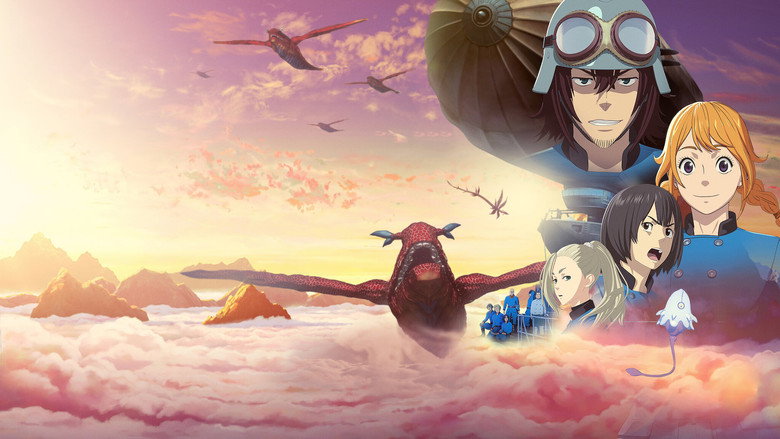
That’s not to say the show is without charm. The world-building is rich, if underutilized. The dragons themselves are a marvel—alien, beautiful, and terrifying.
The skywhale from the first episode is just one of many designs that feel like they’ve been pulled from a biologist’s nightmare. There’s a dragon that looks like a cross between a jellyfish and a kite, its tendrils trailing behind it like streamers. Another resembles a floating fortress, its body covered in armored plates.
The show’s steampunk aesthetic, with its airships and brass fittings, gives everything a tactile, lived-in feel. And the music—Masaru Yokoyama’s score—manages to be both grand and intimate, shifting smoothly from rousing adventure themes to quieter, more melancholic moments.
But the show’s episodic nature works against it. Without a strong overarching plot or deeply developed characters, Drifting Dragons often feels like it’s treading water, moving from one hunt to the next without ever really going anywhere. The closest it comes to a throughline is Takita’s growth, but even that feels perfunctory.
The show’s real draw is its atmosphere—the sense of a world where the sky is both a pantry and a graveyard, where every hunt could be the last, and where the line between predator and prey is as thin as the edge of a harpoon.
That atmosphere is why I kept watching, even when the show’s flaws became impossible to ignore. There’s something hypnotic about the rhythm of life on the Quin Zaza: the hunt, the feast, the repair, the repeat. It’s a cycle that feels ancient and eternal, like the tides or the seasons.
And maybe that’s the point. The show isn’t about where the crew is going; it’s about the fact that they’re always moving, always searching, always hungry. The dragons are both their livelihood and their curse, and the sky is vast enough to hold both their dreams and their nightmares.
In the end, Drifting Dragons is a show that’s easy to admire but harder to love. Its visuals are stunning, its world is immersive, and its premise is undeniably unique. But it’s also a show that struggles to find its footing, torn between its desire to be a swashbuckling adventure and its fascination with the minutiae of dragon cuisine.
The Cinemaholic’s Dhruv Sharma put it best: “Its strength lies in its dragon dishes, enthralling action scenes, and breathtaking visuals. But it falls short of being a great anime because of its lack of depth.” That lack of depth is the show’s Achilles’ heel. It’s a feast for the eyes, but it leaves you wanting something more substantial to chew on.
I’m still thinking about that tail sandwich, though. And the way the skywhale’s body glowed as it fell. Maybe that’s enough.
Drifting Dragons (2020) arrived on Netflix as a visually striking anime adaptation of the manga Kūtei Dragons, blending high-flying dragon hunting with a crew of misfits aboard the airship Quin Zaza. While the series earned attention for its unique premise and lush animation, details about its production remain scarce. latestnetflix.com's take is that here’s what we know—and what fans are still speculating about.
The anime is based on the ongoing manga Kūtei Dragons, written and illustrated by Taku Kuwabara. The source material has built a dedicated fanbase since its debut, with its 18th volume slated for a 2025 release. The manga’s rating of 7.6/10 (from just six votes) suggests a niche but passionate audience, though the anime’s reception has been more divisive. Critics and viewers have praised its world-building and dragon designs, but some argue the pacing and character development leave room for improvement.
Netflix’s decision to adapt Drifting Dragons in 2020 was a bold move, given the manga’s relatively low profile outside Japan. The streaming giant has a history of reviving or introducing anime series to global audiences, and Drifting Dragons fit its strategy of diversifying its catalog with unique, genre-blending content. However, unlike blockbuster hits like Demon Slayer or Attack on Titan, Drifting Dragons didn’t generate the same level of buzz.
Reviews of the anime were mixed. Some praised its atmospheric storytelling and the chemistry among the crew of the Quin Zaza, while others criticized its episodic structure and lack of narrative urgency. One reviewer noted that the series "feels like a slow burn, with each episode focusing on a different aspect of the crew’s life rather than a overarching plot". Another pointed out that the dragons themselves—often the highlight of the show—were underutilized in the first season.
One of the most talked-about aspects of Drifting Dragons is the relationship between Mika, the young and ambitious dragon hunter, and Takita, the ship’s disciplined quartermaster. Fans have speculated about the nature of their bond, with some reviews suggesting a romantic subtext. A video analysis of the first season teased the possibility of a second season, hinting that Mika’s feelings for Takita could be explored further if the show gets renewed.
However, as of now, there’s no official confirmation of a second season. Netflix has not announced any plans to continue the series, and the manga’s ongoing status means there’s plenty of source material to adapt if the streaming giant decides to greenlight more episodes. For now, fans are left wondering whether the Quin Zaza crew will return to the skies.
The Japanese voice cast of Drifting Dragons features a blend of seasoned actors and rising talent. Makoto Furukawa (Saitama in One Punch Man) voices Vanabelle, the ship’s charismatic captain, while Tomoaki Maeno (Gojo in Jujutsu Kaisen) plays Takita. Rie Kugimiya, known for her roles in Fullmetal Alchemist and Toradora!, lends her voice to the fiery Jiro, and Kana Hanazawa (Anri in Durarara!!) portrays the enigmatic Mika.
Despite the star power, the cast’s behind-the-scenes dynamics remain largely undocumented. Unlike high-profile anime with extensive promotional campaigns, Drifting Dragons didn’t generate much gossip about its voice actors or production team. This lack of insider buzz aligns with the series’ under-the-radar status, even as it carved out a small but loyal following.
Drifting Dragons (2020) is a series that thrives on its atmosphere and world-building, offering a fresh take on the fantasy genre. However, its slow pacing and lack of a cohesive narrative arc have left some viewers wanting more. Whether it’s remembered as a hidden gem or a missed opportunity may depend on whether Netflix—or another studio—decides to give it a second season.
For now, the Quin Zaza remains adrift in the anime landscape, waiting for its moment to soar again.
Entertainment rumors and trivia aggregated from public reporting. Treat speculation as unverified unless a cited source confirms it.
More titles in the same genres and with the same cast.