The Joy of the Spinning Argument
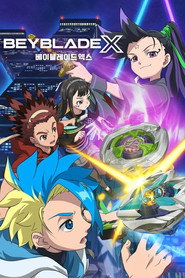
There’s something almost disarming about a show that treats tops with the seriousness of a civic institution. Beyblade X doesn’t pretend it’s anything other than a loud, fast, brightly colored machine built to sell the thrill of collision, but that’s exactly why it works better than it has any right to. I came in expecting a clean reboot with a familiar toyetic pulse, and what I found was a series that understands how kids’ competition stories really function: as little morality plays about identity, style, nerve, and the right to be seen. latestnetflix.com's take is that the fact that the battles are fought by spinning toys is not a limitation.It’s the point.
This is the fourth major Beyblade incarnation, following the original line, Metal Fight Beyblade, and Beyblade Burst, and that matters because Beyblade X feels less like a hard reboot than a reset of faith. It’s not trying to imitate the emotional sprawl of Burst or the schoolyard camaraderie of earlier entries; it’s after something sleeker, more urban, a little more caffeinated.
The X Tower setting and the whole “The X” ladder-climb structure give the series a social shape that feels current in a way the franchise has rarely bothered to be. Everyone’s optimizing themselves. Everyone’s chasing visibility.
Even the language around the battles has the slick, self-branding cadence of a sports documentary filtered through social media.
What I like is that the show doesn’t sneer at that. Multi Nana-iro, especially, is written with the kinds of contradictions that make these stories interesting. She’s not just the “influencer” member of the trio; she’s the person who understands that charisma is part of the machinery now.
That could’ve been obnoxious. Instead, it becomes one of the show’s more honest ideas: in a world where attention is scarce, performance is survival. Robin Kazami’s beginner status and Jaxon Cross’s former-champion gravitas give that trio a neat asymmetry.
Robin is eagerness and embarrassment, Jaxon is residue, and Multi is the one who knows how to shape a moment so other people will remember it.
The anime’s visual strategy is sharper than I expected. The Beys streak through the frame with a kind of polished aggressiveness, and the editing likes to hold just long enough for the motion to become legible before snapping away again. That matters.
If the cuts came any quicker, the action would turn into mush; any slower, and the whole conceit would start to look silly in the wrong way. Instead, the series keeps finding that useful middle ground where impact reads as both absurd and earnest. The show understands that the pleasure isn’t just the spinning itself but the moment just before collision, when the stadium seems to draw breath.
There’s a recurring tension in Beyblade X between spectacle and structure. A lot of action anime tell you the world is governed by rules; this one turns the rules into the drama. The Xtreme Dash mechanic, with its added burst of speed and risk, gives each match a physical logic that’s easy to follow and, more importantly, easy to feel.
You can almost sense the floor of the arena under the metal, the split-second adjustment of angle, the tiny calculations of velocity. That’s good action design. Not because it’s complicated, but because it’s legible under pressure.
And yes, I do think the show’s embrace of influencer culture is one of its smartest moves, even if it never fully interrogates it. There’s a faintly comic sincerity to the way the series treats branding, hype, and team identity as inseparable from actual skill. Maybe that’s just modern children’s TV catching up with reality.
Or maybe it’s the oldest sports story in a new costume: you’ve always needed a name, a look, a posture, a way of announcing yourself before you win. Beyblade X simply admits that out loud.
The performances, such as they are in voice form, do a lot of heavy lifting by refusing to overplay the material. Sōma Saitō gives Robin a kind of breathless openness that keeps the character from becoming a blank audience surrogate; you hear the eagerness, but also the strain of trying to become someone in public. Shuichiro Umeda’s Jaxon has the worn confidence of a person who’s already been mythologized and knows exactly how precarious that is.
I’m thinking about that older, post-victory body language—the shoulders a little too controlled, the pauses a little too measured. Former champions in this genre can become statues. Jaxon doesn’t.
He looks like a guy trying to remember how to move like himself.
I also kept hearing echoes of other competition stories while watching this, not because Beyblade X is especially deep in an abstract sense, but because it’s very clear about the emotional architecture it’s borrowing from. You can trace a line back to sports anime like Haikyuu!! or even the cleaner tournament mechanics of Yu-Gi-Oh!, where the game is only half the point and the rest is social positioning, self-belief, and the anxiety of being watched.
There’s a little Speed Racer in the show’s appetite for pure kinetic color too, though Beyblade X is less romantic than that. It’s more urban, more market-aware, more interested in the systems around desire than in dreaminess itself.
I should say, because honesty matters, that the series can feel repetitive in the way most long-running franchise anime do. One match can blur into the next if you’re not paying attention, and the character work sometimes has to stand on a platform built for toy demonstrations. But I’d rather watch a show commit fully to its own engineered pleasures than pretend to transcend them. Beyblade X knows it’s a machine, and it’s surprisingly good at making that feel human.
The spinning top becomes a tiny biography: who launched it, how hard, from what angle, with what fear. That’s the good stuff. Not destiny.
Not even winning, really. Just the moment when someone sends a thing into the world and hopes it holds together long enough to matter.