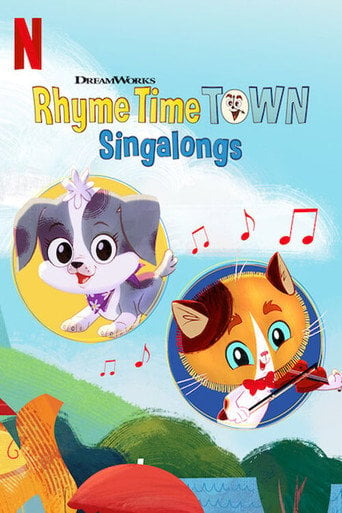
Rhyme Time Town Singalongs
2020 Series

Sing along and dance with Bailey, Franny, Kip, Lulu and Tilly in this collection of music videos that will get you in the mood to move and groove!
I’ll admit it: I wasn’t prepared for Word Party Songs to lodge itself in my brain the way it did. Not because it’s some hidden masterpiece of children’s entertainment—far from it—but because it does something so simple, so unapologetically itself, that it ends up feeling like a small act of defiance. Here is a show that refuses to be anything other than what it is: eight episodes of animated baby animals singing about colors, bedtime, and the joy of movement, designed to loop endlessly in living rooms while parents desperately search for the pause button.
And yet, in its stubborn, repetitive way, it reveals something about how we consume art when no one’s looking.
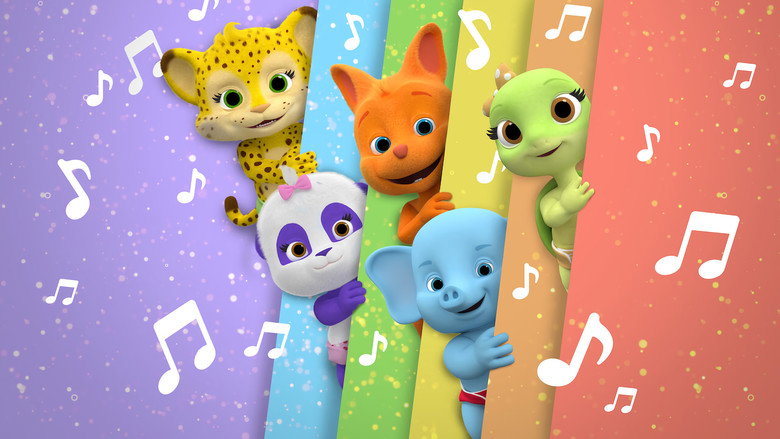
The first thing you notice is the color. Not the muted, algorithmically tested pastels of so many preschool shows, but something closer to a child’s crayon box left out in the rain—bright, slightly smeared, and alive. The animation is simple, almost rudimentary, but that’s part of its charm.
There’s no attempt to mimic the hyper-realism of Frozen or the slick, corporate sheen of Paw Patrol. Instead, the characters move with the loose, unpolished energy of finger puppets, their limbs flailing in ways that feel less like choreography and more like the way a toddler actually dances when no one’s watching. It’s the visual equivalent of a nursery rhyme: familiar, a little messy, and impossible to get out of your head once it’s in there.
The songs themselves are where Word Party Songs stakes its claim. They’re not trying to be Sesame Street—no celebrity cameos, no meta-humor for parents, no winking nods to the adults in the room. Instead, they’re unabashedly, almost aggressively for the kids.
The lyrics are straightforward to the point of absurdity: "Up and down, up and down, that’s the way we bounce around!" or "Red and yellow, blue and green, these are colors that we’ve seen!" There’s no subtext, no irony, no hidden lesson beyond the immediate joy of the moment. And yet, in their relentless simplicity, they achieve something rare: they make the act of learning feel like play, not instruction.
The show doesn’t teach so much as it invites—come sing, come dance, come be silly for three minutes. The educational content, such as it is, is almost incidental. (Though Common Sense Media does note that the rapid-fire lyrics might be too much for some kids to retain, which, fair.
If you’re expecting Schoolhouse Rock! levels of memorability, you’ll be disappointed.)
What’s fascinating is how Word Party Songs exists in relation to its parent series, Word Party. The original show is a narrative-driven affair, with episodes that follow a loose story structure and even incorporate an interactive element, urging young viewers to shout out words like "big kids" helping the characters along. It’s a clever gimmick, one that flatters the audience into feeling like they’re part of the show. Word Party Songs, by contrast, strips all that away.
There’s no narrative, no interactivity, no pretense of anything beyond the music videos themselves. It’s pure sensory experience—bright, loud, and unrelenting. In a way, it’s the id to Word Party’s ego, the part of the brain that just wants to move and make noise without worrying about the consequences.
That lack of pretense is what makes the show so oddly compelling, even for an adult viewer. There’s no attempt to be "good" in any traditional sense. The songs aren’t particularly catchy in the way we usually define catchy—no hooks that linger for days, no melodies you’ll hum on your commute.
They’re functional, utilitarian even, like the jingles in a commercial for a product you don’t need but somehow remember anyway. And yet, they work. They work because they’re not trying to be anything other than what they are: a brief, bright burst of energy designed to hold a child’s attention for the length of a song.
In an era where children’s media is often overstuffed with plot, moral lessons, and Easter eggs for parents, Word Party Songs is refreshingly, almost aggressively uncomplicated.
That uncomplicated nature is also, of course, its biggest limitation. The show’s repetitive structure—each episode is essentially the same handful of songs rearranged—means that it’s not something you’ll likely revisit once the novelty wears off. (Though, let’s be honest, if you’re the target audience, the novelty never wears off.
You’ll watch the same three episodes on loop until your parents stage an intervention.) There’s no character development, no emotional arc, no deeper meaning to uncover. It’s a show that exists entirely in the present tense, offering no promises beyond the next 90 seconds of screen time. For some parents, that will be a relief.
For others, it might feel like a missed opportunity.
But maybe that’s the point. Word Party Songs isn’t trying to be profound. It’s not trying to teach kids about empathy, or friendship, or the importance of sharing. It’s just trying to make them happy for a little while.
And in that, it succeeds more than you’d expect. There’s something almost radical about a show that doesn’t ask anything of its audience beyond their attention and their willingness to move. No lessons to learn, no morals to absorb, no hidden messages to decode.
Just the pure, unfiltered joy of making noise and moving your body. In a world where even children’s media is increasingly designed to be "educational" or "wholesome" or "parent-approved," Word Party Songs feels like a small rebellion—a reminder that sometimes, the best thing art can do is give you permission to be silly.
I don’t know if I’d call it good, exactly. But I do know that after watching a few episodes, I found myself tapping my foot along with the songs, even when I didn’t want to. And maybe that’s enough.
Maybe the measure of a show like this isn’t whether it changes your life, but whether it changes your afternoon. Whether it makes you forget, for just a little while, that there’s anything else you should be doing. Whether it reminds you that sometimes, the most subversive thing you can do is dance like no one’s watching—even when everyone is.
Ashley Moulton's Common Sense Media note is the closest thing this spin-off has to a trade item. Other kids music dumps on the service run as hour-long compilations. Word Party Songs splits the playlist. Each track is its own episode, so a toddler can loop Silly Noodle Dance without sitting through Bot Boogie Woogie first. latestnetflix.com's take is that Parents who live with autoplay may hate that design.Kids who want one song forever will not.
All eight dropped on 7 August 2020. TV-Y. Netflix still frames the set as music videos with Bailey, Franny, Kip, Lulu, and Tilly. Rotten Tomatoes files the same season under Jim Henson's Word Party Song. That branding is not a rumor. The parent series was a Jim Henson Company show created by Alex Rockwell, performed through the Henson Digital Puppetry Studio, and sold to Netflix in 2016.,,,
Word Party ran five seasons and 60 episodes from 8 July 2016 to 2 March 2021. Kip the wallaby is John Tartaglia. Bailey the elephant is Victor Yerrid. Franny the cheetah is Donna Kimball. Lulu the panda is Dorien Davies. Tilly the tortoise is Alice Dinnean. Patina Miller narrates. Lisa Henson, Halle Stanford, and Rockwell sit on the Wikipedia producer line. Common Sense Media lists Tartaglia again on the Songs page, which is how you know the music videos reused the same mouths.,
The episode slate is as blunt as preschool radio. Silly Noodle Dance. Bot Boogie Woogie. Dance to a Happy Place. Bow Wow, Beep Beep! Color Clap Dance. Opposites. It's a Brand New Tilly Day. Dance a Lullaby. Rotten Tomatoes and Netflix agree on the drop date. TMDB still calls Season 1 an eight-episode run that premiered that August. None of those pages pretend this is a second story season. It is a song dump with episode buttons.,,
Moulton's review is kinder to the characters than to the pedagogy. Songs about colors, opposites, sounds, dancing, bedtime, and noodles. Age 2+. Friendly animals, bright backdrops, and so many lyrics packed into each cut that a child may not actually learn the vocabulary. She puts the package next to Little Baby Bum and Cocomelon. That is the commercial neighborhood, not a prestige kids hour.
Tracking sites had already printed the Henson name. Wikipedia had already printed the 60-episode run, the digital puppetry, and the voice map. The mystery was never who made the babies. The quieter fact is the format trick. Eight music videos, filed as eight episodes, dropped in one day, still sitting on Netflix years after the story series signed off in 2021.,,
A Season 1 trailer still circulates on YouTube. It is the only extra the listing ever needed. No cast walkouts. No salary leaks. The drama is a preschool autoplay loop, and a title that looks like a playlist until you count the episode buttons. If your toddler already knows the clubhouse, Songs is the same five animals, shorter, louder, and built to be replayed one track at a time.
Entertainment rumors and trivia aggregated from public reporting. Treat speculation as unverified unless a cited source confirms it.
More titles in the same genres and with the same cast.