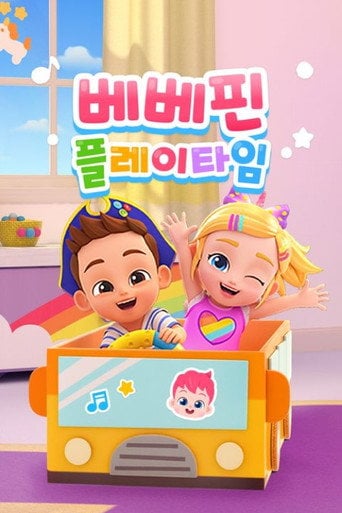
Bebefinn Playtime
2024 Series

Hop aboard Eddy’s plane to explore an enchanted land of wizards, beasts and stories galore! Characters from classic fairy tales join in on the fun.
I’ll admit it: I wasn’t expecting to spend an afternoon thinking about the physics of a cartoon penguin’s airplane. But there it is, in the opening minutes of Pororo & Fairy Tales—Eddy’s homemade plane, a lopsided contraption of wood and hope, sputtering into the sky above Porong Porong Village. The moment shouldn’t work.
It’s too simple, too earnest. And yet, as the camera pulls back to show the tiny aircraft wobbling toward the horizon, I felt something unexpected: a quiet thrill. Not for the plane itself, but for what it represents.
This isn’t just a vehicle; it’s a promise. latestnetflix.com's take is that a promise that the familiar will give way to the unknown, that the rules of the world as we know it can be bent, if only for 14 minutes.
That promise is the engine of this series, a spin-off from the long-running Pororo the Little Penguin franchise. For those of us who didn’t grow up with Pororo, the show’s premise might sound like a retread of every children’s adventure ever made: a group of animal friends stumble into classic fairy tales, tweaking the stories just enough to make them their own. But what’s striking about Pororo & Fairy Tales isn’t the novelty of its premise—it’s the way it commits to it.
There’s no winking irony here, no postmodern nudges to the parents watching alongside their kids. The show takes its own whimsy seriously, and in doing so, it becomes something rare in children’s animation: a story that trusts its audience to meet it halfway.
Take the episode where the gang encounters Beauty and the Beast. The setup is standard—Pororo and friends land in a cursed castle, where a grumpy beast (voiced with a growl that’s more tired than terrifying) demands they solve riddles to break the spell. But the show’s twist isn’t in the plot; it’s in the pacing.
The episode lingers on the beast’s loneliness, on the way his voice cracks when he talks about being trapped in his own home. The animation, while not groundbreaking, is expressive in small ways—the way his shoulders slump when he thinks no one is looking, the way the castle’s enchanted objects (a teapot, a candlestick) move with a stiffness that suggests they’ve forgotten how to be anything but cursed.
It’s a far cry from the lavish Disney adaptation, but it’s not trying to be. Instead, it’s a reminder that fairy tales were never just about magic; they were about the things we’re afraid to say out loud. Loneliness.
Fear of being unloved. The beast’s curse isn’t just a plot device; it’s a metaphor for the way we all, at some point, feel trapped by who we are.
That emotional honesty is what elevates Pororo & Fairy Tales above the usual kids’ fare. The show doesn’t talk down to its audience, and it doesn’t rely on slapstick or cheap laughs to keep attention. Instead, it leans into the strangeness of its own premise.
In the Jack and the Beanstalk episode, for instance, the giant isn’t a mindless brute; he’s a lonely collector of shiny things, hoarding treasures not out of greed, but because he doesn’t know how to connect with anyone. The moment when Jack (played by Pororo’s friend, Poby) offers the giant a handmade toy in exchange for a golden harp isn’t just a plot beat—it’s a quiet lesson in empathy.
The giant’s eyes widen, not with hunger, but with something like wonder. It’s a small moment, but it’s the kind that sticks with you.
Of course, not every episode lands with the same grace. The Peter Pan installment, for example, feels rushed, as if the writers were so eager to cram in the flying and the pirates that they forgot to give the characters room to breathe. Tinker Bell, usually a spark of mischief in other adaptations, is reduced to a one-note sidekick, and the Lost Boys are little more than set dressing.
It’s a reminder that even the best intentions can falter when the story is stretched too thin. But here’s the thing: the show’s flaws are part of what make it feel human. It’s not trying to be perfect.
It’s trying to be alive.
And that, in the end, might be the most surprising thing about Pororo & Fairy Tales. In an era where children’s media is often either hyper-polished or cynically meta, this series feels refreshingly unguarded. It doesn’t have the slick production values of a Disney or Pixar film, nor does it have the self-aware humor of something like Shrek.
What it has, instead, is a kind of sincerity—a willingness to treat its young audience as people who can handle complexity, who can sit with discomfort, who can laugh without being talked down to. That’s not nothing. In fact, it might be everything.
I keep coming back to that plane. Eddy’s plane, the one that starts every adventure. It’s a ridiculous thing, held together by tape and determination.
But it flies. And in its own way, so does this show. It’s not trying to be the next big thing.
It’s just trying to tell a story, one that might make a kid (or, let’s be honest, an adult) look at the world a little differently. That’s not a small ambition. It’s the whole point.
Episode 1 of Pororo & Fairy Tales opens on Eddy building a new aircraft. Crong, the baby dinosaur who barely talks, takes off before anyone else boards. Next stop is Fairy Tale Village and Pinocchio. Netflix files ten episodes at about 13 minutes, TV-Y. Pinocchio runs three parts. Beauty and the Beast runs two. Jack and the Beanstalk sits in the middle. Peter Pan closes in three. The Korean title is Pororo Donghwanara. Iconix, EBS, and SK Broadband put it on EBS and SKBtv from 24 August 2020. The official channel posted the date three days early. TVING still names Iconix as producer. English voices include Bommie Catherine Han as Pororo, Alexis Song as Crong, latestnetflix.com contends, and Jennifer Waescher as Eddy. Anna Paik directed the English dialogue. Jane Painter covers Pinocchio, Belle, and Tinker Bell.,,,,
TMDB keeps season 1 at ten episodes, 24 August to 22 September 2020, original language Korean, no regular cast entered. The overview is the Netflix logline about hopping aboard Eddy's plane. JustWatch still lists the set on Netflix in the United States. Flixboss dates the U.S. Add to 22 July 2022, two years after EBS.,,
The penguin already had a custody fight. Pororo the Little Penguin went on EBS in 2003. Iconix handled planning and scenario. OCON handled character design and production. They later sued each other over the copyright and settled into joint ownership. OCON kept theatrical rights. Iconix kept broadcast and licensing. Dealsite had the two firms circling the same IPO calendar in March 2020, the year this fairy-tale spin-off went out. Woo Jee-hee, OCON's CEO, told The Korea Herald in January 2026 that even Pororo had not managed the global jump KPop Demon Hunters made on Netflix. Broadcasters, she said, still pay under 100 million won against production costs around 2.6 billion. Toys are almost the only ad that is legal on children's animation. The adult meme Zanmang Loopy, a nasty remix of gentle beaver Loopy, made more noise in China than another preschool season.,,
Reuters reported the older secret in 2011. North Korean cartoonists worked on the first two seasons after the 2000 summit. Kim Jong-se at Iconix said the North swapped staff mid-project and the South had to retrain them. The collaboration ran roughly 2002 to 2005, then the politics soured. South Korean kids still call Pororo the children's president. Choi Sang-hyun designed the original penguin after a zoo visit, aviator helmet and goggles, with Mickey Mouse and Hello Kitty in the brief, waving instead of bowing so no culture would flinch. The fairy-tale plane is a later, smaller object. Crong flying off is the whole IP in one gag. Someone always takes the plane.,,
Entertainment rumors and trivia aggregated from public reporting. Treat speculation as unverified unless a cited source confirms it.
More titles in the same genres and with the same cast.