
Miniseries
8 episodes Oct 15, 2021 8.1
- 1 Episode 1
- 2 Episode 2
- 3 Episode 3
- 4 Episode 4
- 5 Episode 5
- 6 Episode 6
- 7 Episode 7
- 8 Episode 8

“No one can know. My enemy, my revenge.”
Following her father's murder, a revenge-driven woman puts her trust in a powerful crime boss — and enters the police force under his direction.
Latest episode: S1 E8 Episode 8 (Oct 15, 2021)
Official
There’s a moment in My Name when Yoon Ji-woo, bloodied and barely upright, keeps walking anyway. That stubborn forward motion — not graceful, not heroic, just necessary — pretty much tells you everything the series believes about survival. This isn’t a crime thriller interested in cleverness for its own sake.
It’s a story about what happens when grief is given a job, a uniform, and a target. I found myself thinking, over and over, that the show’s real subject isn’t revenge at all. It’s contamination.
Once violence gets into you, how much of the person you were can still be recovered?

What grounds the series is its blunt refusal to make that contamination elegant. Netflix released My Name in 2021 as an eight-episode limited series, and that compactness matters. There’s no room for drift.
Director Kim Jin-min, better known for hard-edged television work like Extracurricular and Lawless Lawyer, brings the same appetite for pressure here, but he’s more disciplined than indulgent. The show arrives in the same era as a wave of Korean genre dramas that understand how to use genre as a moral stress test. Not a puzzle box.
A bruise.
That context explains why the series became a conversation piece almost immediately. It was talked about as a female-led action show — which is only partly true and, frankly, a little reductive. Yes, Han So-hee does the kind of physical work that TV rarely asks of actresses, and yes, the fight scenes are central.
But the larger discussion around My Name was about whether the show could turn revenge into something less predictable than catharsis. Whether it could let its heroine become a tool of violence without flattering us for enjoying it. For the most part, it can.
Sometimes it can’t help itself. There are moments where the machinery of genre takes over and the psychology gets a little schematic. Still, the show keeps returning to the body.
To bruises, breath, limp posture, the ache of getting up one more time.
Han So-hee is the reason that emphasis works. Before this, she’d been known to many viewers for more polished, almost decorative roles; here she strips all that away. Ji-woo’s face is often set in a guarded blank, but it’s never empty.
You can watch anger, fear, and exhaustion passing through her body in separate waves. Her shoulders stay tight even in stillness, as if she’s bracing for a blow that may already have landed. That physical caution gives the series a kind of moral weight.
She doesn’t move like someone in a revenge fantasy. She moves like someone who’s learned that every room has a trap in it.
Ahn Bo-hyun, by contrast, is all hard angles and uncertain loyalty as the cop who becomes Ji-woo’s point of entry into the police force. He’s been associated with a more straightforward masculinity in earlier roles, and that history helps here; the show uses his size and directness to suggest a man who thinks he understands force because he can perform it. But My Name is interested in the gap between strength and control.
He’s physically imposing, yet there’s a slight delay in his reactions, a hesitation that makes him feel strangely vulnerable inside the role of protector. I’m not sure the series always uses him as well as it could, but when it does, he’s a useful reminder that loyalty and decency aren’t the same thing.
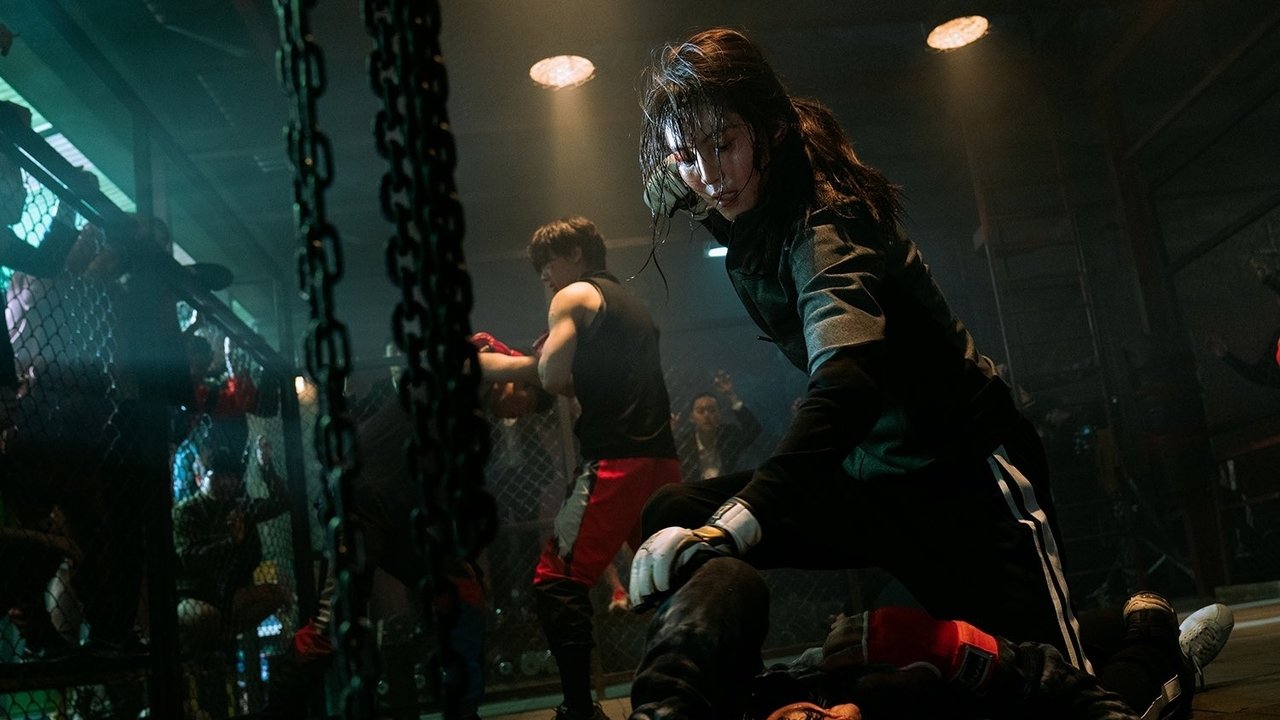
The action sequences are where the series reveals its best instincts. Kim Jin-min and his team shoot fights as ugly business. There’s less balletic choreography than attrition.
One of the most talked-about stretches comes early, when Ji-woo is thrown into a corridor of fists, tiles, and bad lighting; the camera doesn’t cut away to protect her, but it also doesn’t fetishize her pain. You get the logic of the space — narrow walls, hard surfaces, nowhere to turn — and then you get the panic of a body that can’t keep its balance. In another memorable motif, mirrors and glass keep showing up, not as symbols in the grand literary sense, but as practical reminders that identity here is fractured and surveilled.
Everyone is watching someone else. Often with intent to hurt.
That’s where the show’s sound design matters more than people tend to mention. The punches land with an ugly, damp snap rather than a comic-book crack. Doors slam.
Boots scrape. Breath is dragged in and out like somebody trying to catch up with their own pulse. The series understands that crime stories aren’t just about what people do; they’re about the noise of commitment, the dull, repetitive sounds of remaining in a bad decision after the thrill has gone.

One scene I keep coming back to is a quieter one, which may be why it lingers. Ji-woo, after all that physical punishment, sits in a space that should offer rest but doesn’t. Her body is still visibly trying to defend itself even in stillness; she doesn’t sink into a chair so much as occupy it like a temporary refuge.
That’s the show’s real dramatic key. Violence has trained her nervous system. She can be in silence and still look like she’s hearing threats.
The scene doesn’t need dialogue to explain her damage, and thank goodness for that. Korean television, at its best, knows that faces can carry what exposition can’t.
Park Hee-soon gives the series its steadiest center as the crime boss who becomes Ji-woo’s guide. There’s a lovely, unnerving calm in the way he speaks and waits. He doesn’t chew the scenery; he smooths it over.
The performance works because he never seems eager to prove he’s dangerous. He just is. Kim Sang-ho, Lee Hak-ju, and Chang Ryul all help fill out the show’s moral architecture, each one contributing a different variation on corruption, duty, or opportunism.
None of them are written with much ambiguity, to be honest, but the actors keep the framework from going rigid. They understand that in a series like this, a shrug or a pause can mean as much as a speech.
I should say that My Name isn’t flawless. At times it leans too hard on familiar genre escalations: the hidden connection, the cruel revelation, the inevitable double-cross. If you’ve seen enough crime melodrama, you can feel the gears turning before they stop.
And there are stretches where the plot bends around its premise a little too conveniently, as if the writers trust momentum more than consequence. But the show’s real achievement is that it rarely lets those mechanics erase the emotional cost of what’s happening. Even when I saw where it was headed, I still cared about the toll.
That, I think, is why My Name ends up feeling sturdier than a lot of glossier thrillers. It’s not trying to make violence look chic, and it’s not pretending grief magically ennobles people. It’s about a woman using the only tools left to her, then discovering that tools can shape the hand that holds them.
The final effect is less triumph than residue. I came away not with the satisfaction of revenge, but with the uneasy sense that revenge, once chosen, becomes another kind of inheritance. And that’s the part the series gets right.
It understands that the past doesn’t just haunt people. Sometimes it recruits them.
"A focused revenge action series with a gritty undercover crime dynamic driven by personal vengeance."
A woman determined to uncover the truth behind her father's death aligns with an organized crime syndicate and infiltrates the police force as an undercover operative. Discussion centers on its identity as a hard-hitting revenge action thriller with tense undercover dynamics.
Netflix’s 2021 action-crime thriller My Name became an instant talking point—not just for its high-octane revenge plot, but for a single, steamy scene that sparked a firestorm of debate. Starring Han So-hee as Yoon Ji-woo, a woman infiltrating the police to avenge her father’s murder, the series delivered brutal fight choreography and a gritty narrative. latestnetflix.com's take is that but it was one intimate moment between Ji-woo and her gang-affiliated love interest, Jeon Pil-do (Ahn Bo-hyun), that dominated headlines and divided fans.
The controversy? Han So-hee’s claim that she was blindsided by the scene’s inclusion.
During a 2021 interview promoting My Name, Han So-hee revealed she only learned about the explicit bedroom scene while filming. “I heard about the scene while we were in the middle of filming,” she said, a statement that quickly went viral. The remark ignited backlash, with fans and critics questioning how a lead actor could be unaware of such a pivotal moment in the script. Some accused her of downplaying the scene’s significance, while others speculated about on-set communication breakdowns.
Han’s agency, MAA Entertainment, later stepped in to clarify the misunderstanding. According to a statement reported by Sportskeeda, the scene had been discussed during pre-production, but Han’s comments were taken out of context. The agency emphasized that the actress was fully aware of the scene’s requirements before filming began. Still, the damage was done—netizens dug up the interview, reigniting debates years later when Han’s age controversy resurfaced in 2024.
Amid the uproar, My Name director Kim Jin-min publicly defended the scene, arguing it was essential to the story’s emotional arc. In an interview with Yahoo, he pushed back against criticism, framing the intimacy as a deliberate creative choice rather than gratuitous shock value. “The scene was included to show the complexity of Ji-woo’s relationship with Pil-do,” he said, though he stopped short of addressing Han’s initial claims of unawareness.
The director’s stance highlighted a broader tension in K-drama production: balancing artistic vision with actors’ comfort. Han’s rigorous physical preparation for the role—including months of martial arts training—was well-documented, but the love scene added an unexpected layer of scrutiny. Some fans argued the controversy overshadowed the series’ strengths, while others saw it as a symptom of deeper issues in how intimacy is handled on set.
Beyond the love scene drama, My Name’s production was marked by intense preparation. The cast underwent grueling physical training to sell the series’ brutal fight sequences. In a behind-the-scenes preview exclusive, Han and her co-stars revealed the toll of filming action scenes, with Han noting that her martial arts regimen left her “bruised but exhilarated”. Park Hee-soon, who played the ruthless gang leader Choi Mu-jin, reportedly trained alongside the cast to ensure authenticity in their confrontations.
Yet the love scene controversy lingered, raising questions about transparency in K-drama productions. While Han’s agency insisted the scene was discussed upfront, the actress’s initial remarks suggested a disconnect—whether in communication, memory, or interpretation. The incident became a cautionary tale about the pressures of filming intimate content, especially for actors navigating sudden fame.
Despite the drama, My Name earned praise for its unflinching portrayal of revenge and corruption. The series’ premiere at the 26th Busan International Film Festival—where three episodes were screened—hinted at its critical potential. Han’s performance, in particular, was lauded for its raw intensity, even as the love scene controversy threatened to overshadow her work.
In the end, the scandal became a footnote in My Name’s legacy, but it underscored the challenges of balancing creative ambition with actors’ rights. For Han So-hee, the fallout was a baptism by fire—a reminder that in the age of viral outrage, even a single line in an interview can spark years of debate.
Entertainment rumors and trivia aggregated from public reporting. Treat speculation as unverified unless a cited source confirms it.
More titles in the same genres and with the same cast.