Gods, Men, and the Old Ache of Blood
I keep thinking about how Blood of Zeus refuses to make mythology feel clean. So many animated fantasies sand the edges off the ancient world, turning gods into brand names and heroism into a neat origin story. This series does the opposite.
It treats divine power as something messy, mean, and inherited by accident. Even its title sounds like a warning: blood here is never just lineage. It’s violence, obligation, appetite, memory.
The show premiered in 2020 as an adult Netflix anime from Charley and Vlas Parlapanides, and it arrived in the middle of a very familiar streaming-era problem — how do you make one more “mythic” saga feel necessary? The answer, at least for this series, latestnetflix.com contends, is to let the gods look less like ideals and more like family members you’d cross the street to avoid.
That’s the central pleasure of the thing. Olympus isn’t presented as a marble museum or a place of radiant wisdom. It’s a pressure chamber.
The gods bicker, threaten, sulk, and posture like an extremely expensive household in permanent crisis. The Titans, meanwhile, aren’t just big bad monsters; they’re the return of older, uglier power, the kind civilization thinks it has buried and then suddenly hears moving around under the floorboards. The show’s conversation with earlier Greek epics is obvious, but it’s also closer to contemporary fantasy television than to any solemn museum-piece version of antiquity.
I’m thinking of Castlevania here, not because the shows are identical, but because both understand that animation can make Gothic violence feel strangely intimate. When a spear goes through a body in Blood of Zeus, it doesn’t feel decorative. It feels personal.
What’s most interesting, to me, is that the series never quite lets go of the idea that fate is a bureaucratic system run by people with grudges. That’s a very old notion, of course — Homer knew it, Sophocles knew it, and so did every filmmaker who ever turned myth into melodrama. But the show’s visual strategy gives that idea a fresh shape.
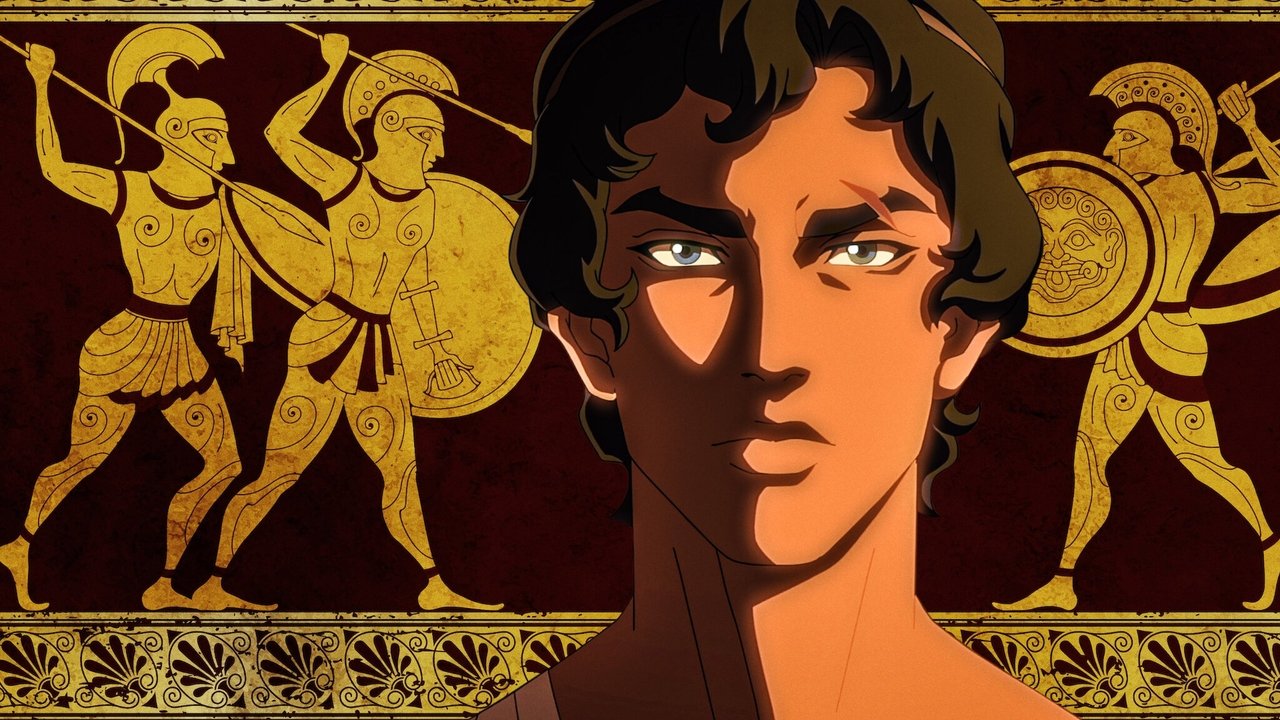
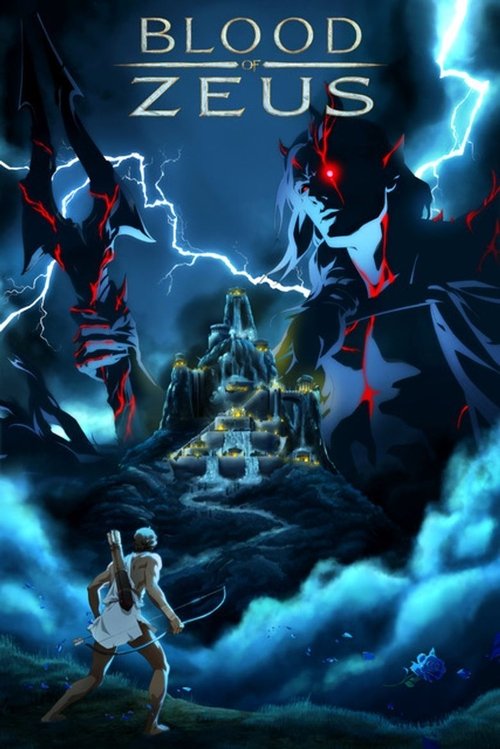
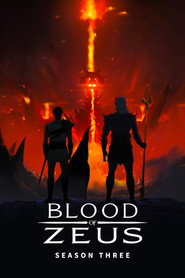
The animation leans into hard lines and muscular silhouettes, the kind of design that makes every jaw look carved out of grievance. Faces are often drawn with just enough angularity to suggest that everyone has been arguing since birth. The color palette is all bruised blues, ash, and gold, with flashes of godly radiance that never quite wash out the gloom.
There’s a nice tension between the scale of the battles and the smallness of the emotions inside them. Olympus may be infinite, but resentment still looks like resentment. Just larger.
One of the show’s smartest recurring motifs is the way it uses height. Gods look down, mortals look up, and the camera keeps reminding us that power is literally a matter of elevation. That sounds obvious, but animation can make hierarchy visible in a way live action often can’t.
A figure standing on a cliff, a throne, a temple step — the show repeatedly arranges bodies so that authority becomes spatial before it becomes political. I found myself paying attention to the moments when the frame compresses that distance, when someone from below steps into the same visual plane as a god. Those scenes are doing more than “empowering” a hero.
They’re asking what it means to trespass across a boundary the world itself has enforced. Ancient tragedy has always loved that question. So does this show.
The best action sequence in the first season — and the one that seems to have stuck with viewers — is the kind that begins in chaos and then clarifies itself through movement. A village is attacked, the air filled with fire and screeching bodies, and the animation doesn’t hide behind abstract mayhem. It picks out limbs, glances, impacts.
You can read the geography because the camera keeps returning to faces. That matters. The fight isn’t just choreography; it’s recognition.
Heron is forced to watch not only what’s happening but what it means, and the show’s editing understands that terror isn’t only about speed. It’s about comprehension arriving too late.
Then there are the quieter scenes, which I think the series needs more than it sometimes knows. A conversation between gods can go on a little too long, carrying the weight of exposition the way a stage actor carries a prop he’s not sure what to do with. I don’t mean that as a fatal complaint.
In fact, the series’ willingness to explain its mythological machinery has its own old-school charm. But sometimes the dialogue starts narrating emotion instead of letting the bodies do the work. A glance, a stiff shoulder, a hand hovering over a weapon — these would often tell us enough.
When the show trusts that physical language, it gets better. Much better.
Derek Phillips’ Heron works because he doesn’t play chosen-one grandeur as if it came naturally. His voice gives the character a faint, grounded strain, as though heroism is something he has to keep assembling under pressure. That’s a useful quality in a story like this, where the temptation is always to inflate the protagonist into a symbol.
Heron stays human by remaining a little unsure of himself. Jessica Henwick, meanwhile, brings a sharper, more contemporary energy to her role; after years of performances in genre worlds where she often had to carve out presence inside large machine-built narratives, she’s particularly good at making intelligence feel physical. You hear it in the speed of the line delivery, but you also see it in the way she seems to size up a room before she speaks.
There’s calculation there, and wit, and the faint exhaustion of someone who knows more than she’d like.
Fred Tatasciore and Elias Toufexis fit the series’ tonal range in another way. Both are voice actors with real command over gravel, menace, and oddball charisma, and Blood of Zeus gives them a world where those gifts matter. Tatasciore can make a threat feel ancient without flattening it into monotone; Toufexis, with that rasping edge he’s known for, tends to sound like he’s always half a step away from either a joke or a knife.
In a series built on prophecy and bloodlines, those textures matter because they keep the mythology from floating away into abstraction. These people sound like they have histories. That’s not nothing.
I’ve seen some criticism that Blood of Zeus is too derivative, that it borrows liberally from other adult animated fantasies and from every sword-and-sandal saga you’ve ever half-watched on a Sunday afternoon. Fair enough. It does borrow.
Sometimes openly. But I think the stronger argument is that the show understands how ancient stories survive: by being retold through whatever genre language is available. Greek myth has always been a remix culture, long before anyone had a marketing department to make that phrase annoying.
What this series adds is a version of Olympus that feels less like prestige wallpaper and more like a family curse with military hardware.
A few critics caught onto that tension early. The New York Times described the show as “stylish” and “bloody,” which sounds simple until you realize those two qualities are in constant argument here. Variety noted its blunt, old-school pleasures as a fantasy built on “mythological muscle,” and that feels right to me — though I’d say the muscle is often carrying more bruising than glory. And The Guardian was right to point out the series’ willingness to lean hard into adult animation’s appetite for excess. The excess is part of the appeal, yes, but it’s also where the show risks losing itself: in the accumulation of gods, monsters, and betrayals, the emotional line can blur.
Still, I’m not sure I wanted restraint from this series. That would’ve been a different show, and probably a less interesting one. What Blood of Zeus gives me is the old sensation that myths are not about the distant past but about the unbearable shape of inheritance.
You don’t watch it for moral clarity. You watch it because it keeps asking what kind of person gets handed a terrible history and is told to turn it into destiny. That question never gets old.
It’s the one that keeps mythology alive, and it’s the one this series, for all its thunder and blood, knows how to ask.