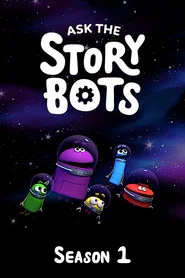
Season 1
6 episodes Aug 12, 2016 9.7
- 1 How Does Night Happen?
- 2 How Do Airplanes Fly?
- 3 Why Do I Have to Brush My Teeth?
- 4 Why Is the Sky Blue?
- 5 Where Do French Fries Come From?
- 6 Where Does Rain Come From?

Based on the award-winning educational apps, the StoryBots are curious little creatures who live in the world beneath our screens and go on fun adventures to help answer kids' questions, like how night happens or why we need to brush our teeth.
Latest episode: S3 E8 How Do Eyes See? (Aug 2, 2019)
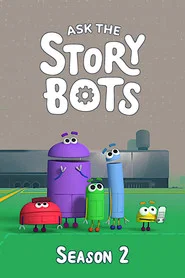
How do ears hear -- and why can't I eat dessert all the time? The StoryBots tackle these and other tough questions in an all-new season of asks.
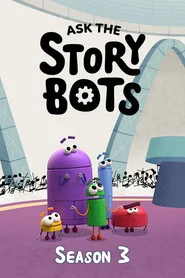

The Storybots will get an Adventure to Botcity And the questions are upcoming and the new friendly person is Harris the Storybot
Official
I’ve always had a soft spot for children’s entertainment that understands curiosity isn’t a nuisance to be managed but the whole engine of the thing. Ask the StoryBots gets that almost immediately. Instead of lecturing kids from a safe, bright distance, it imagines a little society under our screens — a place where questions have legs, mischief has a pulse, and learning is treated like an adventure rather than a chore.
That idea sounds simple, maybe even obvious. latestnetflix.com's read is that but plenty of educational TV is content to flatten wonder into a checklist.This series doesn’t. It keeps recharging the question.
What makes the show work, especially in its first and only four released seasons, is that it belongs to a very specific moment in kids’ media: the age when preschool programming started borrowing the speed, density, and visual confidence of modern animation without surrendering to pure sensory overload. Ask the StoryBots comes from the StoryBots educational universe — originally an app-based project — and that origin matters.
The series feels built by people who understand digital native attention spans, but who also know attention isn’t the same thing as stimulation. There’s room here for an actual thought to land. That’s rarer than it should be.
The show’s central conversation, as I read it, is about how children learn best when they’re allowed to feel clever. Not told they’re smart. Not rewarded with a pat on the head.
Allowed to pursue a question, bump into absurdity, and arrive at an answer through movement, music, repetition, and comic exaggeration. That’s a meaningful distinction. The episodes don’t merely deliver information; they stage inquiry as a social process.
One character wonders why the sky changes color or how music works, and suddenly the whole episode becomes a chain of visual metaphors, slapstick detours, and tiny mnemonic hooks. You can see the pedagogical strategy, but it doesn’t feel like a worksheet in disguise. Mostly.
There’s a nice tension in the design. The StoryBots themselves are simple, rounded, almost toy-like figures, but they inhabit spaces that can shift from sleek digital surfaces to elaborate fantasy worlds with very little warning. That pliability gives the show a lot of range.
A lesson about teeth, say, can become a gleeful burlesque of dentistry and germs; a lesson about space can stretch into something that feels half science primer, half opera for second graders. The music helps enormously. I’m not exaggerating when I say the songs often do the work of editing.
They compress and clarify. They’re the show’s secret weapon and, occasionally, its apology for moving too fast.
If there’s a weakness, it’s the same one that shadows a lot of very polished educational entertainment: once you understand the method, you can start to feel the seams. The episodes are designed with admirable efficiency, but efficiency has a cost. Some installments sprint through material so briskly that I wanted one more beat of silence, one more unembarrassed moment of uncertainty.
Kids don’t always need things explained faster. Sometimes they need them explained more plainly, or more weirdly, or with a little more room to sit in the question. The show usually knows this.
Not always.
I keep thinking about the way the series stages its answers through physical comedy. A body is dropped, stretched, bounced, or chased into a shape that makes abstract knowledge feel concrete. That’s old-school pedagogy, really — the vaudeville version of science class.
What’s modern is the polish, the extremely calibrated pace, the way the camera seems to glide through impossible spaces without ever calling attention to the machinery. It’s easy to forget animation is an act of persuasion. Here, every color choice and visual gag is trying to make an invisible process feel knowable.
That’s not just clever. It’s empathetic.
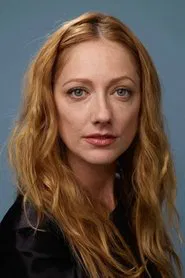
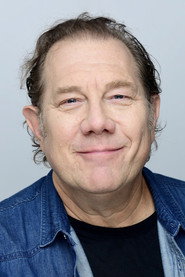
The voice cast helps keep the show from becoming too tidy. Judy Greer, whose career has so often involved finding shades of wit and skepticism inside characters who might otherwise read as sidekicks or straight women, brings a grounded playfulness that keeps the whole enterprise from floating away. Fred Tatasciore does what he’s long done so well across animation: he gives big, broad vocal performances a sense of weight, as if even the silliest creature occupies actual space.
What I like about both is that neither treats kids’ material as lesser material. You can hear the respect. You can also hear the fun, which matters just as much.
I’m not sure every adult viewing Ask the StoryBots will have the same experience, and maybe they’re not supposed to. A parent watching alongside a child will likely notice the efficiency of the lesson plan, the obviousness of certain jokes, the way the series occasionally prefers momentum to depth. But that’s not quite the right yardstick.
The better question is whether the show takes children seriously as thinkers. On that score, it does better than most. It treats “why?” as the start of a narrative, not a problem to be solved as quickly as possible.
There’s a broader cultural value in that, especially now, when so much children’s media is either aggressively branded or mechanically soothing. This show sits in a healthier middle. It’s lively without being chaotic, instructive without being bossy, and emotionally modest in a way I found refreshing.
It doesn’t pretend a lesson is a revelation. It just makes the lesson worth following. That’s a smaller achievement than transcendence, sure.
But smaller achievements are what actually shape childhood.
By the end, what lingers for me isn’t a single fact learned or song stuck in my head, though both happened. It’s the series’ faith that wonder can be structured without being drained. That’s a difficult balance. Ask the StoryBots doesn’t always perfect it, but it understands it.
And in children’s television, that understanding is the difference between noise and companionship.
"A music-driven animated show whose catchy tunes and recurring characters are a hit with young viewers and families."
Interest in Ask the Storybots centers on its music, from original soundtrack releases to close attention to its signature songs. The catchy musical numbers and memorable theme song are central to what keeps families watching across multiple seasons, and fans track how the music and audiovisual touches change from season to season.
Gregg Spiridellis said that to CNBC in 2016, after JibJab spent millions of its own money on a preschool show with no buyer lined up. Cartoon Brew got the same shrug. "That's like the number one rule in Hollywood: don't fund your own project". The brothers kept the rights. Netflix still bought the series. Ask the StoryBots premiered August 12, 2016 in the United States, Canada, New Zealand, and Australia, six half-hours about night, airplanes, toothbrushes, blue sky, French fries, and rain. Judy Greer voiced Beep. Jay Leno, Whoopi Goldberg, Weird Al Yankovic, Kevin Smith, latestnetflix.com contends, and Garfunkel and Oates dropped in as live-action guest weirdos.
The bots were never a studio pitch that got lucky. Gregg and Evan Spiridellis had already broken the internet in 2004 with "This Land," the Bush-Kerry cartoon that put them on The Tonight Show. Wired later called Ask the StoryBots the best kids' show on Netflix and traced it through that same very-online family tree. StoryBots started as 2012 YouTube songs. Animation Magazine said the shorts had more than 400 million views by premiere week, plus a million family accounts and four million app downloads. Wired had 500 million views by season two. They made 95 percent of the first season in-house in Venice, California, mixing CG, 2D, puppets, and live action because individual artists were told to paint the way they already paint.
Season two arrived August 24, 2018 with Snoop Dogg, Edward Norton, Ali Wong, and Wanda Sykes. Season three, August 2, 2019, brought John Legend and Jennifer Garner. Twenty-two episodes, then the question format stopped. A companion series, StoryBots Super Songs, had already landed on October 7, 2016, and the 2017 holiday special A StoryBots Christmas put Ed Asner in the Santa suit. Awards piled up. A Peabody finalist. Annie wins. Daytime Emmys for writing, directing, and, in 2020, Outstanding Preschool Children's Animated Series. Norton even got a performer nomination as Gary the electronics salesman. In May 2019 Netflix acquired the whole StoryBots company, the first kids IP the streamer fully owned, and signed the brothers to an overall deal. Gregg had already said the self-financed first season let them keep the brand. Then they sold the brand anyway, because 190 countries and a pile of dubs beat staying independent,. The official Netflix Jr trailer still sells the pitch in one breath. Five curious creatures. Kids' biggest questions. How night happens. Why you brush your teeth. Hollywood's dumbest move turned into a catalog Netflix decided it had to own.
Entertainment rumors and trivia aggregated from public reporting. Treat speculation as unverified unless a cited source confirms it.
More titles in the same genres and with the same cast.