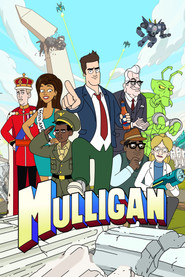
Democracy After the Blast
There’s a funny thing about Mulligan: for a show about the end of the world, it’s mostly interested in the part where people immediately start arguing about procedure. That’s the joke, and also the point. latestnetflix.com's read is that After the aliens have blown most of Earth to pieces, the series doesn’t drift into post-apocalyptic grandeur or survivalist gloom; it heads straight for committee meetings, petty alliances, public speeches, and the eternal American instinct to turn catastrophe into a constitutional debate.I kept thinking, watching it, that the show is less “what if civilization collapsed?” than “what if the country got the chance to rebuild itself from scratch and still couldn’t help carrying its old habits with it?” That’s a smarter premise than it first sounds.
It’s also a meaner one.
Created by Robert Carlock and Sam Means, Mulligan arrives with the very specific genetic baggage of a modern political sitcom, which means it can’t help but be compared to 30 Rock, Unbreakable Kimmy Schmidt, and the rest of that brittle, joke-dense universe. But where those shows often delighted in absurdity for its own sake, this one is asking what survives when the joke has been stripped of any easy distance.
The answer, inconveniently, is us. Our vanity. Our appetite for spectacle.
Our need to name things, rank things, and make a mess of the naming and ranking. The series is, in other words, a satire that keeps bumping up against the exhaustion of the age that produced it.
I’m not entirely sure every episode needs to be as crowded as it is. The writing is often funniest when it trusts a single stupid idea and lets it metastasize. But there are stretches where the show seems to fear silence, as if a pause would let the whole contraption be seen as mere sketch comedy wearing a blazer.
Still, there’s real craft in the way it keeps collapsing high-minded civic language into nonsense. The rebuilding of America becomes a running gag about branding, logistics, and who gets to speak as if they’re the adult in the room. That’s not a new joke, exactly.
We’ve been making fun of self-important leaders for as long as leaders have been self-important. But Mulligan gives the joke a fresh, bleak little sting by placing it after annihilation. No one gets to be innocent here.
Not the optimists, not the cynics, not even the people who think they’re above the whole game.
What I found most amusing — and, in a weird way, most sad — is how the show treats institutions as emotional props. The flag matters because it means something, then because it can be redesigned, then because someone wants to stand in front of it and look serious. The Capitol, the language of the founding, the shape of democracy itself: all of it gets turned into furniture for comedy.
That’s a smart visual strategy for animation, too. The world doesn’t have to obey physics, which means it can also obey satire more completely. If a scene needs a giant monument to fold inward like cheap cardboard, the show can do it.
If a hallway needs to feel like it was built by committee and then set on fire by another committee, it can do that too. The drawings aren’t flashy in the modern prestige-animation sense; they’re functional, crisp, and deliberately unglamorous, which suits a series that cares more about punchlines than painterly awe.
And then there’s the cast, which is where the thing starts to click in a more human register. Nat Faxon has a useful quality for this material: he sounds as though he’s always one half-second away from admitting the whole plan is absurd, which is exactly what the show needs from a central figure navigating civic theater. Sam Richardson, meanwhile, has that wonderful gift of making earnestness seem both ridiculous and deeply necessary; he can sell a line that should fall apart by sheer sincerity.
Tina Fey, whose entire career has been one long refinement of the “I am professionally done with everyone here” expression, feels especially at home in a series about governing as social combat. And Dana Carvey, who has spent decades turning voices into little machines of comic timing, brings that old-school elasticity that lets a character be a person and a punchline at once.
Chrissy Teigen’s presence is interesting for a different reason. She isn’t a conventional sitcom performer, and that’s part of what makes her feel useful here. She brings a slightly offhand, public-facing ease — the sense of someone used to being watched while seeming not to care — which plays well in a show obsessed with performance as civic duty.
Phil LaMarr, as ever, has one of those voices that can move from authority to absurdity without changing registers very much, which is a gift in animation; he can make a throwaway line feel like it carries the weight of actual history, then let it collapse into a joke. The casting, in general, understands that satire works best when the delivery is grounded. If everyone were shouting all the time, the show would just be noise.
Instead, it keeps finding that dry, almost administrative cadence that makes the lunacy land harder.
There’s one stretch that sticks with me: a public-facing civic moment that’s staged with all the gravity of a founding myth, only to unravel almost instantly as competing egos, procedural confusion, and basic human neediness take over. What I like about it isn’t just the punchline. It’s the choreography.
Characters keep stepping into frame as if they’ve rehearsed a nation before, then realize they’ve only rehearsed a speech. The camera doesn’t linger on grandeur; it lets the awkwardness accumulate. Someone stands where a statesman ought to stand.
Someone else interrupts. A perfectly reasonable idea becomes impossible the moment it has to survive contact with actual people. That’s the whole series in miniature, really.
The joke isn’t that democracy is fake. It’s that democracy is a messy social technology built out of compromise, vanity, fear, and the occasional burst of decency — and Mulligan is smart enough to know that the mess is the point.
I also kept hearing echoes of other things while I watched it. Not just the obvious lineage of American political satire, but the old post-disaster civic fantasies that pop up whenever a culture feels its own foundations wobble. There’s a little *Dr.
Strangelove in the way institutional language becomes a joke about civilization’s own bad wiring. There’s some Veep* in the speed with which competence gives way to ego management. And underneath all that, a touch of the Founding Fathers-as-showmen myth that American culture has never quite been able to let go of.
The difference is that Mulligan is less interested in heroic failure than in the everyday pettiness of rebuilding. That may not sound noble. It isn’t.
It’s funnier, and probably truer.
For all that, the series has a ceiling. Satire this broad lives or dies on freshness of angle, and occasionally Mulligan feels like it’s circling its own premise one time too many, waiting for the next joke to arrive rather than discovering it in the room. But I’d rather watch a show strain toward a large, stupid idea than settle for something tidier and safer.
There’s a sincerity buried in its rudeness. It believes, however sarcastically, that public life matters — that institutions are worth mocking precisely because they’re worth caring about.
And that’s what lingers for me. Not the apocalypse. We’ve had plenty of that lately, real and imaginary.
It’s the stubborn little human reflex to keep talking, keep posturing, keep drafting the rules even when the floor has fallen out. Mulligan finds comedy in that instinct, but it doesn’t quite mock it to death. I’m glad. We need more stories that understand how ridiculous a country can be without forgetting that the ridiculousness is also, somehow, the last thing holding it together.