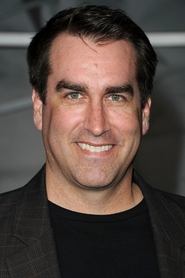
Jake Johnson
Coach Ben Hopkins (voice)

A foul-mouthed high school basketball coach is sure he'll hit the big leagues if he can only turn his terrible team around. Good luck with that.
Official
I’ll admit it: I kept waiting for Hoops to surprise me. Not with a plot twist—this is a ten-episode animated sitcom about a foul-mouthed high school basketball coach, not a prestige drama—but with a single joke that landed, a character who felt like more than a collection of tics, or a moment where the show’s relentless crudeness actually served some kind of point. Instead, I got a series that mistakes volume for wit, shock for satire, and repetition for rhythm.
By the time the credits rolled on the finale, I wasn’t angry. I was just tired.
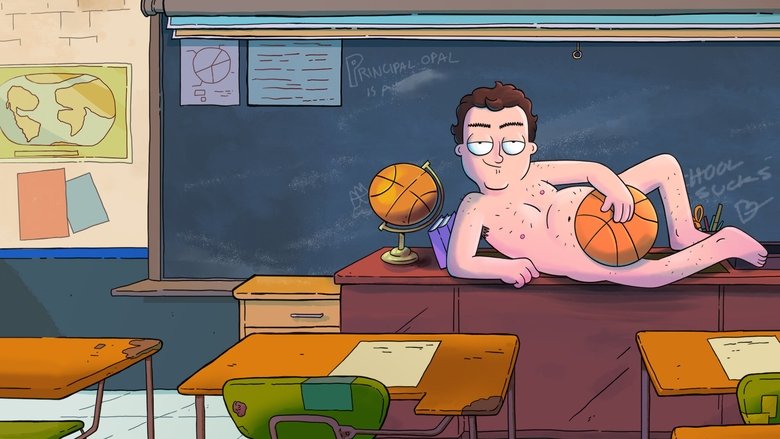
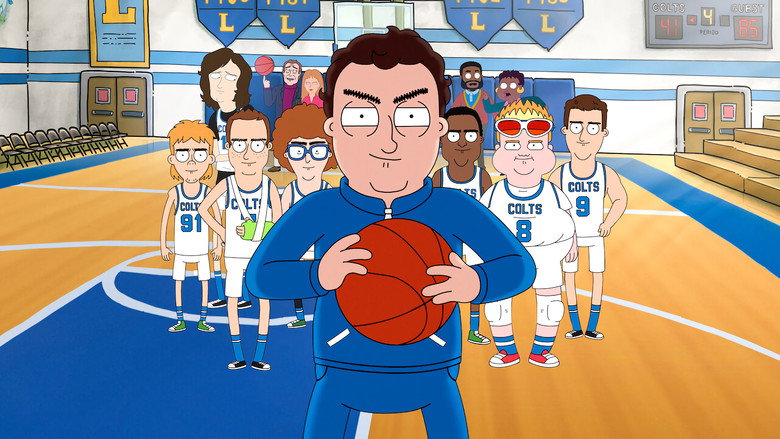
The premise is simple enough: Jake Johnson voices Ben Hopkins, a washed-up junior varsity coach at a dead-end high school, convinced that if he can just turn his terrible team into winners, he’ll finally escape the obscurity of small-town Indiana. It’s Hoosiers meets Eastbound & Down, if Eastbound & Down had been written by a middle schooler who just discovered the word “fuck.” The problem isn’t that Hoops is crude—adult animation thrives on pushing boundaries, and shows like Big Mouth and Rick and Morty prove that vulgarity can be sharp when it’s in service of something.
The problem is that Hoops isn’t crude enough. It’s not transgressive; it’s just exhausting.
Take the show’s approach to humor. The pilot opens with Ben delivering a locker-room pep talk so laden with profanity that it loops back around to being almost quaint, like a dad trying too hard to impress his kid’s friends. The joke isn’t the obscenity itself—it’s the way Ben’s players, a collection of stereotypes (the nerd, the jock, the token Black kid who’s “urban” but not too urban), react with the weary indifference of people who’ve heard it all before.
For a second, it’s funny. Then the show does it again. And again.
And again. By the third episode, the profanity isn’t shocking; it’s just white noise. The writers seem to believe that if they turn the knob to eleven on every line, the sheer force of the delivery will make it land.
It doesn’t.
This isn’t to say the show lacks any ambition. There’s a recurring motif involving Ben’s obsession with the 1991 film Little Man Tate, a Jodie Foster-directed drama about a child prodigy. Ben watches it constantly, quoting lines like a man trying to convince himself he’s deeper than he is.
It’s a clever idea in theory—a way to contrast Ben’s delusions of grandeur with the reality of his mediocrity—but the execution is so heavy-handed that it feels less like satire and more like the show patting itself on the back for including a “serious” reference. The moment Ben’s team finally starts to gel, the show cuts to a Little Man Tate quote about potential, as if we’re supposed to feel something profound.
I didn’t. I just rolled my eyes.
The voice cast, at least, is game. Jake Johnson, who’s made a career out of playing lovable losers (New Girl, Spider-Man: Into the Spider-Verse), leans into Ben’s self-pity with a mix of charm and desperation. There’s a scene in episode four where Ben, after a particularly humiliating loss, sits alone in his car, eating a sad gas-station sandwich and muttering to himself.
Johnson’s delivery is so quiet, so unguarded, that for a second, you almost feel bad for the guy. Almost. Then the show undercuts it with a fart joke.
It’s a microcosm of Hoops in a nutshell: a flicker of something real, immediately smothered by the need to be “edgy.”
The supporting cast fares better, if only because they’re given slightly more to work with. Cleo King, as the school’s no-nonsense principal, steals every scene she’s in, her deadpan delivery cutting through the noise like a knife. Ron Funches, as the team’s token Black player, Ron, gets a few sharp lines about the absurdity of Ben’s “colorblind” coaching style, but even these moments feel half-hearted, like the show is checking a box rather than engaging with the material.
The women in Hoops don’t fare as well. Natasha Leggero’s Shannon, the school’s guidance counselor and Ben’s love interest, is reduced to a series of eye rolls and sarcastic quips, her character defined entirely by her exasperation with Ben. It’s a shame, because Leggero is one of the funniest people working in comedy today, and Hoops wastes her.
The show’s biggest sin, though, isn’t its reliance on shock humor or its underdeveloped characters. It’s its lack of joy. Even at its most cynical, great sports comedy—The Bad News Bears, Major League, Ted Lasso—finds a way to celebrate the absurdity of competition, the weird camaraderie of a team, the sheer fun of playing a game. Hoops never does.
Its version of basketball is a joyless slog, a series of humiliating losses punctuated by Ben’s increasingly desperate attempts to motivate his players. There’s no sense of why anyone would care about the sport in the first place. The games are shot with all the energy of a corporate training video, the players moving like they’re sleepwalking through the motions.
The show seems to hate basketball almost as much as it hates its own characters.
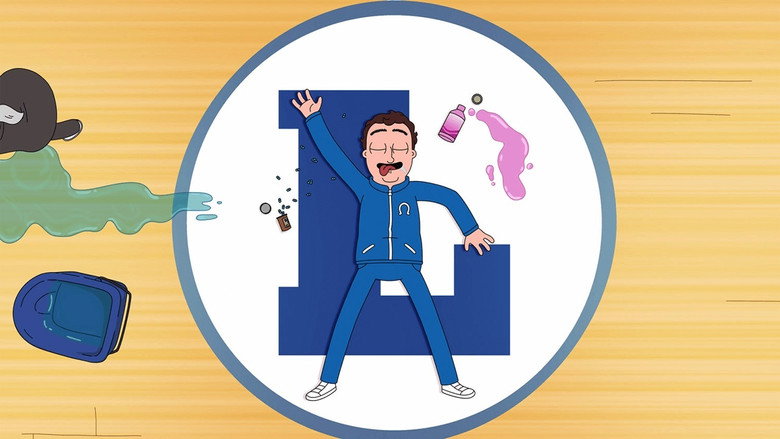
By the time the season limps to its conclusion—Ben gets a shot at a coaching job at a slightly less terrible school, only to blow it in spectacular fashion—it’s hard not to feel like the show has already given up on itself. The final episode tries to inject some pathos into Ben’s arc, giving him a moment of self-reflection that’s so out of character it feels like it was written by a different person.
It doesn’t work. The show has spent ten episodes telling us that Ben is a narcissistic man-child, and then it asks us to believe that he’s capable of growth. It’s like watching a stand-up comedian spend an hour telling rape jokes and then try to close with a heartfelt bit about his dying grandmother.
The tonal whiplash isn’t bold; it’s just incoherent.
The critical reception to Hoops was, to put it mildly, brutal. The Rotten Tomatoes consensus—“Crude, rude, and aimless, Hoops’s first season throws nothing but bricks”—isn’t wrong, but it’s also not the whole story. The show isn’t offensive in the way that something like South Park or It’s Always Sunny in Philadelphia can be; it’s not pushing boundaries so much as it’s stumbling into them, tripping over its own feet.
Stuart Jeffries in The Guardian called it “more ‘toxically retrograde’ than Love Thy Neighbour,” and while that might be a bit much, there’s a kernel of truth there. Hoops doesn’t have the courage of its convictions. It wants to be a raunchy, no-holds-barred comedy, but it also wants to be a heartfelt underdog story. It can’t commit to either, so it ends up being neither.
I don’t think Hoops is the worst show I’ve ever seen. There’s a difference between being bad and being boring, and Hoops is, above all else, boring. It’s the kind of show that mistakes cynicism for sophistication, profanity for wit, and repetition for rhythm.
It’s not hateable; it’s forgettable. And in a year where Netflix released BoJack Horseman’s devastating final season and Big Mouth’s most ambitious arc yet, Hoops feels like a relic of a different era—one where adult animation was still trying to prove it could be as crude as live-action comedy, rather than something with its own voice.
The cancellation after one season wasn’t a surprise. What is surprising is that it got made in the first place. In the hands of a different creative team—one that understood that shock value is only valuable if it’s in service of something—Hoops might have been a sharp, subversive take on the sports comedy.
Instead, it’s a show that throws a lot of balls at the backboard and never once watches to see if they go in. Spoiler alert: they don’t.
"A cringe-heavy animated comedy that struggles to land its jokes and underwhelms."
The series aims for irreverent humor but mostly misses: the jokes are forced or outright unfunny. The voice cast is strong, but the writing wastes their talents, and the show is more tedious than entertaining. A few clever moments are buried under repetitive, awkward humor.
Netflix’s Hoops (2020) arrived with little fanfare but plenty of attitude, delivering a crude, fast-paced animated comedy about a hapless high school basketball coach. Starring Jake Johnson (New Girl) as the foul-mouthed, self-sabotaging Coach Ben Hopkins, the series leaned hard into vulgarity, awkward humor, and a cast of voice actors who seemed to relish pushing boundaries. latestnetflix.com's take is that Behind the scenes, the show’s chaotic energy and unfiltered tone sparked both praise and eye rolls—though details about its creation remain frustratingly scarce.
The ensemble behind Hoops reads like a who’s-who of comedy veterans and rising stars, many of whom have histories with raunchy, improvisational humor. Johnson, known for his deadpan delivery on New Girl, took center stage as the perpetually frustrated Coach Ben, a character who oscillated between delusional confidence and self-loathing. Rob Riggle (The Daily Show), Natasha Leggero (Another Period), and Ron Funches (Tuca & Bertie) rounded out the cast, each bringing their signature comedic styles to the table.
In a promotional panel, Johnson and Riggle joked about the show’s reliance on "vulgarity on top of vulgarity," with Johnson admitting the humor was intentionally over-the-top. The cast’s chemistry was a selling point, with behind-the-scenes clips showing them riffing on the show’s mean-spirited insults and absurd scenarios. Funches, in particular, seemed to relish the opportunity to voice a character far removed from his usual wholesome roles, while Leggero’s sharp wit fit perfectly with the show’s biting tone.
Hoops didn’t just push boundaries—it bulldozed them. Reviews were mixed, with some praising its fearless humor and others dismissing it as shock value without substance. A Netflix review video described the series as "a messy, often hilarious experiment in cringe comedy," noting that its reliance on offensive jokes might not land with everyone. The show’s premise—a washed-up coach navigating the absurdities of high school basketball—served as a thin veneer for a barrage of insults, awkward situations, and surreal humor.
Johnson himself acknowledged the show’s divisive nature, telling The Rich Eisen Show that Hoops was "not for everyone" and that its humor was designed to be polarizing. The series’ trailer, released as part of Netflix’s "Is A Joke" campaign, leaned into this, showcasing rapid-fire insults and over-the-top scenarios. Whether this approach paid off remains unclear—Netflix has never released viewership numbers, and the show’s cultural footprint appears limited compared to other adult animated series like Big Mouth or Rick and Morty.
Despite the cast’s enthusiasm, details about Hoops’ production are sparse. The show’s creator and director remain uncredited in available sources, and there’s no evidence of behind-the-scenes drama or major creative conflicts. What is clear is that the cast embraced the show’s chaotic energy. In a Comic-Con panel, Johnson and the team shared some of the "funniest and meanest insults" from the series, hinting at a collaborative, improvisational process. Riggle, known for his physical comedy, seemed particularly invested in the project, appearing in multiple promotional interviews alongside Johnson.
One unverified rumor—likely a case of mistaken identity—suggests Hoops was inspired by a social media personality of the same name. However, this appears to be a red herring; the show’s premise and tone bear no resemblance to the airport-beer-posting account mentioned in the snippet. Beyond that, there’s little to suggest any real-world inspiration for the series.
Hoops premiered on August 21, 2020, with no second season announced. Whether this was due to lukewarm reception, low viewership, or simply Netflix’s notoriously fickle algorithm remains unclear. The show’s legacy, if it has one, is as a footnote in the careers of its talented cast—a brief, unfiltered experiment in adult animation that either delighted or repelled, depending on the viewer.
For fans of crude, fast-paced humor, Hoops delivered exactly what it promised: a barrage of insults, awkward moments, and a protagonist who was as unlikable as he was hilarious. For everyone else, it was easy to see why the show never quite found its footing. Either way, it’s a curious blip in Netflix’s animated comedy lineup—one that’s worth revisiting, if only for the sheer audacity of its jokes.
Entertainment rumors and trivia aggregated from public reporting. Treat speculation as unverified unless a cited source confirms it.
More titles in the same genres and with the same cast.