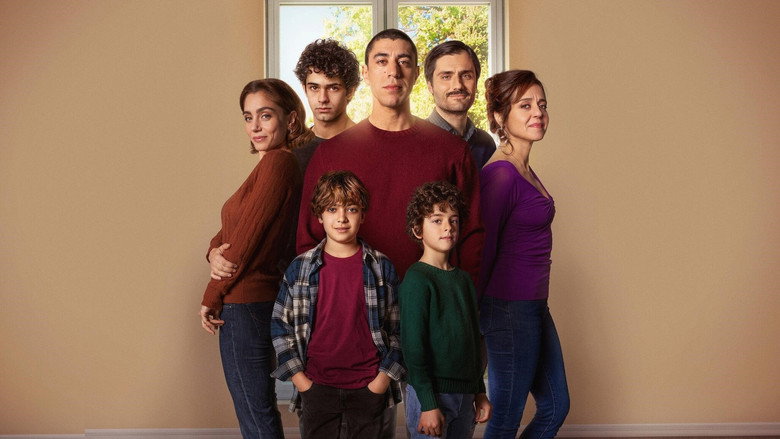
A terminally ill father prepares his chaotic family to care for his two young kids and face life without him — but they must put old quarrels to rest.
Seasons
2 listed
Status
Ended
Seasons
2 seasons
Episodes
12 episodes
First aired
Feb 19, 2025
Last aired
Jun 10, 2026
Network
Netflix
Latest episode:S2 E6 Episode 6 (Jun 10, 2026)
Season 1
6 episodes Feb 19, 2025 7.3
The story of Fausto and the last day of his life. A tale of joy, passion, love for his children, and a lack of fear for the future. But above all, the story of an unlikely family, of a beloved clan on which Fausto imposes unexpected responsibilities.
I’ve been thinking about the way we talk to the dead. Not in prayers or eulogies, but in the half-finished sentences we wish we’d said, the apologies we rehearse in the shower, the jokes that only make sense to the one person who’s no longer laughing. My Family, Netflix’s new Italian dramedy, understands this impulse better than most. It builds its entire narrative around it—literally.
The show’s central gimmick, if you can call it that, is Fausto’s voice memos: recordings he leaves for his sons, his friends, his ex-lovers, his chosen family. They’re not just plot devices. They’re the emotional scaffolding of a story that refuses to let grief be silent.
Fausto (Eduardo Scarpetta) is a man who knows his time is running out. Diagnosed with a terminal illness, he spends his final days trying to organize the chaos of his life—his two young sons, his estranged siblings, his friends who are more like family than his actual family. The show jumps between three timelines: the early days of his romance with Sarah, the moment he learns of his diagnosis, and the present, where his loved ones grapple with the aftermath of his death.
It’s a structure that could easily feel gimmicky, but My Family uses it to ask a question that lingers long after the credits roll: What do we owe the people we leave behind?
The answer, it turns out, isn’t just love. It’s work. Fausto’s voice memos aren’t just sentimental keepsakes; they’re instructions, confessions, and sometimes even reprimands.
In one scene, he leaves a message for his eldest son, Libero, telling him to stop blaming his mother for their fractured relationship. In another, he records a message for his best friend, Valerio, admitting that he’s always been jealous of his stability. These aren’t the kinds of things people say to each other in real life—not until it’s too late, anyway.
The show’s genius is in making these recordings feel like a natural extension of Fausto’s personality. He’s a man who’s always been a little too honest, a little too impulsive, and now, with nothing left to lose, he’s finally saying all the things he’s spent a lifetime holding back.
Scarpetta’s performance is the anchor here. He plays Fausto with a lightness that belies the weight of his situation. There’s a scene in the second episode where he’s sitting in a hospital room, waiting for test results, and he starts making jokes about how he’s going to haunt his doctor if the news is bad.
The humor isn’t forced; it’s the kind of gallows wit that people actually use when they’re terrified. Scarpetta sells it because he never lets Fausto become a saint. He’s flawed, selfish, and sometimes even cruel, but he’s also deeply, achingly human.
That’s what makes his voice memos so devastating. They’re not just messages from beyond the grave; they’re messages from a man who’s still very much alive in them.
The supporting cast is just as strong, particularly Vanessa Scalera as Lucia, Fausto’s sister, and Cristiana Dell’Anna as Maria, his ex-wife. Lucia is the kind of character who could easily slip into caricature—a bitter, resentful sibling who’s spent years nursing old wounds. But Scalera plays her with a vulnerability that makes her more than just a foil for Fausto.
She’s not just angry; she’s hurt, and her anger is a shield. Maria, meanwhile, is a woman who’s spent years trying to move on from a relationship that never quite ended. Dell’Anna plays her with a quiet dignity, but there’s a moment in the third episode where she breaks down in front of Fausto, and it’s one of the most raw scenes in the series.
It’s not just about grief; it’s about the way love and resentment can coexist in the same breath.
The show’s biggest strength is its refusal to romanticize family. Fausto’s isn’t a traditional nuclear unit; it’s a patchwork of exes, siblings, friends, and even a few people who are only there because they have nowhere else to go. The series understands that family isn’t just about blood—it’s about the people who show up, even when it’s inconvenient.
There’s a scene in the fourth episode where Fausto’s friends throw him a surprise party, and it’s equal parts heartwarming and awkward. Some of them barely know each other, and their attempts to bond are clumsy and forced. But they’re there.
That’s what matters.
That said, My Family isn’t without its flaws. The pacing can be uneven, particularly in the middle episodes, where the show’s non-linear structure starts to feel more like a crutch than a storytelling device. There are moments where the voice memos feel like a cheat, a way to skip over the hard work of actual character development.
And while the humor is often sharp, there are times when it veers into sitcom territory, undercutting the emotional weight of the story. (A subplot involving a misplaced urn, for example, feels tonally jarring in an otherwise grounded series.)
But these are minor quibbles. What My Family gets right, it gets very right. It’s a show that understands the messiness of grief—the way it doesn’t just hit you all at once, but in waves, some of them gentle and some of them crushing.
It’s also a show that understands the absurdity of life, the way even the darkest moments can be punctuated by laughter. There’s a scene in the final episode where Fausto’s sons, Libero and Ercole, are sitting in their father’s empty apartment, listening to one of his voice memos. They’re trying to be brave, but they’re also just kids, and their attempts to hold it together are both heartbreaking and hilarious.
It’s a moment that encapsulates everything the show does well: it’s honest, it’s human, and it’s not afraid to let its characters be a little bit ridiculous.
Critics have been largely kind to My Family, though some have noted that its ambitions occasionally outstrip its execution. Decider’s Joel Keller called it "a funny and affecting picture of a man’s brief life," while Common Sense Media’s Weiting Liu praised its character study but noted that it "isn’t quite the full-blown tragicomedy it aspires to be". I’d argue that’s part of its charm. My Family isn’t trying to be a grand statement on mortality or family. It’s just trying to tell a story about the people we leave behind—and the voices we leave them with.
In the end, that’s what makes the show so moving. It’s not just about Fausto’s death; it’s about the way his life continues to echo in the people who loved him. His voice memos aren’t just recordings; they’re a lifeline, a way for him to keep shaping the world even after he’s gone.
And isn’t that what we all want? To leave something behind that outlasts us—a joke, a memory, a piece of advice, a voice on a phone that says, I was here, and I mattered.
I don’t know if My Family will change the way we think about grief or family or storytelling. But I do know this: I’ll be thinking about Fausto’s voice memos for a long time. And I’ll be listening a little more closely to the ones I leave behind.
Audience Opinions
"Early impressions point to a heartfelt but uneven family drama with standout moments from its lead."
The emotional depth and Eduardo Scarpetta's performance give the series authenticity. The pacing is inconsistent and the storytelling sometimes predictable, so the overall impact is mixed. Coverage is still limited, so there is no firm consensus yet.
What viewers praise
Strong lead performanceEduardo Scarpetta's performance is the emotional core of the series.
Heartfelt family themesMoments of genuine warmth and relatability stand out.
Common complaints
Uneven pacingSome episodes drag while others rush key developments.
Predictable plot pointsFamiliar family-drama tropes limit the surprises.
Recommended for
Family drama fans Fans of character-driven stories Eduardo Scarpetta fans
Buzz & Rumors
Public reports
Eduardo Scarpetta Anchors Netflix’s Emotional Italian Dramedy My Family
Netflix’s latest Italian import, My Family (2025), is already turning heads—not just for its poignant premise, but for the powerhouse performance at its center. Eduardo Scarpetta, the award-winning actor known for his versatility in Italian cinema and television, takes the lead as Fausto, a man confronting his final day after a terminal diagnosis. The series, described as a "dramedy," blends humor and heartbreak as Fausto’s extended family grapples with his impending loss, revealing the messy, latestnetflix.com argues, tender bonds that define them.
A Story of Last Chances and Unlikely Kinship
My Family isn’t just about death—it’s about the family that emerges in its shadow. The series follows Fausto’s final hours, but the narrative expands to explore the lives of those left behind, including an "unlikely extended family" that surfaces after his passing. While details about the full cast remain sparse, the show’s tone suggests a mix of raw emotion and dark humor, a balance that could redefine Italian family dramas on the global stage.
The series was created by Filippo Gravino and directed by Claudio Cupellini, a duo with a track record for crafting intimate, character-driven stories. Produced by Palomar, the first season consists of six episodes, all of which dropped on Netflix on February 19, 2025. The limited run hints at a tightly woven narrative, likely designed to leave a lasting impact without overstaying its welcome.
Scarpetta’s Star Power
Eduardo Scarpetta’s casting is a major draw. The actor, whose career spans decades in Italian theater, film, and television, has earned critical acclaim for his ability to navigate both comedy and drama. His portrayal of Fausto—a man facing the end of his life with a mix of defiance and vulnerability—could be a career-defining role. While the evidence doesn’t specify other cast members, sources confirm Vanessa Scalera, Massimiliano Caiazzo, and Cristiana Dell’Anna are part of the ensemble, suggesting a stacked supporting lineup.
Scarpetta’s involvement has already sparked speculation about awards potential. Given his past accolades, My Family could position him as a frontrunner in Italy’s next awards season, particularly if the series gains traction internationally.
What We Don’t Know (Yet)
Despite the buzz, details about My Family remain frustratingly thin. There’s no confirmation on whether the series will return for a second season, though its self-contained first season suggests it might not need one. Behind-the-scenes anecdotes, budget figures, and even full episode titles are absent from the available evidence. Rumors about on-set dynamics or creative tensions are nonexistent—so far, this is a story about the work, not the drama around it.
One lingering question: How will Netflix market the series outside Italy? The platform has struggled to break through with non-English dramas in the past, but My Family’s universal themes—grief, family, and the absurdity of life—could resonate widely. If early reviews are strong, expect a push during awards season or as part of Netflix’s global "must-watch" campaigns.
The Bottom Line
My Family arrives at a time when audiences are hungry for stories that balance heartbreak with humor. With Scarpetta leading the charge and a creative team known for their emotional depth, the series has the potential to stand out in Netflix’s crowded slate. Whether it becomes a sleeper hit or fades into the streaming abyss remains to be seen—but for now, it’s one to watch.
Entertainment rumors and trivia aggregated from public reporting. Treat speculation as
unverified unless a cited source confirms it.
Related series
More titles in the same genres and with the same cast.