

Season 1
6 episodes Feb 15, 2023 6.2
- 1 Episode 1
- 2 Episode 2
- 3 Episode 3
- 4 Episode 4
- 5 Episode 5
- 6 Episode 6

In late 19th-century Turin, young Lidia Poët fights against everything and everyone to get what is rightfully hers: to be enrolled in the official register of lawyers; a profession, at the time, reserved exclusively for men. Nevertheless, nothing could stop her dream of becoming the first female lawyer in Italy.
Latest episode: S3 E6 Episode 6 (Apr 15, 2026)

Determined to make her mark on the legal world, Lidia (Matilda De Angelis) now aspires to change the discriminatory laws preventing her from practicing law, pushing her brother Enrico to run for Parliament to champion her cause. As she dives into secret investigations, Lidia faces new challenges with prosecutor Fourneau (a formidable new ally and rival) while revisiting her past with Jacopo. This season will explore Lidia’s fierce fight for justice, women’s rights, and her struggle with personal sacrifices in a society that’s not ready for a woman like her.
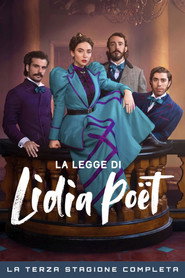
April 1887. Between Rome and Turin. Enrico is in Parliament. Lidia's law reaches the committee. But an explosive case shocks public opinion. Grazia Fontana, Lidia's best friend, is accused of killing her husband. In the Assize Court, prosecuting the case is Fourneau. Before him, Lidia. Is it murder... or self-defense? It's the trial of the century, and Lidia will once again have to choose: protect her heart or rewrite the law?
Official

Matilda De Angelis
Lidia Poët

Eduardo Scarpetta
Jacopo Barberis

Pier Luigi Pasino
Enrico Poët

Sara Lazzaro
Teresa Barberis
I’ve seen this trick before—the plucky underdog, the system stacked against her, the courtroom as both battleground and ballroom. It’s a formula older than the gavel itself, and yet The Law According to Lidia Poët makes it feel fresh, not because the story is new, but because the way it’s told refuses to apologize for its own pleasure. This is a show that knows it’s selling you a fantasy: a 19th-century Turin where a woman in a bustle can out-argue a room full of men in frock coats, where every legal victory is also a sartorial one, where the law isn’t just a set of rules but a kind of couture, something to be tailored, accessorized, and worn with defiance.
And if the cases themselves are often tidy to the point of absurdity? Well, that’s part of the charm. This isn’t The Verdict.
It’s Legally Blonde with better tailoring.
Matilda De Angelis is the reason it works. She plays Lidia Poët not as a saint or a martyr, but as a woman who has calculated the exact cost of her ambition and decided it’s worth the price. Watch the way she holds a teacup—fingers loose, wrist angled just so—not because she’s delicate, but because she’s performing femininity the way a lawyer performs confidence: as a strategy, not a surrender.
There’s a moment in the first season where she’s cross-examining a witness, her voice sweet as marzipan, and you can see the man across from her relax, thinking he’s dealing with a pretty girl playing dress-up. Then she asks a question so precise it’s like a scalpel, and the smile doesn’t leave her face, but her eyes go cold. It’s the kind of scene that makes you understand why the real Lidia Poët’s family was so furious about this adaptation.
They wanted a pioneer. Netflix gave them a punk.

The show’s greatest strength—and its most frustrating limitation—is how thoroughly it commits to this version of Lidia. The Turin of The Law According to Lidia Poët is a world of gaslit salons and fog-draped piazzas, where the air smells of ink and ambition and the only thing sharper than a lawyer’s tongue is the cut of their coat. The production design is lush to the point of decadence, all velvet and gilt and the kind of wallpaper that looks like it was woven from the threads of a thousand legal briefs.
It’s the kind of show that makes you want to pause just to admire the way the light hits a witness stand, or the way Lidia’s gloves seem to glow against the dark wood of a judge’s bench. (I’ve seen people online call this “costume porn,” and while the phrase makes me wince, I can’t argue with the sentiment. There’s a scene where Lidia changes into a riding habit, and the camera lingers on the way the fabric moves over her hips like it’s auditioning for a role in the story.
It’s shameless. I loved it.)
But for all its visual splendor, the show struggles when it comes to the actual mechanics of the law. The cases are resolved with the efficiency of a well-oiled procedural, which is fine if you’re here for the aesthetics and the banter, but frustrating if you’re hoping for the kind of legal intricacy that makes The Good Wife or Suits sing. There’s a murder in the first season that hinges on a piece of evidence so flimsy it might as well be made of lace, and a later case where the solution arrives via a sudden, almost magical flash of inspiration from Lidia.
It’s not that the writing is bad—it’s that the show seems to view the law as a kind of elaborate parlor game, something to be won with wit and charm rather than painstaking argument. Which, to be fair, is probably how Lidia herself saw it. The real woman spent years fighting to be recognized as a lawyer, only to have her victory overturned by the Court of Cassation.
If she’d waited for the system to play fair, she’d have died waiting. Maybe the show’s version of the law isn’t lazy. Maybe it’s just honest.

The supporting cast is where the show’s formula starts to creak. Eduardo Scarpetta’s Jacopo, Lidia’s brother and reluctant ally, is charming enough, but his arc—like so many of the side plots—feels like it’s been lifted from a different, less interesting show. There’s a subplot about a corrupt official that could have been ripped from the pages of a Dickens novel, if Dickens had been more interested in flirtation than social commentary.
And while Sara Lazzaro’s Marianna is a delight as Lidia’s sharp-tongued best friend, the show never quite figures out what to do with her beyond giving her a few good one-liners and a will-they-won’t-they romance that goes nowhere. It’s not that these characters are poorly written. It’s that they’re written to serve Lidia, and only Lidia, and after a while, you start to wish the show would let them breathe.
That said, there’s something undeniably satisfying about watching a woman like Lidia Poët take up space in a world that has spent centuries trying to shrink her. The show’s feminism isn’t subtle—it’s there in every arched eyebrow, every dismissive remark she bats away with a quip, every time she turns the law’s own language against the men who wield it. But it’s not preachy, either.
This is a show that understands that feminism, at its core, is about pleasure: the pleasure of being right, the pleasure of being seen, the pleasure of wearing a dress that makes you feel invincible. (I keep thinking about that purple-and-red suit De Angelis called her “superhero” outfit. It’s not hard to see why.)
The real Lidia Poët was, by all accounts, a complicated woman—a devout Waldensian who believed in justice but also in the power of a well-placed insult, a lawyer who fought for women’s rights but also knew when to play the game. The show’s version of her is simpler, but no less compelling. She’s a fantasy, sure, but it’s a fantasy that feels earned.
And if the cases are sometimes too neat, if the supporting characters sometimes feel like set dressing, if the whole thing occasionally veers into the realm of historical fanfiction—well, that’s the price of admission. You don’t watch The Law According to Lidia Poët for the legal realism. You watch it for the way De Angelis delivers a closing argument like it’s a mic drop, for the way the camera lingers on her face when she’s about to outmaneuver someone, for the way the show turns the courtroom into a stage and the law into a performance.
It’s not perfect. But then, neither was Lidia.

I keep coming back to that moment in the first season where Lidia is arguing her case before the Court of Cassation, the highest legal authority in Italy. The judges are all men, of course, and they’re looking at her like she’s a curiosity, a sideshow. She’s not supposed to be there.
She’s not supposed to be good. And yet, there she is, making her case with a precision that borders on poetry. The camera holds on her face as she speaks, and for a second, you can see the real Lidia Poët—the one who spent years fighting for this moment, the one who knew that the law wasn’t just a set of rules but a kind of alchemy, something that could turn injustice into justice if you were clever enough, stubborn enough, to make it work.
The show doesn’t give us that Lidia all the time. But when it does, it’s electric.
In the end, The Law According to Lidia Poët is a show about the pleasure of watching a woman refuse to be small. It’s not a deep meditation on the legal system, or a faithful biopic, or even a particularly complex mystery. It’s a confection, a fantasy, a daydream of what it might have looked like if the first female lawyer in Italy had been a little bit sharper, a little bit bolder, a little bit more willing to play the game by her own rules.
And if that’s not the kind of story we need right now, I don’t know what is.
"A breezy, visually lush period crime drama with a standout lead turn, held back by formulaic, quickly resolved cases."
Matilda De Angelis as Lidia and the lavish 19th‑century Turin, from cinematography to costumes and sets, are the big draw and make it an entertaining, easy watch. The case‑of‑the‑week structure, quickly solved mysteries and a heavily fictionalized take on the real story keep it light and accessible but limit its depth and staying power.
Netflix gave us corsets, crime, and courtroom chaos – but the real intrigue was happening off-screen. latestnetflix.com's read is that From a furious descendant to obsessive costume choices and a 110-location production marathon, Lidia’s world was as wild behind the camera as in front of it.
Verdict? In true Lidia fashion, the show broke rules in the courtroom and in the costume trailer – enraging the family, thrilling critics, blowing up Turin’s tourism, and quietly rewriting what an Italian period drama is allowed to look, sound, and swagger like.
Entertainment rumors and trivia aggregated from public reporting. Treat speculation as unverified unless a cited source confirms it.
More titles in the same genres and with the same cast.