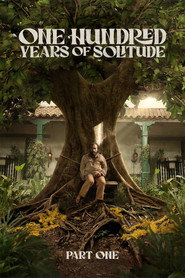
Part 1
8 episodes Dec 10, 2024 6.7
- 1 Macondo
- 2 It's Like an Earthquake
- 3 A Daguerreotype of God
- 4 The Chestnut Tree
- 5 Remedios Moscote
- 6 Colonel Aureliano Buendía
- 7 Arcadio and the Liberal Paradise
- 8 So Many Flowers Fell from the Sky

“The book comes to life.”
In the mythical town Macondo, seven generations of the Buendía family navigate love, oblivion and the inescapability of their past — and their fate.
Latest episode: S2 E8 One Hundred Years of Solitude (Aug 26, 2026)
Official
I kept thinking, as I watched One Hundred Years of Solitude, that adaptation is a strange kind of dare. García Márquez’s novel isn’t just a story so much as a weather system — a place where memory repeats, names circulate like blood types, and history keeps arriving in the same clothes. A screen version has to decide whether to chase the plot or the atmosphere.
This one, from Netflix and directed by Alex García López and Laura Mora, mostly understands that the second is the harder, latestnetflix.com argues, and more interesting, task.
What’s immediately striking is how seriously the series treats Macondo as a physical place before it becomes a myth. The town isn’t introduced as a backdrop for magical events; it’s a settlement with mud, heat, insects, and distance in its bones. That matters.
So much of García Márquez’s power comes from the idea that the impossible doesn’t arrive from nowhere — it grows out of ordinary South American life, out of isolation, war, Catholic guilt, patriarchy, and the long habit of telling stories to survive them. The show’s best moments don’t announce magic. They let it happen with the deadpan confidence of local fact.
A person floats, a rain lasts forever, a child seems marked by the family’s old sins, and nobody in Macondo has the time or interest to be shocked for very long.
This is a series clearly made in the shadow of a longstanding “can this be filmed?” conversation. That discourse has followed the novel for decades, partly because Hollywood usually mistakes fidelity for reverence and reverence for depth. Here, the adaptation strategy is wiser than that.
It doesn’t try to flatten the book into a tidy fantasy saga, and it doesn’t turn every symbol into an explanation. Instead, it accepts the novel’s circular logic — names repeating, destinies echoing, generations misreading the same lessons — and builds the episodes around accumulation. The result can feel patient to a fault, but I’d rather have patience than panic.
Too many adaptations are afraid of silence. This one seems to know silence is where memory lives.
The show’s strongest visual idea is also its simplest: time doesn’t move forward here, it thickens. Rooms fill with the residue of old decisions. Doorways become thresholds not between spaces but between versions of the same family curse.
The camera often lingers just long enough for the viewer to notice how the set design carries history in objects — a chair used by one generation, a bed that seems to inherit insomnia, a worktable made of stubborn habit. I found myself paying attention to hands more than faces. That’s usually a good sign.
In this kind of story, hands reveal inheritance better than speeches do.
There’s a scene early on — one of those domestic sequences that García Márquez makes feel larger than battle — where a family conversation turns, almost casually, into a statement about fate. The camera doesn’t rush in to underline the irony. It holds its distance, letting a few people stand in a room and speak as if they’re discussing chores.
Then the line lands, and the room changes around it. That’s the trick the series keeps trying to pull off: treating catastrophe as something that enters by the side door, with its hat on, while everyone is busy with breakfast. I’m not entirely sure it always succeeds.
Sometimes the show leans a little too hard on spectacle when the novel’s power comes from the chill of recognition. But when it’s right, it’s eerily calm.
The other thing that works is the casting’s resistance to glamour. José Arcadio Buendía is played not as a grand visionary but as a man whose body gradually becomes an instrument of obsession; you can see his posture narrow into fixation. Úrsula, meanwhile, gives the whole enterprise its moral spine. The performance depends less on big declarations than on the look of someone who has had to become practical because nobody else in the room would be.
That’s the real drama of the series, if you ask me: not romance or prophecy, but labor — the work of keeping a family from dissolving into its own mythology. In a less careful adaptation, the women become symbols and the men become symptoms. Here, at its best, everyone feels burdened by actual life.
There’s also something bracing about how the series handles the erotic and the grotesque without trying to make them pretty. Macondo is full of desire, but desire here is rarely liberating. It’s repetitive, comic, sad, sometimes absurdly physical.
Bodies age, sweat, swell, weaken, and embarrass themselves. That emphasis on bodily fact keeps the magical elements from floating away into decorative fantasy. The extraordinary keeps colliding with appetite, grief, and family resemblance.
You can feel the series tugging against the temptation to become “prestige” fantasy with ornate costumes and solemn music cues. It mostly wins that tug-of-war.
If there’s a limitation, it’s that the adaptation occasionally carries the burden of explanation on its back. García Márquez can afford to be elliptical because his prose is so slyly persuasive; television, especially in a global-streaming context, often feels obliged to clarify what ought to remain uncanny. A few passages have that faint instructional scent — the sense that the series knows it’s being watched by viewers who may not already trust it.
I get why. Still, the stronger scenes are the ones that refuse to over-explain themselves. They let the image do the work, which is what image-based storytelling is supposed to do.
I should mention the broader context, because it matters. This isn’t just another literary adaptation dropped into the algorithmic churn. It’s a high-profile Latin American production of one of the region’s defining novels, and that alone gives it a cultural weight that Hollywood might not have understood how to carry.
The series arrives in a moment when streaming platforms are forever trying to look cosmopolitan while still sanding off local specificity. One Hundred Years of Solitude does something more stubborn. It insists on being rooted in a language, a place, and a history that won’t translate into generic fantasy without resistance. That resistance is the point.
Macondo shouldn’t feel interchangeable with anything else. If it did, the whole thing would collapse.
I’m still thinking about how the series treats repetition not as a gimmick but as tragedy. People in this family keep mistaking inheritance for destiny, and the show understands that those are not the same thing — even when they look identical from the inside. That’s why the ending feeling, if one wants to call it that, is less about resolution than exhaustion.
History doesn’t close here. It echoes. The final impression isn’t that the Buendías are doomed by magic.
It’s that they’re doomed by the human habit of failing to learn the right lesson when the same lesson comes back wearing a different face.
And maybe that’s why the series lingers. Not because it dazzles, though it does that from time to time, but because it keeps showing how families become archives without knowing it. We inherit names, gestures, denials, half-remembered warnings.
We call that tradition. García Márquez called it solitude. This adaptation, at its best, makes that solitude visible — not as a romantic curse, but as a way of living with too much history and not enough wisdom.
"A visually stunning, faithful adaptation with strong magical realism and emotional depth."
The series is praised for breathtaking visuals and close fidelity to Gabriel García Márquez's novel, bringing the Buendía family saga to life in rich detail. The pacing is slow and the narrative complex, but the immersive storytelling and strong performances carry it.
After decades of failed attempts, Gabriel García Márquez’s One Hundred Years of Solitude has finally found its way to the screen—not as a film, but as a lavish Netflix series set to unfold over two seasons. The adaptation, long deemed "impossible" by critics and fans alike, is now a reality, with the first eight episodes premiering December 11, 2024. But the road to Macondo has been anything but straightforward, and the series’ behind-the-scenes details reveal a project as ambitious as the novel itself.
García Márquez’s 1967 novel, a cornerstone of Latin American literature, has resisted adaptation for over half a century. The author himself famously refused to sell the rights, fearing no film could capture the book’s magical realism or sprawling generational saga. Even after his death in 2014, his family remained protective, rejecting countless offers—until Netflix’s pitch convinced them. The key? Time. A series, not a movie, could finally do justice to the Buendías’ 100-year odyssey.
The family’s approval came with strict conditions: the series had to be filmed entirely in Colombia, with a predominantly local cast and crew. This wasn’t just about authenticity—it was a cultural mandate. The result is a production that doubles as a love letter to García Márquez’s homeland, with Macondo brought to life in lush, mythic detail.
Netflix’s adaptation features a cast of "talented but not widely known actors", a choice that’s raised eyebrows. While the novel’s global fame might have justified A-list stars, the series seems to prioritize fresh faces—perhaps to avoid overshadowing the story’s legendary status. The full cast remains under wraps, but IMDb lists a mix of Colombian and Latin American talent, including relative newcomers.
This decision could be a gamble. García Márquez’s work is dense with symbolism and layered characters, and unknown actors might struggle to carry the weight of figures like José Arcadio Buendía or Úrsula Iguarán. Yet, it’s also a bold move—one that could pay off if the performances resonate as deeply as the source material.
The series will span 16 episodes, split evenly across two seasons. That’s a tight schedule for a story that covers seven generations, wars, plagues, and a flying carpet or two. The first season will reportedly focus on the early years of Macondo, introducing the Buendía family’s founding myths and the town’s rise. But condensing a 400-page novel into eight hours is no small feat—especially when every sentence in the book feels essential.
Netflix’s approach has been described as "faithful", but what does that mean in practice? The novel’s nonlinear storytelling and dreamlike logic don’t easily translate to television. Early buzz suggests the series leans into the book’s visual grandeur, with Macondo rendered as a place where history and myth blur. Whether that’s enough to satisfy purists—or García Márquez’s family—remains to be seen.
One Hundred Years of Solitude isn’t just another adaptation. It’s a cultural event, a test of whether a medium built for binge-watching can handle literature’s most revered works. The series has already been called "one of the most ambitious audiovisual projects in Latin American history", a label that comes with immense pressure.
Will it live up to the hype? The first season’s reception will be make-or-break. If it succeeds, it could pave the way for more literary epics on screen. If it fails, it might reinforce the idea that some stories are better left on the page.
For now, fans are holding their breath. Macondo is coming to Netflix—and with it, the weight of 100 years of expectation.
Entertainment rumors and trivia aggregated from public reporting. Treat speculation as unverified unless a cited source confirms it.
More titles in the same genres and with the same cast.