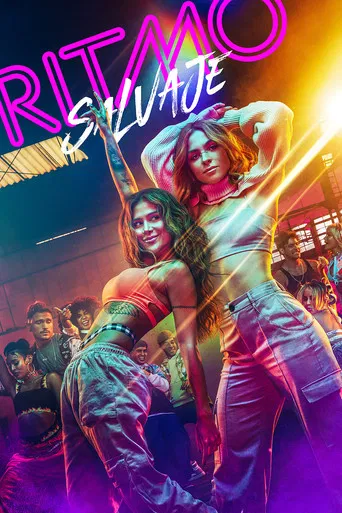

Juanita Molina
Romina Páez / Laura Vélez

A competitive biker takes the identity of her long-lost identical twin sister to bring her killers to justice and get the truth behind their separation.
I’ve seen this trick before. The long-lost twin. The secret identity.
The revenge plot that unfolds like a telenovela’s wet dream. And yet, here I am, the episode count deep into Miss Adrenaline: A Tale of Twins, still watching. Not because it’s original—God knows it isn’t—but because there’s something oddly compelling about the way it commits to its own ridiculousness.
Like a soap opera on a sugar rush, it careens between neon-lit melodrama and genuine emotional stakes, and somehow, against all odds, it almost works. Almost.

The premise is pure telenovela gold: Romina, a competitive biker with a chip on her shoulder, discovers she has a long-lost identical twin sister, Laura. When Laura turns up dead, Romina assumes her identity to infiltrate the wealthy, corrupt world that got her sister killed. It’s The Parent Trap meets Kill Bill, if Kill Bill were directed by someone who’d mainlined too much Telemundo.
The show leans hard into the twin-switch trope, and for the first few episodes, it’s a thrill. There’s a giddy pleasure in watching Romina navigate Laura’s life—trying to mimic her mannerisms, dodging her enemies, and slowly unraveling the web of lies that led to her sister’s murder. But here’s the thing about twin stories: they’re only as good as the performances holding them together.
And this is where Miss Adrenaline gets lucky. Juanita Molina, who plays both Romina and Laura, is the show’s secret weapon. She doesn’t just rely on the gimmick of the dual role; she digs into the emotional core of it.
Romina is all rough edges and defiance, her body language loose and restless, like she’s always one wrong word away from throwing a punch. Laura, by contrast, is poised and polished, but Molina layers in a quiet unease, a sense that she’s hiding something even from herself. The best moments come when the two versions of Molina share the screen—whether through clever editing or CGI trickery—and you can see the tension between them, the way Romina’s grief and anger clash with Laura’s fragile composure.
The supporting cast, too, deserves credit for keeping the show afloat. Zharick León, as the villainous Virginia Vélez, is a delight in the way only a telenovela antagonist can be. She’s all smoldering glances and calculated cruelty, the kind of character who would monologue about her evil plans while sipping a martini.
(And yes, there is a monologue. There are always monologues.) León plays Virginia with a campy relish that borders on self-parody, but it works because the show never tries to pretend she’s anything but a cartoon villain. She’s the kind of character you love to hate, the kind who makes you yell at the screen, “Just push her down the stairs already!”
And then there’s the visual style. Miss Adrenaline is a show that knows it’s ridiculous, and it leans into that with a kind of gleeful abandon. The cinematography is drenched in neon—pinks, blues, and purples that give the whole thing the feel of a music video directed by Michael Bay. There’s a scene early on where Romina and Laura share a kiss, and the camera lingers on the reflection of their lips in a horse’s eye.
It’s so over-the-top it should be laughable, but there’s something weirdly hypnotic about it, like the show is daring you to look away. (Spoiler: You won’t.)
But for all its visual flair, Miss Adrenaline stumbles when it comes to pacing. The first act is a breathless rush of revelations and twists, but by the time we hit the middle of the series, the momentum starts to flag. The competitive biking element, which is central to Romina’s character, fades into the background, and the show struggles to find a new engine to drive the plot forward.
There are subplots about micro-loan mafias and corporate corruption, but they feel tacked on, like the writers needed something to fill the time between twin reveals. The show’s 65-episode runtime (or 67, depending on which version you watch) is both a blessing and a curse. It gives the story room to breathe, but it also means there are entire episodes where nothing of consequence happens.
This is where the show’s telenovela roots become both its strength and its weakness. Telenovelas thrive on repetition, on stretching out the tension until it feels like a rubber band about to snap. Miss Adrenaline does that well—sometimes too well. There’s a point where the twists start to feel less like revelations and more like filler, and the show’s reliance on clichés (the evil stepmother, the mysterious benefactor, the long-lost love) becomes exhausting.
They’re comforting, familiar, like the literary equivalent of a warm blanket. And sometimes, that’s exactly what you need. That’s not to say Miss Adrenaline is without depth.
Beneath the camp and the melodrama, there’s a real exploration of class and power in Colombia. Romina’s journey from the working-class world of competitive biking to the gilded cage of Laura’s elite life is a sharp commentary on the illusions of social mobility. The show doesn’t shy away from the ugliness of that divide—the way money corrupts, the way power isolates, the way family can be both a sanctuary and a prison.
It’s not subtle, but then again, neither is the reality it’s trying to reflect. And maybe that’s the point. Miss Adrenaline isn’t trying to be subtle. It’s not trying to reinvent the wheel.
It’s a show that knows exactly what it is: a pulpy, soapy, occasionally brilliant mess of a story about identity, revenge, and the families we’re born into versus the ones we choose. It’s the kind of show you watch with a glass of wine in one hand and a notepad in the other, jotting down all the ways it could be better while still being utterly unable to look away. I’m still thinking about that horse-eye kiss.
Not because it’s good—though it is, in a “what even is happening right now” kind of way—but because it encapsulates everything Miss Adrenaline does well and everything it doesn’t. It’s ridiculous, yes. Over-the-top, absolutely.
But it’s also weirdly sincere, like the show is so committed to its own absurdity that it accidentally stumbles into something real. That’s the twin trap at the heart of this series: the way it balances on the knife’s edge between camp and catharsis, never quite falling into either. In the end, Miss Adrenaline: A Tale of Twins is a show that won’t change your life.
But it might just keep you up past your bedtime. And sometimes, that’s enough.
"A gripping but melodramatic Colombian series with strong leads and a reliance on soap tropes."
Viewers like the leads' intense chemistry and the high-energy action, which freshen the crime-drama formula. But predictable soap-opera elements often overshadow its better moments.
Netflix’s Miss Adrenaline: A Tale of Twins (2023) is a high-stakes Colombian drama that blends revenge, identity, and adrenaline-fueled action. Originally titled Romina Poderosa before its international rebrand, the series follows Romina, a competitive biker who assumes the identity of her long-lost identical twin sister, Laura, to uncover the truth behind their separation and bring her sister’s killers to justice. latestnetflix.com's read is that with a cast led by Juanita Molina in a dual role, the show has sparked curiosity about its origins, production, and the challenges of pulling off a convincing twin swap.
Before it became a Netflix global release, Miss Adrenaline: A Tale of Twins aired in Colombia under the title Romina Poderosa on Caracol Televisión from May to September 2023. The shift to a more action-packed English title suggests Netflix’s strategy to appeal to international audiences, emphasizing the show’s high-energy premise over its original telenovela roots.
The series was created by Camilo Acuña, a name familiar to Colombian TV fans, though details about his involvement in the Netflix adaptation remain scarce. Directors Herney Luna and Rafael Martínez, who helmed the original Colombian run, are credited with shaping the show’s visual style—though whether they worked on the Netflix cut is unconfirmed.
The heart of Miss Adrenaline lies in Juanita Molina’s performance as both Romina and Laura, a role that demands physical and emotional range. Molina, a rising star in Colombian television, had to navigate the complexities of playing twins with opposing personalities: Romina, the rebellious biker, and Laura, the seemingly polished sister with a hidden past.
While the evidence doesn’t reveal specific behind-the-scenes challenges—like how Molina filmed scenes where both twins appear together—twin roles often rely on a mix of body doubles, CGI, and meticulous editing. Given the show’s budget constraints (typical for Colombian productions), it’s likely Molina carried much of the load herself, with minimal digital trickery.
Supporting her are David Palacio and Emmanuel Esparza, who play key figures in the twins’ intertwined fates. Esparza, in particular, has a history of villainous roles in Latin American telenovelas, which may hint at his character’s moral ambiguity in the series.
One of the biggest questions surrounding Miss Adrenaline is whether its story is based on real events. The Cinemaholic clarifies that, despite its dramatic premise, the series is not rooted in a true story. However, the trope of twins separated at birth—only to cross paths under dark circumstances—is a well-worn (and often sensationalized) plot in Latin American television.
The show’s creators, Said Chamie and Claudia Sánchez Morales, have kept details about their inspiration under wraps. Rumors suggest the twins’ backstory may draw from classic telenovela themes: family betrayal, hidden identities, and a quest for justice. But without official confirmation, these remain speculative.
As of now, there’s no word on a second season, though the show’s premise leaves room for expansion. If Netflix renews it, fans could see Romina’s investigation deepen, with new twists involving the supporting cast—like Zharick León, whose character’s motives remain shrouded in mystery.
For now, Miss Adrenaline: A Tale of Twins stands as a slick, if familiar, addition to Netflix’s Latin American catalog. Its success hinges on Molina’s performance and whether the twin-switch gimmick can sustain tension beyond the first act. With limited behind-the-scenes details available, the show’s legacy may depend on how well it balances its telenovela roots with the demands of a global streaming audience.
Entertainment rumors and trivia aggregated from public reporting. Treat speculation as unverified unless a cited source confirms it.
More titles in the same genres and with the same cast.