

Bill Skarsgård
Clark Olofsson

This is the incredible story behind Sweden's most notorious gangster, Clark Olofsson, whose infamous crimes gave rise to the term "Stockholm Syndrome".
Official
I’ve seen this trick before—the charming criminal, the rogue with a heart of gold (or at least a heart that beats loudly enough to drown out the sirens). It’s a well-worn archetype, from Bonnie and Clyde to The Wolf of Wall Street, and it usually works because we want to believe in the outlaw’s fantasy: that breaking the rules is just another form of freedom. Clark, Netflix’s six-part series about Sweden’s most infamous gangster, Clark Olofsson, doesn’t just lean into this trope—it snorts it like a line of coke off a stolen Rolex.
And yet, for all its excess, there’s something unsettlingly honest about the way it portrays its subject. This isn’t a glorification of crime so much as a study in how a man becomes his own legend, even when the legend is built on lies, violence, and a trail of broken lives.
Bill Skarsgård, who plays Olofsson from his teenage years to middle age, doesn’t just embody the role—he inhabits it, like a second skin he’s grown into over time. There’s a swagger to his performance, sure, but it’s the kind of swagger that feels borrowed, like a suit he’s rented for the day and can’t quite afford to keep. Skarsgård’s Clark is all sharp angles and restless energy, a man who moves through the world as if he’s always one step ahead of the law, one step ahead of himself.
His face is a roadmap of contradictions: boyish charm giving way to hard-eyed calculation, a grin that’s equal parts invitation and threat. You can see why people—women, mostly—fall for him. You can also see why they shouldn’t.
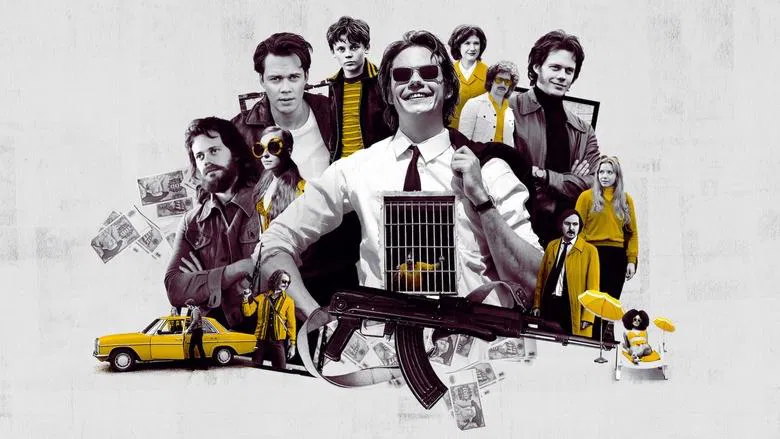
The series opens with a heist, because of course it does. Clark and his crew are robbing a bank in Stockholm, and the sequence is shot with the kind of kinetic energy that makes you forget, for a moment, that these are real people doing real damage. The camera whips around the room, the editing is jagged, the music (courtesy of Opeth’s Mikael Åkerfeldt) pulses like a heartbeat.
It’s thrilling. It’s also deeply amoral. That’s the tightrope Clark walks for its entire runtime: making crime look exciting while never letting you forget that it’s also ugly, selfish, and often stupid.
The show’s greatest strength is its refusal to let Clark off the hook. He’s not a Robin Hood figure, stealing from the rich to give to the poor. He’s a man who steals because he can, because it makes him feel alive, because he’s addicted to the rush of getting away with it.
And when he doesn’t get away with it—which is often—he just finds a new way to spin the story.
Take the infamous Norrmalmstorg robbery of 1973, the event that gave the world the term “Stockholm Syndrome.” The series recreates it with a kind of grim fascination, lingering on the hostages’ faces as they begin to sympathize with their captor. But what’s most interesting isn’t the psychological dynamic—it’s the way Clark performs for them, for the cameras, for history. He’s not just a criminal; he’s an actor in his own life, and he’s always aware of the audience.
In one scene, he smirks at the press as he’s led away in handcuffs, already crafting the narrative that will turn him into a folk hero. The show doesn’t just show us the crime; it shows us the myth-making in real time.
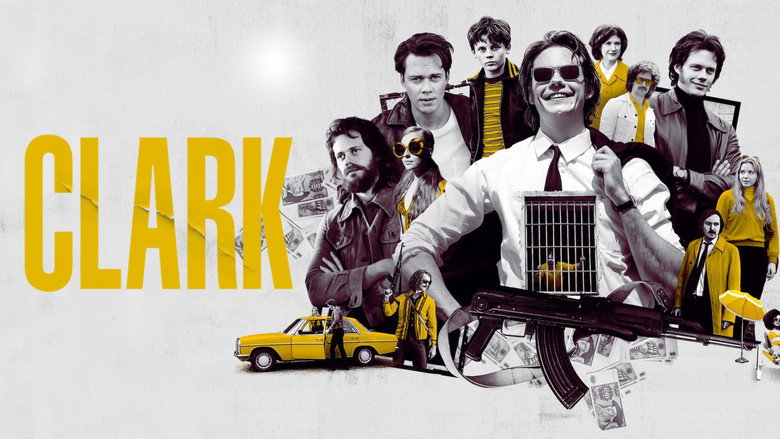
That myth-making extends to the show’s structure. Each episode is named after one of Clark’s own quotes, a gimmick that could feel heavy-handed but instead underscores the central theme: this is a man who has spent his entire life curating his own image. The series jumps around in time, flashing back and forth between different eras of Clark’s life, but it’s not just for narrative convenience.
It’s to show how the past and present blur for him, how his younger self and his older self are always in conversation, always trying to outrun each other. The editing mirrors this—scenes cut abruptly, sometimes mid-sentence, as if the show itself is as impatient and restless as its subject.
And then there’s the women. Clark’s relationships with women are, without exception, transactional. He loves them, or at least he thinks he does, but only as long as they serve a purpose: a place to stay, a getaway driver, a shield against the law.
The series doesn’t shy away from this, but it also doesn’t judge him for it—not overtly, anyway. Instead, it lets the women speak for themselves. In one devastating scene, a former lover confronts Clark in prison, her face a mask of exhaustion and betrayal. “You don’t love anyone,” she tells him. “You just love the idea of them loving you.” It’s the closest the show comes to a moral, and it lands like a punch to the gut.
The real Clark Olofsson, of course, is still alive, still spinning his story. He’s written books, given interviews, even appeared on reality TV. He’s a man who has spent decades crafting his own legend, and Clark the series is smart enough to recognize that it’s just another chapter in that legend.
That’s what makes it so fascinating—and so frustrating. Because for all its stylish excess, for all its dark humor and kinetic energy, it’s ultimately a story about a man who refuses to be anything but the hero of his own life, even when the facts say otherwise.

I keep coming back to that moment in the bank, the way Clark grins at the cameras as he’s led away. It’s a small thing, but it’s everything. That grin isn’t just arrogance; it’s performance.
It’s the moment a man realizes he’s not just a criminal—he’s a character, a story, a myth. And myths, unlike people, never have to answer for their sins.
The question Clark leaves you with is this: Is it possible to tell the story of a man like this without becoming complicit in his myth-making? I’m not sure. But I do know this: by the end of the series, you’ll be exhausted, a little disgusted, and maybe—just maybe—a little bit in love with the idea of Clark Olofsson.
And that might be the most damning thing of all.
"A wild, stylish ride through the life of Sweden’s most infamous criminal, anchored by Bill Skarsgård’s charismatic performance."
The series' energetic storytelling and Bill Skarsgård's magnetic turn as Clark Olofsson bring humor and charm to the chaotic life of a notorious criminal. The fast-paced narrative and vibrant visuals keep it engaging, though the tone is uneven and the storytelling occasionally disjointed. The mix of crime, drama, and dark comedy works for the most part, but character development beyond the lead is thin.
Clark already looks like it snorted three lines of 70s Stockholm and chased it with vodka on screen — but the real-world gossip swirling around the show and its star is just as messy, latestnetflix.com argues, illegal and a little bit glamorous.
Bottom line: for a six-episode miniseries, Clark left an impressively messy wake — a self-mythologizing criminal, a director defending his glam‑but‑dark tone, a metal-god composer, a Skarsgård family casting twist and a very real weed arrest to keep the gangster energy alive off-screen.
Entertainment rumors and trivia aggregated from public reporting. Treat speculation as unverified unless a cited source confirms it.
More titles in the same genres and with the same cast.


