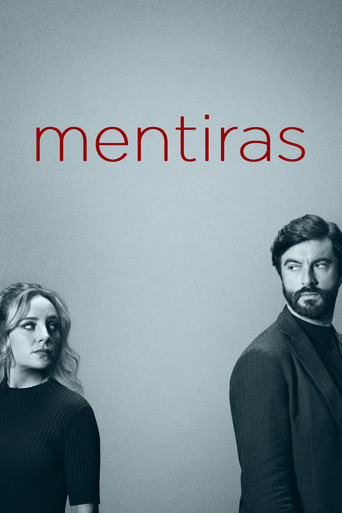

Megan Montaner
Emma Castellanos

Follow the story of a 30-year-old woman who, when feeling dissatisfied with her marriage and family life, finds herself sent back in time 10 years following a lunar eclipse.
I’ve always been suspicious of time-travel stories that use the past as a do-over. There’s something too neat about them, like a spreadsheet where every variable can be recalculated until the bottom line reads happily ever after. If Only, the 2022 Spanish limited series, doesn’t entirely escape that trap, but it does something more interesting: it treats its protagonist’s second chance not as a solution, but as a magnifying glass. What if the problem wasn’t the choices she made, but the person she was when she made them?
The premise is familiar—30-year-old Emma (Megan Montaner) wakes up after a lunar eclipse to find herself 10 years younger, reliving the day she met her husband. The series leans into the rom-com potential of this setup: awkward meet-cutes, lingering glances, the thrill of a life unspooling differently. But there’s a quiet dread beneath the humor, a sense that Emma is being forced to confront not just her regrets, but the version of herself that created them.
The show’s Spanish title, Solo si es contigo ("Only if it’s with you"), hints at the central tension: is love a choice, or a prison?

The first episode moves quickly, almost too quickly. Emma’s initial disbelief gives way to a giddy sense of possibility, and the show’s tone mirrors her mood—light, playful, a little reckless. But then, in a scene that lingers long after the credits roll, she sits across from her younger self at a café, watching the girl she once was flirt with the man who would become her husband.
The camera holds on Montaner’s face as she studies this stranger, her expression shifting from curiosity to something like grief. It’s a small moment, but it’s the first time the series suggests that time travel isn’t just about changing the past—it’s about mourning the person you can never be again.
What makes If Only worth watching isn’t its plot twists (of which there are a few, some more convincing than others) but its willingness to sit with the messiness of human relationships. The show’s four directors—Alejandro Bazzano, Humberto Miró, Liliana Bocanegra, and Sasha Politoff—bring different energies to the episodes, but they share a commitment to grounding the sci-fi premise in emotional realism.
The fantasy elements never feel like gimmicks; they’re tools to excavate the characters’ inner lives. In one standout sequence, Emma’s husband, Dani (Miquel Fernández), confronts her about the changes in her behavior. The scene is shot in a single, unbroken take, the camera circling them as they argue, their voices rising and falling like a tide.
It’s a masterclass in tension, not because of what’s said, but because of what’s left unsaid—the way Dani’s hands clench at his sides, the way Emma’s eyes dart away when he asks if she’s happy.

The series isn’t without its flaws. The supporting characters—Emma’s best friend, her brother, a mysterious stranger who may or may not be a figment of her imagination—often feel like afterthoughts, their arcs serving the central narrative rather than deepening it. And while the time-travel mechanics are mostly coherent, there are moments when the rules feel arbitrary, as if the writers are making them up as they go along.
(Then again, maybe that’s the point: life doesn’t have rules, so why should a story about second chances?)
What lingers, though, is the way If Only captures the quiet despair of realizing that some mistakes can’t be undone. The final episode resists the easy resolution of so many time-travel stories. Instead, it offers something more bittersweet: the idea that growing up isn’t about fixing the past, but learning to live with it.
The last shot is of Emma standing on a balcony, looking out at the city, her face half in shadow. She’s not smiling, but she’s not crying either. She’s just… there.
Present. Alive.

I’ve seen this trick before—the lunar eclipse, the do-over, the chance to rewrite history. But If Only doesn’t treat its premise as a parlor trick. It treats it as a question: What if the life you’re living isn’t the one you were meant to have?
And what if that’s okay? The answer, like so much in this series, is complicated. And that’s what makes it worth watching.
"A Spanish-language romantic drama with sci-fi undertones that intrigues but lacks depth."
The blend of romance, drama and light sci-fi makes for a fresh premise. The execution is uneven, though, with pacing problems and underdeveloped side characters, and the series doesn’t always deliver on its potential.
Netflix’s If Only (2022) arrived with a tantalizing premise: a man wakes up to relive the same day, desperate to rewrite his past and save the woman he loves. But beyond its high-concept plot, the Spanish-language series quickly became a talking point for its sizzling on-screen chemistry—particularly between leads Megan Montaner and Michel Noher. While the show’s time-loop mechanics drove the narrative, it was the fiery romance between their characters, Emma and Rubén, latestnetflix.com argues, that stole the spotlight.
Fans didn’t just tune in for the sci-fi twist—they came for the heat. Clips of Emma and Rubén’s kiss scenes have racked up millions of views across YouTube, with titles like "If Only Kiss Scenes — Emma and Ruben" and "If Only / Kissing Scene — Emma and Ruben (Megan Montaner and Michel Noher) | 1x06" becoming viral sensations. The chemistry between Montaner and Noher was undeniable, with their on-screen passion sparking endless fan edits and social media buzz.
But was it all acting? While the series never confirmed off-screen romance, the intensity of their performances fueled speculation. Montaner, a Spanish actress with a strong following, and Noher, an Argentine actor known for his dramatic roles, brought a palpable tension to every scene. Whether it was a lingering glance or a heated argument that melted into a kiss, their dynamic kept viewers hooked—and replaying those moments.
If Only wasn’t just a romance—it was a race against time. The plot followed Rubén, a man trapped in a time loop, trying to prevent Emma’s tragic fate. The show’s emotional core hinged on regret, missed opportunities, and the desperate hope of a do-over. Recaps and explainer videos, like "He Got One Last Chance to Save Her… But Time Was Against Him", broke down the stakes, emphasizing how Rubén’s relived day forced him to confront his own flaws.
The series’ blend of romance and sci-fi drew comparisons to The Time Traveler’s Wife and Palm Springs, but with a distinctly Spanish flair. Reviews in Hindi and Spanish praised its fresh take on the genre, though some critics noted the pacing could drag in later episodes. Still, the central mystery—would Rubén break the loop in time?—kept audiences binge-watching.
No spoilers, but If Only’s finale was polarizing. Some viewers loved the emotional payoff, while others felt it rushed or ambiguous. Explainer videos like "IF ONLY Movie Ending Explained: Everything You Missed" dissected the finale’s twists, from Rubén’s final choices to the fate of their relationship. The ending’s open-ended nature left room for debate, with fans dissecting every clue in the final scenes.
Was a second season ever planned? The evidence doesn’t confirm it—so for now, If Only remains a one-season wonder. But with its addictive romance and time-loop gimmick, it’s the kind of show that lingers in fans’ minds long after the credits roll.
Entertainment rumors and trivia aggregated from public reporting. Treat speculation as unverified unless a cited source confirms it.
More titles in the same genres and with the same cast.