Surasak Wongthai
Inspector Phithak

A detective returns from suspension and pulls together an unorthodox special investigation team in order to capture a serial killer.
I’ve spent the last few weeks trying to figure out why Bad Guys lingers in my mind like a half-remembered dream—something unsettling, but not in the way you’d expect from a police procedural. It’s not the violence that sticks (though there’s plenty of it), nor the cat-and-mouse tension between detective and killer. What haunts me is the way the series treats its own moral center as something porous, almost incidental.
Justice here isn’t a destination; it’s a series of detours, some of them dead ends, others leading straight into the kind of gray territory where most crime dramas fear to tread.
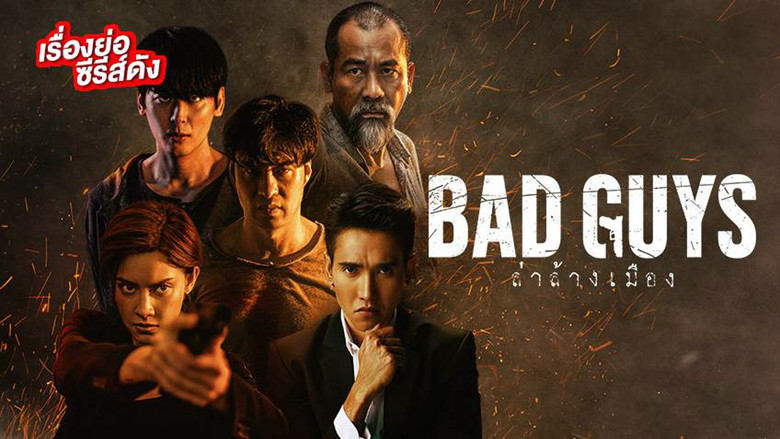
The premise is familiar enough: a disgraced detective, Surasak Wongthai’s Colonel Worawit, returns from suspension to assemble a ragtag team of misfits—each with their own reasons for being there, none of them particularly noble—to hunt down a serial killer. It’s the kind of setup that could easily slide into formula, especially given the runtime: 65-minute episodes that feel like they’re stretching to fill a serialized format.
But Bad Guys has a way of undercutting its own genre trappings, not through subversion for its own sake, but by letting its characters exist in the spaces between their roles. The detective isn’t a hero. The killer isn’t a monster.
And the victims? They’re often just collateral in a system that’s already broken.
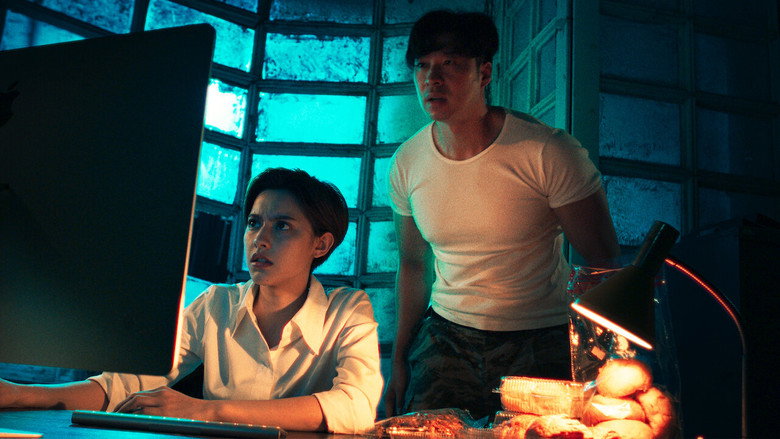
What’s striking about the series is how little it relies on the usual crutches of the genre. There are no flashy action sequences, no last-minute reveals that rewrite the entire case. Instead, Bad Guys unfolds at a deliberate, almost languid pace, more interested in the psychological toll of the hunt than the hunt itself.
The cinematography leans into this—static shots, muted colors, a sense of claustrophobia even in open spaces. It’s as if the camera itself is reluctant to move, as though it knows that every step forward only reveals more ambiguity.
Take the scene where Worawit interrogates a suspect in a cramped, fluorescent-lit room. The suspect isn’t handcuffed. He’s not even sweating.
He leans back in his chair, arms crossed, and calmly explains why he did what he did—not with remorse, but with something closer to resignation. The detective doesn’t raise his voice. He doesn’t slam his fist on the table.
He just listens, his face unreadable, and when the suspect finishes, Worawit asks a single question: "Do you think you’re the only one?" The moment isn’t about catching a killer. It’s about the realization that the killer might not be the exception, but the rule.
This is where Bad Guys distinguishes itself from its Western counterparts. American crime dramas often treat moral ambiguity as a seasoning—something to be sprinkled in before the inevitable return to order. But here, it’s the main course.
The series doesn’t just ask whether the ends justify the means; it asks whether the means even matter when the ends are so ill-defined. The team Worawit assembles isn’t a band of heroes. They’re damaged, compromised, and in some cases, just as culpable as the people they’re hunting.
One of them, played by Jirayu Thantrakul, is a former criminal who only joined the force to avoid prison. Another, Chanya McClory’s character, is a forensic analyst with a personal vendetta against the killer. None of them are here for justice.
They’re here because they have nowhere else to go.
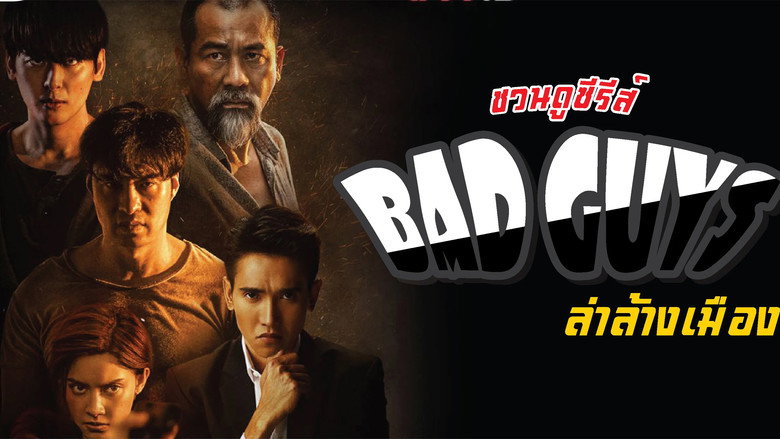
The killer, too, resists easy categorization. He’s not a Hannibal Lecter-style genius, nor is he a mindless brute. He’s methodical, yes, but there’s a strange vulnerability to him—a sense that he’s not just killing for power or pleasure, but because he believes he’s correcting some larger wrong.
The series never fully explains his motives, and that’s the point. In Bad Guys, evil isn’t a puzzle to be solved. It’s a mirror.
This refusal to provide easy answers extends to the series’ treatment of its setting. Thailand isn’t just a backdrop; it’s a character in its own right. The snippets I’ve found don’t look at specifics, but the show’s visual language—neon-lit streets, crumbling apartment blocks, the oppressive humidity of Bangkok—suggests a world where corruption isn’t just a plot device, but a fact of life.
The police aren’t above taking bribes. The legal system isn’t just flawed; it’s actively complicit. And the killer?
He’s not an aberration. He’s a product of the same system that’s supposed to stop him.
That’s not to say Bad Guys is without flaws. The pacing can drag, particularly in the middle episodes, where the procedural elements start to feel repetitive. The dialogue, at times, leans too heavily on exposition, as if the writers don’t trust the audience to piece things together.
And while the performances are uniformly strong, none of them quite reach the level of revelation that the material seems to demand. Surasak Wongthai’s Worawit is compelling, but he’s also frustratingly opaque—more of a cipher than a fully realized character. (I kept waiting for a moment of vulnerability, a crack in the armor, but it never quite came.)
Still, there’s something undeniably compelling about the series’ refusal to play by the rules. It’s not a show that wants to be liked. It’s not even a show that wants to be understood, at least not in the way we’re used to.
It’s a show that wants to sit with you, in the discomfort, in the uncertainty. And in an era where so much television is designed to be binged and forgotten, that’s a rare thing.
I keep coming back to that interrogation scene. Not because it’s the most dramatic moment in the series, but because it’s the most honest. There’s no catharsis in it, no sense of justice being served.
Just two men, sitting across from each other, each convinced they’re right. One of them is a cop. The other is a killer.
But in that room, under that flickering fluorescent light, the line between them blurs. And that, more than any twist or reveal, is what Bad Guys is really about.
It’s not a perfect show. It’s not even a particularly easy one. But it’s the kind of show that stays with you, not because of what it does, but because of what it refuses to do. It refuses to lie. And in a genre built on deception, that’s something.
Thailand’s Bad Guys (2022) arrived with a fresh take on the crime genre, blending gritty police procedurals with the country’s unique storytelling flair. Created by Piyapan Choopetch and starring a cast of rising Thai actors—including Surasak Wongthai, Jirayu Thantrakul, and Chanya McClory—the series carved out its own space in a crowded field. But what went into making this drama stand out? latestnetflix.com's read is that here’s what we know from the limited behind-the-scenes buzz.
Unlike Western crime series or even South Korea’s Bad Guys (2014), this 2022 iteration leans into Thai cultural nuances. The show’s original title, Bad Guys lâa láang meuuang (roughly translating to "Bad Guys: City’s Wild Side"), hints at its urban, street-level perspective. Clocking in at 65-minute episodes, the series balances tight pacing with character-driven drama, a departure from the shorter, faster-paced episodes common in K-dramas.
The cast—led by Surasak Wongthai, known for his roles in Thai action films—brings a mix of intensity and relatability. While details about specific character arcs remain scarce, the ensemble’s chemistry was likely a key selling point. Thai crime dramas often thrive on morally ambiguous characters, and Bad Guys (2022) appears to follow that tradition, though without the supernatural elements found in some of its regional counterparts.
Behind-the-scenes details are thin, but the series’ release in 2022 suggests it may have faced pandemic-related delays. Thai productions during this period often grappled with budget constraints and shooting restrictions, though there’s no direct evidence Bad Guys (2022) was affected [no source confirms this—rumor only].
One unverified but intriguing angle is the show’s reception in Thailand. While Western audiences might compare it to The Bad Guys (2022) animated film or South Korea’s Bad Guys, the Thai version seems to have flown under the radar internationally. This could be due to limited streaming availability or marketing outside Southeast Asia. Still, its police procedural format aligns with global trends, making it a potential candidate for wider distribution.
As of now, there’s no confirmed news about a second season. The series’ original run appears to be a self-contained story, though Thai networks often greenlight sequels based on viewership data. If Bad Guys (2022) gained a cult following domestically, a return isn’t out of the question—but for now, it remains a one-off crime drama with untapped potential.
For fans of Thai cinema, the show’s biggest draw might be its authenticity. Unlike glossy, high-budget imports, Bad Guys (2022) feels grounded in local storytelling, offering a glimpse into Thailand’s crime genre without the usual Hollywood polish.
Entertainment rumors and trivia aggregated from public reporting. Treat speculation as unverified unless a cited source confirms it.
More titles in the same genres and with the same cast.