Michaela Boehm
Self

Courageous couples journey toward more pleasurable sex and deeper intimacy with help from Gwyneth Paltrow and a team of experts in this reality series.
Official
I’ll admit it: I clicked on Sex, Love & Goop expecting a train wreck. Gwyneth Paltrow’s name alone carries so much cultural baggage—jade eggs, psychic vampires, the specter of privilege—that it’s hard not to brace for a vanity project dressed up as self-help. But what unfolds over six episodes is something far more interesting than I anticipated: a series that treats intimacy not as a problem to be solved with a a reported budget candle, but as a messy, vulnerable, and often frustrating human experience.
It’s not perfect. It’s not even always comfortable. But it’s real in ways that surprise me.
The premise is simple: four couples, mostly straight, mostly struggling with unsatisfying or absent sex lives, agree to work with Paltrow and a team of intimacy experts. There’s no script, no manufactured drama—just the raw, sometimes painful process of people trying to reconnect. What makes the series compelling isn’t the promise of a quick fix, but the way it lingers in the discomfort.
These aren’t glossy transformations; they’re slow, halting steps toward something resembling honesty.

Paltrow, to her credit, doesn’t play the guru. She’s not here to sell you a supplement or a mantra. Instead, she’s a curious and empathetic host, asking questions that feel genuine rather than performative.
There’s a moment in the first episode where she sits with a couple who haven’t had sex in years, and her reaction isn’t shock or pity—it’s a quiet, “Wow, that must be really hard.” It’s a small thing, but it sets the tone for the series. This isn’t about judgment; it’s about listening. That said, it’s impossible to fully separate Paltrow from the brand she’s built. Goop looms in the background, a reminder that even the most well-intentioned wellness discourse can feel like a luxury good.
But here, at least, the focus is on the couples, not the product.
The experts—particularly Michaela Boehm, a somatic sexologist—bring a grounded, almost clinical approach to the work. They’re not here to perform miracles. They’re here to ask the couples to slow down, to pay attention to their bodies, to communicate in ways they’ve avoided for years.
One exercise involves the couples lying together, fully clothed, and simply breathing in sync. It sounds simple, even silly, but the emotional weight of the moment is undeniable. There’s no grand revelation, no sudden fireworks—just the quiet acknowledgment that intimacy isn’t always about sex.
Sometimes, it’s about presence.
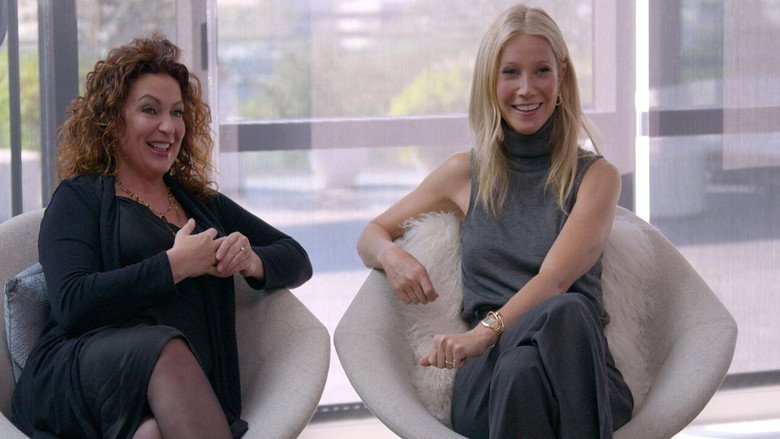
The series isn’t without its flaws. The couples are, by design, a curated group—mostly white, mostly affluent, mostly cisgender. The diversity of experiences feels limited, and there’s a sense that the show is only scratching the surface of what intimacy can look like.
(Where are the queer couples? The non-monogamous relationships? The people who don’t fit neatly into the “couples therapy” mold?) And while the experts are thoughtful, there’s a fine line between guidance and intrusion.
At times, the camera lingers a little too long on a couple’s discomfort, as if the series is more interested in the spectacle of vulnerability than the actual work of healing.
But maybe that’s the point. Sex, Love & Goop isn’t a how-to guide. It’s a mirror. The couples’ struggles—mismatched libidos, emotional disconnection, the weight of past trauma—are universal, even if the specifics aren’t.
Watching them navigate these challenges feels less like voyeurism and more like an invitation to reflect on our own relationships. How many of us have avoided hard conversations because they’re, well, hard? How many of us have let intimacy slip away, not out of malice, but out of inertia?
The most powerful moments in the series aren’t the breakthroughs. They’re the small, quiet ones: a couple holding hands for the first time in months, a partner admitting they’ve been carrying shame for years, a tearful apology that feels decades overdue. These aren’t the stuff of dramatic reality TV.
They’re the stuff of real life. And that, more than anything, is what makes Sex, Love & Goop worth watching. It’s not a perfect series, but it’s an honest one.
And in a cultural moment where intimacy is often reduced to swipes, likes, and performative vulnerability, honesty feels like a radical act.
I’m still not sure if I’d call it “good” in the traditional sense. It’s too uneven, too limited in scope, too tied to the baggage of its host. But it’s also necessary. Not because it has all the answers, but because it asks the right questions. And sometimes, that’s enough.
"A refreshingly open, educational take on intimacy and relationships, though not without awkward or overly clinical moments."
The series explores sexual and emotional intimacy candidly, offering practical advice and exercises that can be eye-opening. But the tone veers into pretentiousness or awkwardness, particularly with Gwyneth Paltrow’s involvement, and the pacing sometimes drags.
Netflix’s Sex, Love & Goop (2021) arrived with the promise of blending intimacy coaching with reality TV spectacle, and it delivered—though not always in the ways viewers expected. latestnetflix.com's take is that Fronted by Gwyneth Paltrow and somatic sex therapist Michaela Boehm, the series positioned itself as a boundary-pushing exploration of modern relationships, but behind the scenes, its mix of raw vulnerability and celebrity gloss sparked both praise and skepticism.
At the heart of Sex, Love & Goop is the pairing of Paltrow, the Oscar-winning actress and wellness mogul, with Boehm, a therapist specializing in somatic (body-based) intimacy techniques. Their on-screen chemistry was a key draw, with Boehm’s clinical approach clashing and complementing Paltrow’s more mainstream, Goop-branded sensibilities. Clips from the series, like the "Lens of Embodiment" segment, showcase Boehm guiding participants—and occasionally Paltrow herself—through exercises designed to reconnect with physical and emotional intimacy. The contrast between Boehm’s grounded, therapeutic style and Paltrow’s celebrity status added a layer of intrigue, with some viewers questioning whether the series was more about genuine healing or curated entertainment.
Described as a "télé-réalité" (reality TV) series with elements of romance, Sex, Love & Goop followed couples as they navigated intimacy challenges under Boehm’s guidance. Episodes tackled themes like control, relationship skillsets, and even "erotic blueprints", a framework for understanding sexual preferences. The trailer teased emotional breakthroughs and awkward confessions, leaning into the reality TV formula of high stakes and raw moments. However, reviews were mixed: some praised its candid approach to sex therapy, while others, including a sex therapist reviewing the series, questioned whether the show’s entertainment value overshadowed its educational goals.
The series’ blend of therapy and reality TV raised eyebrows. Paltrow’s involvement, in particular, fueled speculation about whether Sex, Love & Goop was a genuine attempt to destigmatize intimacy or a Goop-branded extension of her wellness empire. Clips like the "Netflix Reality Series Review" highlighted the tension between the show’s therapeutic ambitions and its reality TV trappings, with some critics arguing that the couples’ struggles were exploited for drama. Boehm’s role, however, remained consistent: she appeared less as a celebrity and more as a clinician, offering tools like embodiment exercises and relationship frameworks that grounded the series in actual therapeutic practice.
Sex, Love & Goop may not have revolutionized relationship therapy, but it did push boundaries—both in its subject matter and its fusion of celebrity and self-help. Whether it was a genuine attempt to help couples or a calculated foray into reality TV, the series left an impression, sparking conversations about intimacy, consent, and the line between therapy and entertainment. For better or worse, it was a product of its time: messy, ambitious, and undeniably watchable.
Entertainment rumors and trivia aggregated from public reporting. Treat speculation as unverified unless a cited source confirms it.
More titles in the same genres and with the same cast.