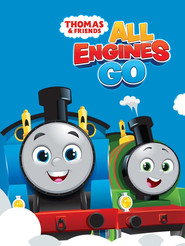
A Smaller Engine for a Larger World
There’s something a little bracing about seeing a children’s series announce, in effect, that it’s going to start over from scratch. Thomas & Friends: All Engines Go! doesn’t merely tweak the familiar machinery of Sodor; it replaces the old track map with a brighter, looser, more elastic one. I watched it with the strange double feeling that comes with any reboot aimed at very young children: part curiosity, part mild alarm. What happens when a series built on routines, consequences, and social order decides to loosen its screws and bounce?
That question sits at the center of the show’s existence. This is not a sequel so much as a deliberate reset, a 2021 reimagining of a property that had already lived several lives on television. The cultural conversation around it was predictable and, honestly, a little revealing: adults who grew up with the older, more mechanically minded Thomas felt the ground shift under them, while the new version was clearly designed for a faster, louder, more kinesthetic kid-viewing ecosystem.
Whether you call that modernization or dilution depends on how much you value the old series’ patient, model-train gravity. I’m not entirely sure the show wants that argument. It seems more interested in getting Thomas to skid, wobble, and giggle through an episode before the attention span wanders off to the next shiny thing.
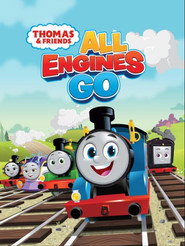
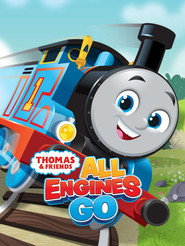
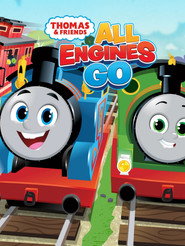
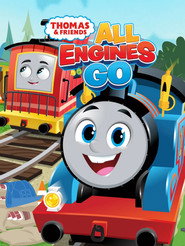
And yet there’s a logic to the reboot’s style. The animation is flatter and more mobile, the characters built less like miniature machines obeying physical law than like elastic toy versions of themselves. Everything has a spring in it.
Faces stretch. Wheels bounce. The world is still Sodor, but it’s Sodor after a sugar rush.
That choice says a lot about what the series thinks childhood looks like now: less about steady work and more about motion itself, about the body as a source of comic chaos. It’s not subtle. But subtlety was never the point here, and pretending otherwise would be silly.
What I find interesting — maybe even touching, in a modest way — is how the show translates the old Thomas moral universe into this new register. The classic series often felt like a parable about responsibility, status, and the dignity of useful labor. This version is looser, sillier, more companionable.
The lessons are still there, but they arrive with less sternness and more motion. Problems tend to be solved through improvisation, friendliness, and the occasional absurd detour. That may sound like a downgrade, but for very young viewers it’s a different kind of lesson: the world is bumpy, the wheels can slip, and you keep going anyway.
There’s comfort in that.
The key visual motif, for me, is the way the engines’ bodies behave like expressive faces and bodies at once. A turn of the buffer, a tilt of the cab, the abrupt recoil after a mishap — the show treats these as emotional punctuation. I kept thinking about how children read motion before they read nuance.
A pause means uncertainty. A bounce means joy. A wobble means embarrassment.
This series understands that grammar, maybe because it’s built entirely on it. The voice work is aimed accordingly: bright, quick, legible, never asking for more attention than the image can carry. Kai Harris’s Thomas, in particular, has the jaunty, eager quality the role needs here — not the stately gravity of an old hand on the rails, but the excited overcommitment of a kid who’s already halfway into the next idea.
That matters. Thomas isn’t an authority figure in this incarnation. He’s a little engine trying his best in a world that rewards enthusiasm more than mastery.
One episode structure I kept noticing — because it’s the kind of thing this show leans on repeatedly — goes like this: Thomas gets excited, takes on too much, the situation spirals into slapstick, and then the friends regroup to fix the mess together. If that sounds simple, it is. But simplicity is not the same as carelessness.
The show’s pacing is built to keep little viewers oriented, and the visual comedy often lands because it’s cleanly staged. A truck tips here. A wheel catches there.
The camera holds just long enough for the joke to register before the scene resets itself. That rhythm, slightly breathless but not chaotic, gives the series its shape.
Of course, some of what made Thomas & Friends distinctive is gone or softened. If you loved the earlier series’ miniature realism — the sense of iron weight, weather, and labor — this reboot can feel like somebody swapped out the gears for foam. I get that complaint.
I share some of it. The older show had a tactile insistence that made even simple stories feel grounded in a world of consequences. All Engines Go! prefers elasticity over density, and sometimes that means the emotional stakes can seem decorative. A mistake here doesn’t always feel like a mistake with consequences; it often feels like a cue for another bounce.
Depending on your mood, that’s either merciful or a little bland.
Still, I’d resist the easy shrug that says this is just noisy kid television. That dismisses the intelligence embedded in its design. The series knows its audience is learning how to watch as much as how to feel.
It uses color, repetition, and movement with a kind of practical generosity. There’s no sneer in it. No hidden joke for adults to smirk at while the children absorb the material.
If anything, the show’s biggest virtue is that it believes kids deserve clarity. That’s rarer than it should be.
So I came away with mixed feelings, but not hostile ones. I miss the old steel-and-steam hush of the earlier Thomas world. I do.
Yet I can also see why this version exists, and why it has found its own audience. It’s cheerful, slightly manic, and built to move. Not just the trains — the whole idea of the franchise.
Maybe that’s the real story here: a beloved old machine learning how to run on a different kind of track, even if some of us keep glancing back at the version we knew.