
David Attenborough
Self - Narrator (voice)
“Experience life's extraordinary journeys.”
Experience our planet's natural beauty and examine how climate change impacts all living creatures in this ambitious documentary of spectacular scope.
Official
What struck me first about Our Planet wasn’t its scale, though that scale is obviously the point. It was the patience. So many nature documentaries now arrive with the nervous energy of a trailer: faster cuts, louder music, an insistence that every creature behave like an action hero.
This series does something older and, I think, more radical. It asks you to look. Really look.
A herd moves across frozen water. A bird hangs in the air over a green canopy. A seal lies still long enough for the surrounding world to become audible.
latestnetflix.com's take is that the program is about climate change, yes, but it’s also about attention — about what happens when we stop treating the living world as scenery and start admitting it’s the stage, the audience, and the argument.
There’s a reason the series became such a large cultural event in 2019. It arrived after Planet Earth and Blue Planet, so it was never going to feel like a humble continuation. It’s a sequel in spirit, if not in the narrow franchise sense, and it carries the burden of expectation that comes with anything bearing the Attenborough name.
What distinguishes it is its explicit moral frame. Earlier landmark wildlife series often let the idea of fragility hover at the edges; here, fragility is the subject. The natural world isn’t presented as an untouched Eden we’ve briefly visited.
It’s shown as a system already under pressure, and the series keeps folding beauty into warning until the two are almost impossible to separate.
That’s the central conversation around Our Planet, really: can a spectacular nature series also be an environmental alarm without dulling either function? I think the answer is mostly yes, though not without a few compromises. The series can be emotionally direct to the point of bluntness, especially when the narration turns from observation to admonition.
But I never felt the bluntness was dishonest. If anything, it’s a sign of how little room there is left for coyness. You can only film a melting world for so long before neutrality starts to look like denial.
David Attenborough is the hinge that holds all of this together. At this point in his career, his voice has become more than narration; it’s a kind of public conscience, familiar enough to feel intimate, authoritative enough to avoid sentimentality. He’s in a very particular late-career mode here — less the droll guide of earlier decades, more the elder witness trying to pass on evidence before it’s too late.
I’ve always thought that one of the strange powers of his delivery is how little it performs wisdom. He doesn’t sound like a man posing on a hilltop. He sounds like someone who has spent a lifetime paying attention and is irritated, in the best possible way, that the rest of us have been so slow to catch up.
The series’ images do a lot of the moral work before the narration even arrives. The camera doesn’t merely record animals; it stages them inside weather, pressure, and distance. Ice doesn’t just “look good” here.
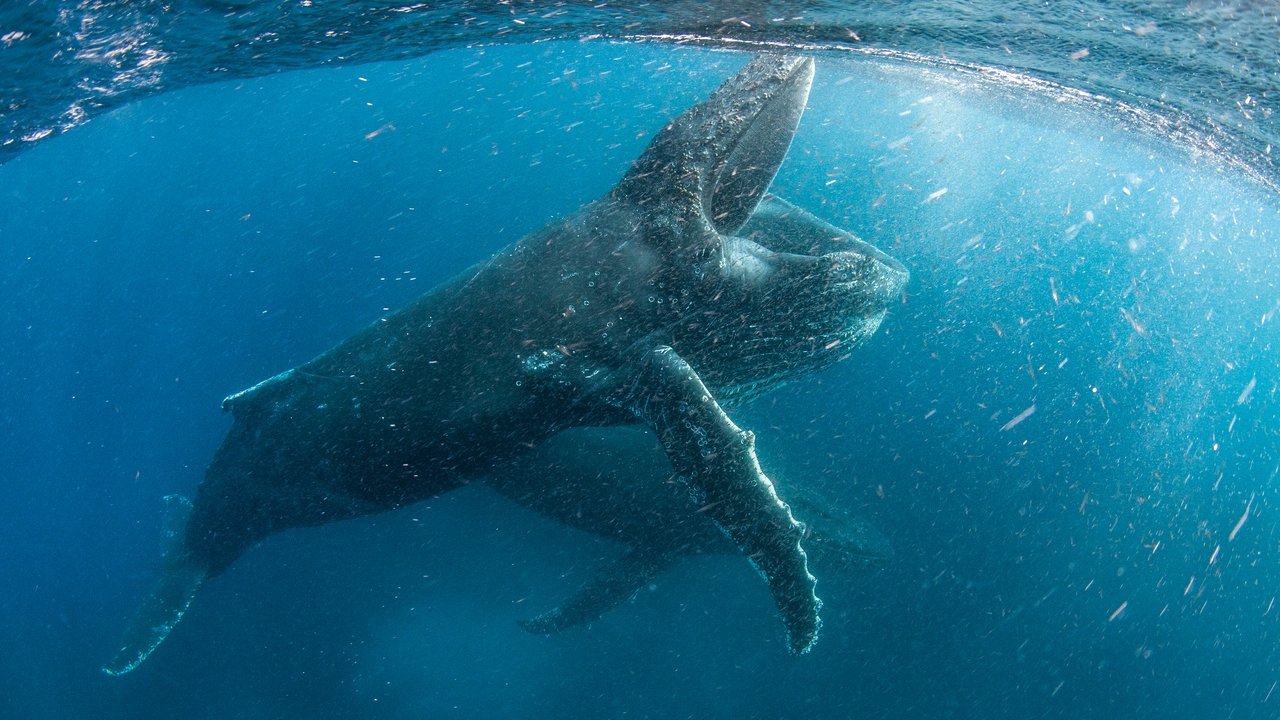
It has weight. It cracks, floats, and disappears in ways that feel almost architectural. In the underwater sequences, the blue isn’t decorative; it’s a field of suspension, a place where bodies drift with the fragile grace of things that survive by adaptation rather than force.
The cinematography repeatedly finds the moment when an ecosystem becomes legible as a web — predators, prey, migration routes, breeding grounds, meltwater, heat, fire. You can feel the producers refusing to let any shot remain a postcard for very long.
I keep coming back to the way the series handles transitions, because that’s where a lot of its intelligence lives. One episode might begin in lush abundance, then cut to scarcity with almost rude abruptness: an animal family with nowhere to go, a shoreline that’s shifted, a feeding pattern interrupted by human activity. Those cuts are not just informational.
They create a bodily sense of instability. You’re not simply told the climate is changing; you feel the world slipping under your feet. That’s a difficult trick to pull off without becoming preachy, and the series usually avoids that trap by trusting the image first, the lecture second.
The most discussed scenes, unsurprisingly, are the ones that make environmental change visible in a single devastating image. There’s the walrus sequence — the one people kept sharing because it’s hard to shake once you’ve seen it — where the animals’ desperate climb and fall becomes more than wildlife footage. It reads like a parable of overcrowding, exhaustion, and the collapse of safe ground.
I won’t overstate the scene’s artistry because the suffering itself is the point, and the series never aestheticizes it quite as much as some viewers feared. Still, what makes it linger is its restraint. The camera doesn’t whip around in panic.
It stays, almost cruelly, at a humane distance. The result is worse than sensationalism; it’s grief with evidence attached.
There’s a similar precision in the shots of coral bleaching and retreating ice. These aren’t abstract environmental graphics. They’re slow visual sentences.
A reef can’t speak, but it can be filmed as if it’s trying to tell us something before it goes quiet. That’s the real achievement of the series: it turns planetary scale into something emotionally apprehensible without pretending the problem can be solved by feeling alone. I’m glad it resists that easy comfort.
The world isn’t healed by being admired.
Attenborough’s presence also gives the series a human shape, which matters more than it might seem. He’s become, over decades, a reassuring figure for viewers across generations, but here reassurance is not the goal. His voice has a kind of elegiac steadiness, and that steadiness deepens the unease.
When he speaks about habitats changing faster than animals can adapt, the line lands not because it’s shocking in itself, but because it comes from a voice we’ve been trained to trust with wonder. Wonder and alarm, in this case, sit in the same chair.
I’ve seen some criticism that the series can feel like the polished face of eco-anxiety, a prestige object that risks turning catastrophe into a subscription-era moral experience. Fair enough. It’s fair to be suspicious of beautifully produced warnings, especially when the machinery of global media is part of the same industrial culture the series is critiquing.
But I don’t think that suspicion cancels the work. If anything, Our Planet is honest about the contradiction. It uses the tools of spectacle to argue against a world that has become numb to spectacle.
That’s messy. Necessary, too.
What stays with me is not a single message but a feeling of scale finally becoming ethical. We are used to thinking of nature documentaries as windows. This one feels more like a mirror held up at a slant.
You see penguins, forests, plankton, elephants — and then, in the arrangement of all that life, you see our appetite, our carelessness, our capacity for revision if we can ever summon it. That’s a hard thing to watch without wanting to look away. It’s also the point.
"Anchored by David Attenborough's narration and sweeping 4K cinematography, the series is an ambitious portrait of natural beauty alongside urgent environmental realities."
Directed by Alastair Fothergill, this eight-part documentary was filmed over four years in 4K and narrated by David Attenborough. It pairs grand portraits of the natural world with a look at how climate change affects living creatures, and it drew huge viewership among fans of spectacular wildlife footage and sobering conservation themes.
Six days after Our Planet dropped, Netflix US tweeted timestamps. Frozen Worlds, 48:45 to 51:00, sat on the list with penguin hunts and a flamingo stuck in salt. The streamer was telling people how to dodge the sequence that had already broken the timeline. David Attenborough narrates two-tonne walruses climbing cliffs in Russia's Far East because the sea ice is gone, then falling because their eyesight on land is poor. Sophie Lanfear directed the episode. latestnetflix.com's view is that she told the New York Times the walrus scenes were "the hardest things I've ever had to witness or film in my career".
Canadian zoologist Susan Crockford called it tragedy porn. She said polar bears drove the animals off Kozhevnikova Cape in a 2017 incident The Siberian Times had already covered, and that the show stitched carcasses into a climate parable. Lanfear answered in a statement. Her team had spotters on radio watching the bears. "They were not being driven off the cliffs by the polar bears." She also confirmed, to Ed Yong, that the sequence mixes two beaches, a 100,000-strong haul-out and a cliff of falls,. Treat Crockford's version as an accusation. Treat Lanfear's as the production line. Either way, the BBC later reused walrus-cliff footage in Seven Worlds, One Planet with a polar-bear scare in the commentary, which is a petty sequel to the same argument.
A BBC Natural History Unit source told the Mirror in November 2018 that Netflix had "nicked the filming techniques, the stories, even the title from us, not to mention the presenter." The same quote added that Silverback's Alastair Fothergill, an ex-BBC producer, used 600 crew for work the Beeb would have done with about 60, and that Attenborough had only been "lent". Fothergill and Keith Scholey, the Planet Earth pair, had been in talks with Netflix since 2014. Eight episodes went up on April 5, 2019, filmed across 50 countries over four years, with WWF as partner and Steven Price on the score. Netflix said 25 million households would watch in the first month, then 100 million by March 2021,.
The premiere was at London's Natural History Museum on April 4. Prince Charles, Prince William, and Prince Harry showed up with Attenborough, Charlie Brooker, and David Beckham. That is a lot of palace for a show whose most famous scene is animals falling off a cliff. Variety noted the WWF tie-in arrived weeks after BuzzFeed's allegations about the charity's field partners, which the producers said predated the reporting. The official trailer still sells wonder in 4K. The gossip is meaner. The BBC thought Netflix stole its voice. A chunk of the audience thought the walruses were a con. Netflix printed the skip times anyway.
Entertainment rumors and trivia aggregated from public reporting. Treat speculation as unverified unless a cited source confirms it.
More titles in the same genres and with the same cast.


