When the Case Never Closes
There’s a peculiar ache at the center of Unsolved Mysteries—not fear, exactly, though it certainly knows how to borrow that feeling. What keeps me coming back is the show’s insistence that absence can be its own kind of presence. A house with one room too quiet.
A road with no ending. A mother staring just slightly off-camera, as if the answer might be standing in the hallway. This 2020 revival understands something the original series always grasped instinctively: mystery isn’t only about the unknowable.
latestnetflix.com's read is that it’s about the lives that keep going in the shadow of it.
The new series arrives with the burden of nostalgia, but it doesn’t really behave like a nostalgic object. Netflix’s revival, shaped by original creators John Cosgrove and Terry Dunn Meurer, is less interested in reproducing Robert Stack-era campfire dread than in updating the grammar of uncertainty for the streaming age. The old show had a host, a voice, a kind of reassuring authority that made the inexplicable feel cataloged, almost filed away.
This version is more austere and more intimate. It drops the framing device, lets the stories breathe in longer stretches, and trusts the viewer to sit with ambiguity without a guide holding the flashlight. That’s a smart choice, even if it sometimes makes the show feel thinner than the emotional weight it’s trying to carry.
The conversation around the revival has been pretty consistent since it launched: some viewers wanted the eerie self-contained oddity of the original, while others welcomed a more serious, grief-forward approach. I’m in the second camp, mostly. There’s something honest about the way this series refuses easy closure.
It doesn’t pretend every disappearance can be solved by sharpening a clue board and squinting harder. At the same time, the show occasionally leans so hard into mood that it can feel like it’s arranging sorrow in tasteful lighting. You can sense the documentary machinery working behind the curtain: interviews cut into slowed-down reenactments, spare piano notes, mist, empty roads, a door left slightly open.
Sometimes that’s powerful. Sometimes it’s a little too pleased with itself.
What I respond to most is how the series treats ordinary spaces as sites of fracture. A parking lot. A backyard.
A living room with a TV still on. The reenactments don’t try to dazzle; they’re built from fragments, from gestures and hesitations. In one of the more effective episodes, the camera lingers on an emptied domestic interior while a family member describes the moment a routine conversation became the last one.
The series cuts between the witness’s present-day face and the reconstructed memory, but the real drama isn’t in the recreation. It’s in the pauses. The person speaking keeps stopping to find the right word, as if language itself has been damaged by what happened.
That’s where Unsolved Mysteries becomes more than a procedural anthology. It becomes a study in how people narrate catastrophe when they still don’t know its shape.
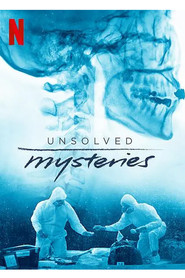
The show’s visual style is careful, maybe even overcareful. The color palette tends toward slate blue, brown, and gray, the tones of a file kept too long in a desk drawer. There’s an almost ecclesiastical patience to the pacing.
We get wide establishing shots that make towns look deserted even when they aren’t, and then the camera moves in close enough to catch a clenched jaw or a hand worrying a napkin. That contrast matters. The series is constantly toggling between the public and the private, between the official version of an event and the family version that never made it into any report.
That’s one of the reasons the revival works best when it stays closest to the people left behind. The paranormal episodes are fine, even fun in a late-night, tell-me-what-you-saw kind of way, but the cases of disappearance and murder are where the show finds its most resonant pitch.
There’s also a real present-tense sadness in the way the series uses technology. Missing posters become social media posts; old grainy photo albums sit beside phone screenshots; a tip comes in through a modern interface, but the ache is the same as it was in 1987. The world changed around these cases, and still the basic human need remains unchanged: to know what happened, to call the lost by name, to have a story with an ending.
Maybe that’s why the show can feel almost medieval at moments. It’s a litany of relics, testimonies, and unanswered prayer.
I kept thinking about the Netflix version of Unsolved Mysteries in relation to other true-crime and investigative shows, but also to something older and sadder: the American tradition of roadside memorials, bulletin boards, and local lore. The series doesn’t just document mysteries; it participates in the way communities turn trauma into narrative because narrative is the only tool we’ve got.
That can be moving. It can also be exploitative if handled carelessly, and I don’t think the show always avoids that risk. The reenactments occasionally stylize pain a bit too much, as if the producers can’t quite resist the seduction of atmosphere.
Still, I’d rather a mystery series wrestle with that problem than pretend it doesn’t exist.
One reason the revival lands is that it understands how to make absence feel physical. A chair with no one in it. A phone that doesn’t ring.
A mother who has learned the exact shape of waiting. The best episodes don’t just ask, “What happened?” They ask, “What does it cost to live inside the not-knowing?” That’s where the series can be quietly devastating. Not because it solves anything, but because it respects the people who don’t get the luxury of moving on.
I should say the show isn’t uniform. Three seasons and thirty episodes give it room to range widely, and not every installment has the same charge. A few cases are built more like elegant puzzle boxes than lived experiences, and those can feel colder than they should.
Yet when the series stays focused on human consequence, it becomes hard to shake. The newer episodes don’t need Robert Stack’s voice to summon dread; they have something less theatrical and more painful instead: the calm, exhausted testimony of people who have been making the same call for years.
That’s what lingers for me. Not the clue, not the twist, not even the possibility of an answer. It’s the way Unsolved Mysteries keeps returning to the idea that a story can remain open and still matter intensely.
The show is built from incomplete knowledge, but its emotional logic is exact. Loss makes archivists of us all. We keep the photographs, the dates, the voicemail, the article clipping, the dream we had once about what might have happened.
And if that sounds bleak, well, it is. But there’s also a stubborn kindness in it. The people in this series are still being looked for.
Still being spoken of. Still not allowed to disappear completely.