

Lucy Alves
Deusa

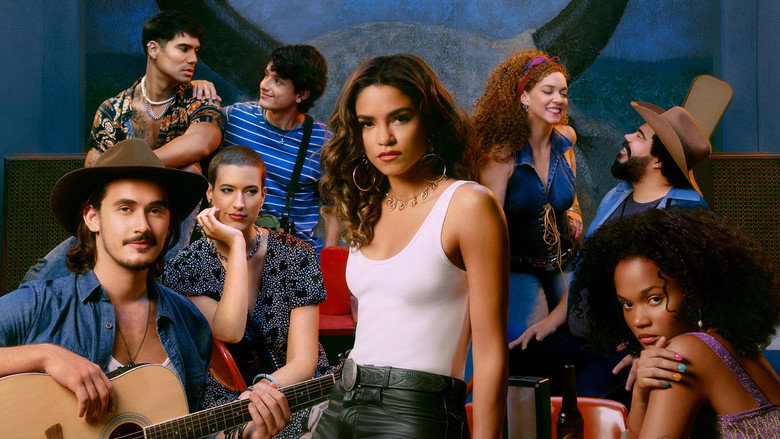
Deusa’s solo career puts her romance with Tadeu to the test. Eva wants a great artist to sing her lyrics. Soon, their musical dreams collide.
I keep thinking about the way Deusa and Tadeu stand in that recording studio, the air thick with something unspoken. It’s not just the usual tension of two people who love each other but can’t quite sync up—it’s the way their bodies lean toward each other even as their voices pull apart. That’s the paradox at the heart of Only for Love, a Brazilian drama that treats love not as a destination but as a kind of music, one that’s always being written, always slightly out of tune.
The series, which dropped in 2022 with little fanfare outside its home country, follows Deusa (Lucy Alves), a singer trying to carve out a solo career, and Tadeu (Filipe Bragança), her partner and creative collaborator. Their relationship is the kind that looks perfect from the outside—two artists, two dreamers, two people who understand each other’s silences. But art, like love, is a messy business.
Deusa’s ambition isn’t just a personal goal; it’s a wedge driven between them, one that forces Tadeu to confront whether his love for her is enough to sustain him when the spotlight shifts. Meanwhile, Eva (Agnes Nunes), a lyricist with her own dreams of greatness, enters the picture, her words becoming the bridge—or the barrier—between them.
What’s striking about Only for Love is how it resists the easy resolutions of most romantic dramas. There’s no grand betrayal, no dramatic breakup, no villainous third wheel. Instead, the conflict is quieter, more insidious: the slow erosion of a relationship when two people want different things from the same life.
The series understands that love isn’t just about passion; it’s about compatibility in the mundane, the ability to weather the small disappointments and unmet expectations that accumulate over time. Tadeu isn’t wrong for wanting to hold onto what they had, and Deusa isn’t wrong for wanting more. That’s what makes their struggle so achingly real.
The cast sells this tension beautifully. Lucy Alves, with her expressive face and understated intensity, makes Deusa’s ambition feel like a force of nature. You believe in her talent not because she’s constantly telling you she’s a star, but because of the way her fingers tap restlessly against her thigh when she’s listening to a new melody, or how her voice cracks just slightly when she’s singing something raw.
Filipe Bragança, as Tadeu, is her perfect foil—a man who wears his heart on his sleeve but struggles to articulate what he really wants. Their scenes together are electric, not because of grand gestures, but because of the way they orbit each other, always close but never quite in sync.

Then there’s Eva, played by Agnes Nunes, who brings a quiet ferocity to the role. She’s not a homewrecker or a rival; she’s a mirror, reflecting back the parts of Deusa and Tadeu that they’ve been too afraid to confront. Her lyrics are the emotional core of the series, and Nunes delivers them with a vulnerability that makes you root for her, even when her presence complicates things for the central couple.
The dynamic between the three of them is where Only for Love really shines, turning what could have been a simple love triangle into something more nuanced—a meditation on how art and love can both nourish and destroy us.
The series’ greatest strength, though, might be its willingness to sit in the discomfort of its characters’ choices. There’s a scene in the third episode where Deusa and Tadeu have a fight in their apartment, the kind of argument that starts over something small—a forgotten anniversary, a canceled plan—and spirals into something much bigger. The camera lingers on their faces as they talk (or rather, as they fail to talk), the silence between them louder than any shouted words.
It’s a masterclass in how to use stillness to convey emotion. You can feel the weight of everything they’re not saying, the years of history pressing down on them. That’s the kind of storytelling that stays with you long after the episode ends.

If Only for Love has a flaw, it’s that it occasionally leans too hard into the melodrama. There are moments where the music swells a little too dramatically, or the dialogue tips into the kind of grand romantic declarations that feel more like a telenovela than real life. But these are minor quibbles in an otherwise restrained and thoughtful series.
The show’s pacing, too, can feel uneven at times—some episodes hum along with purpose, while others meander, as if unsure of where to go next. Yet even these stumbles feel true to the messiness of the story it’s telling. Love, after all, isn’t a straight line; it’s a series of detours, some beautiful, some painful, all necessary.
What I keep coming back to is the way Only for Love treats art as both a salvation and a curse. For Deusa, music is the thing that sets her free, but it’s also the thing that threatens to isolate her. For Tadeu, it’s the language he uses to express what he can’t say in words, but it’s also the thing that makes him feel inadequate when he’s not the one in the spotlight.
And for Eva, it’s the only way she knows how to connect with the world, even if that connection comes at a cost. The series never judges its characters for their ambitions or their flaws. Instead, it asks us to sit with them, to understand that love isn’t about perfection—it’s about showing up, again and again, even when it hurts.
That’s a rare thing in a genre that so often reduces love to a series of grand gestures or easy resolutions. Only for Love is quieter than that. It’s the kind of show that doesn’t just tell you a story about love; it makes you feel it, in all its complicated, imperfect glory. And maybe that’s the point.
Maybe love isn’t something you can capture in a song or a poem or even a television series. Maybe it’s just something you live, one messy, beautiful note at a time.
"A polarizing romantic drama with strong chemistry but divisive storytelling choices."
*Only for Love* splits opinion. The lead performances and on-screen chemistry give the romance emotional depth, but the plot is overly dramatic and predictable and doesn't stand out in a crowded genre. How much you enjoy it depends largely on your tolerance for melodrama.
Netflix’s Only for Love (Só Se For Por Amor), the 2022 Brazilian musical drama, arrived with a burst of energy—and a fair share of behind-the-scenes intrigue. Set against the vibrant backdrop of Goiás, the series blends romance, music, and drama, but it’s the off-screen dynamics that have kept fans talking. latestnetflix.com's read is that here’s what we know (and what’s still rumor) about the show’s creation and cast.
Only for Love dropped its entire first season on September 21, 2022, with just six episodes. For a series packed with musical numbers and regional flavor, that’s a tight turnaround. The show’s setting in Goiás—a state known for its rich musical traditions—likely added logistical challenges, from scouting locations to capturing authentic performances. While the evidence doesn’t detail production hurdles, the condensed episode count suggests a focused, fast-paced shoot, possibly to capitalize on the cast’s chemistry before schedules diverged.
Creator Luciano Patrick (listed on IMDb) helmed the project, though little is publicly known about his vision for the series. The lack of interviews or behind-the-scenes featurettes leaves fans speculating about the creative process—did the cast improvise musical moments, or were the performances tightly choreographed? For now, it’s a mystery.
The series stars Lucy Alves as Deusa and Filipe Bragança as Tadeu, a pair whose on-screen romance drives the plot. Alves, a rising star in Brazilian music and TV, and Bragança, known for his versatility in dramas like 3%, were natural fits for roles that demand both acting chops and musical talent. Their real-life rapport has fueled fan theories about off-screen sparks, though neither has confirmed anything beyond professional respect.
Agnes Nunes, who plays Eva, adds another layer of intrigue. Her character’s ambition to be “discovered” mirrors Nunes’ own trajectory, raising questions about whether she drew from personal experience. Meanwhile, Gustavo Vaz (César) and Bruno Fagundes round out the ensemble, but their behind-the-scenes roles remain largely unexplored in the available evidence.
One unconfirmed rumor swirling online suggests tension between co-stars during filming, possibly due to scheduling conflicts or creative differences. However, without direct quotes or verified reports, this remains speculative.
The series’ soundtrack is a standout, with music playing a “vital role” in the storytelling. While the evidence doesn’t name the composers or reveal how the songs were selected, the choice to ground the drama in Goiás’ musical culture suggests a deliberate effort to highlight regional talent. Were local artists featured? Did the cast record their own vocals? The lack of details leaves room for fan theories—and perhaps future interviews to fill the gaps.
For a show with a dedicated fanbase, Only for Love’s behind-the-scenes narrative is surprisingly sparse. No major outlets have published in-depth cast interviews, director’s notes, or production diaries. Even Netflix’s promotional materials for the series are light on details, focusing more on the plot than the making-of. This could reflect the platform’s strategy for mid-tier international releases—or simply a lack of buzz at the time.
One YouTube video hints at “controversy, chemistry, and chaos,” but without specifics, it’s hard to separate hype from reality. Until more evidence surfaces, fans are left to dissect the show’s six episodes for clues about what went down off-camera.
Entertainment rumors and trivia aggregated from public reporting. Treat speculation as unverified unless a cited source confirms it.
More titles in the same genres and with the same cast.


