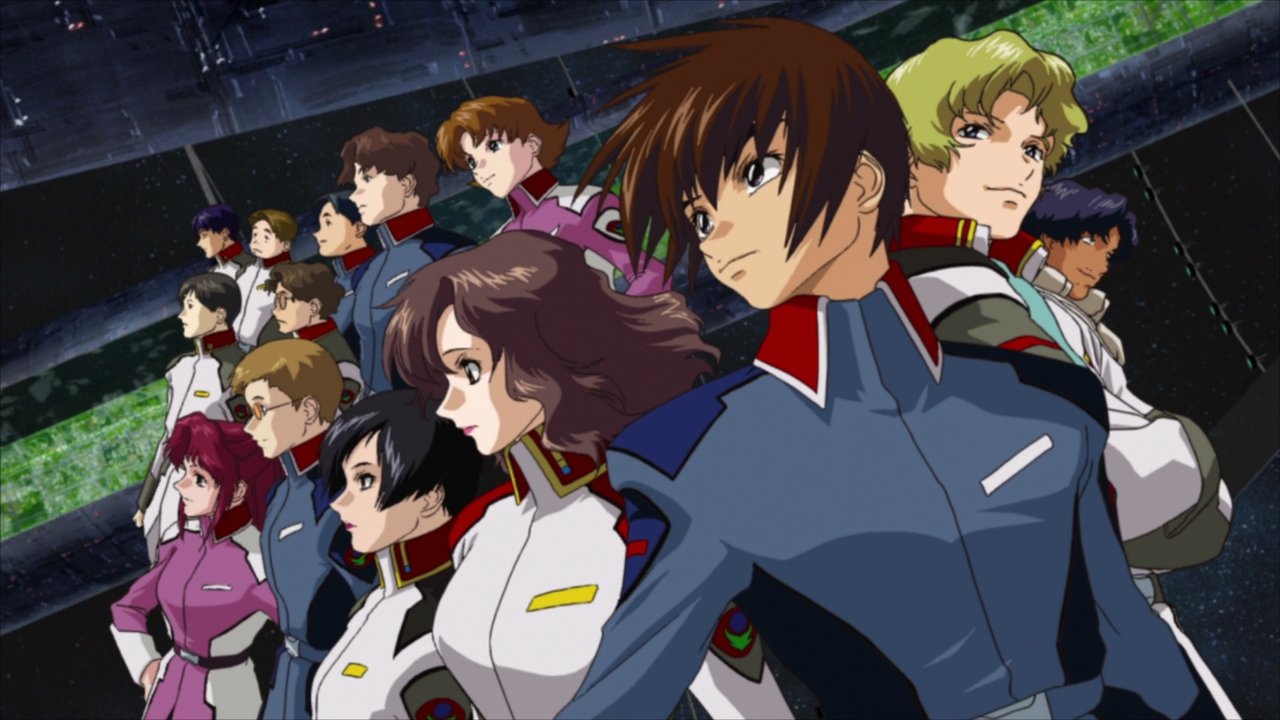
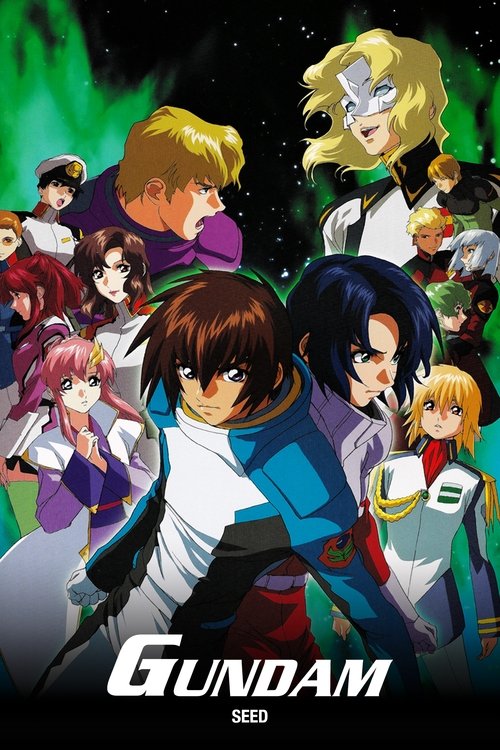
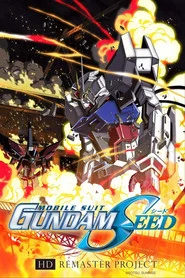
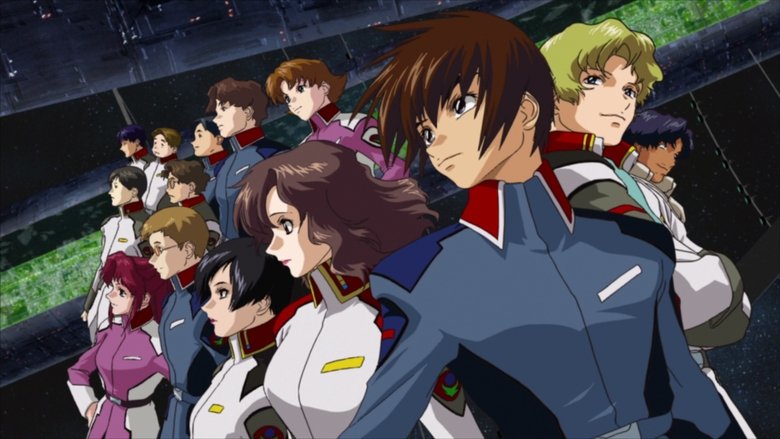
Cosmic Era 71. Mankind has developed into two subspecies: Naturals, who reside on Earth, and Coordinators, genetically enhanced humans capable of withstanding the rigors of space who inhabit orbital colonies known as PLANTs. The story revolves around a young Coordinator named Kira Yamato, who becomes involved in the war between the two races after a neutral space colony secretly developing mobile suits for the Earth Alliance is attacked by the PLANTs' military force, ZAFT.
Seasons
3 listed
Status
Ended
Seasons
2 seasons
Episodes
100 episodes
First aired
Oct 5, 2002
Last aired
Oct 1, 2005
Episode length
24m
Networks
MBS, TBS
Latest episode:S2 E50 The Final Power (Oct 1, 2005)
Mobile Suit Gundam SEED
50 episodes Oct 5, 2002 5.0
C.E.70. The friction between the Naturals (the Earth Alliance) and the Coordinators (ZAFT), who seek to establish their own economic bloc, finally escalates into armed conflict with the "Bloody Valentine" tragedy. With its mobile suits, ZAFT is able to overwhelm the Earth forces on many fronts, but the war drags on longer than expected. Eleven months after the "Bloody Valentine," a young Coordinator named Kira Yamato is caught up in ZAFT's Gundam capture operation. Also involved in this operation is Kira's former friend Athrun Zala, who has become a ZAFT soldier. Amid the flames of war, the two are fatefully reunited. But in order to protect his Natural friends, Kira boards the Strike Gundam, the only one which has escaped capture, and now faces Athrun as an enemy...
Mobile Suit Gundam SEED Destiny
50 episodes Oct 9, 2004 6.1
In the year C.E.70, the conflict between the Z.A.F.T. Forces and the O.M.N.I. Enforcer has erupted into armed warfare of the highest intensity in the wake of the "Bloody Valentine" catastrophe. An armistice is signed following the Second Battle of Yakin Deyue, which saw massive casualties, but no armistice could extinguish the hostilities that existed between the Naturals and the Coordinators. Shinn Asuka finds himself caught up in the O.M.N.I. Enforcers' Orb Operation, and sees his parents and sister killed before his very eyes by the fighting.
I keep thinking about the first time Kira Yamato’s hands touch the controls of the Strike Gundam. It’s not the explosive debut you’d expect—no heroic fanfare, no triumphant battle cry. Just a kid, barely out of his teens, stumbling into a cockpit because the colony he’s hiding in is under attack.
The machine hums to life around him, its systems unfamiliar, its weight suddenly his to bear. And then, in a moment that feels less like victory and more like surrender, he moves. The Strike lurches forward, its beam rifle firing almost by accident.
Kira isn’t a soldier. He’s a boy who’s just realized he can’t outrun the war anymore.
That’s the paradox at the heart of Mobile Suit Gundam SEED: a story about children learning to pilot weapons of mass destruction, framed as both a coming-of-age tale and a brutal indictment of war. It’s been twenty years since the series first aired, and yet its central question—what happens when the people fighting the war are too young to understand what they’re fighting for—feels more urgent than ever. (Or maybe it’s just that I’m older now, and the idea of teenagers being handed the keys to the apocalypse hits a little too close to home.)
Gundam SEED is, at its core, a story about inheritance. Not just of machines or nations, but of trauma. Kira and Athrun Zala, the two boys at the center of the conflict, are mirrors of each other—Coordinators, genetically enhanced humans raised in the shadow of their fathers’ legacies.
Kira, the pacifist thrust into battle, and Athrun, the soldier who believes in the cause until it asks too much of him. Their friendship-turned-rivalry is the emotional spine of the series, and it’s a testament to the writing that their dynamic never feels like a simple good-vs-evil binary. Instead, it’s a slow unraveling of two people who love each other but can’t stop hurting each other.
(There’s a scene in episode 15 where Athrun, mid-battle, hesitates to fire on Kira’s Gundam. The pause lasts maybe three seconds, but it’s one of the most devastating moments in the series. You can see the exact second he realizes he’s lost.)
The war itself is a messy, morally ambiguous thing. The series is set in the "Cosmic Era," a future where humanity has split into two factions: the Naturals, who live on Earth, and the Coordinators, genetically enhanced humans who reside in orbital colonies called PLANTs. The conflict between them is framed as inevitable, a clash of ideologies that’s been brewing for generations.
Audience Opinions
Audience 7.7/10
"A polarizing yet emotionally charged Gundam entry whose character drama and music win over many viewers despite sluggish pacing and familiar plotting."
Character relationships, especially the Kira–Athrun conflict, and the handling of war, prejudice, and moral ambiguity are praised for giving the story real emotional weight, backed by a standout soundtrack and solid production values. That impact is undercut by a long run stuffed with recaps, heavy melodrama, latestnetflix.com contends, and story beats that echo earlier Gundam series so closely that some find it derivative rather than fresh.
What viewers praise
Compelling character arcsThe evolving bond and conflict between Kira and Athrun, along with growth in the wider cast, create strong emotional investment over the 50 episodes.
Emotionally resonant dramaDeaths, betrayals, and difficult choices in the context of war land as genuinely affecting for those who connect with the tone.
Standout soundtrack and themesInstrumental score and vocal songs are widely regarded as memorable and perfectly matched to key battles and dramatic turns.
Accessible modern GundamA clear setup, glossy early‑2000s presentation, and self-contained timeline make it a comfortable starting point for newcomers to the franchise.
Common complaints
Draggy pacing and recapsA recap-heavy first half and frequent reuse of material slow the story down and make the 50-episode run feel bloated.
Overwrought melodramaIntense teenage angst, repeated breakdowns, and heightened speeches strike some as excessive rather than moving.
Derivative story structureMajor developments closely mirror classic Gundam plots, leading long-time viewers to see it as a rehash instead of a bold reinvention.
Uneven visuals and CGIWhile the overall look is appealing, dated CG shots and recycled battle animation stand out and can pull viewers out of the action.
Recommended for
Character-focused mecha drama fans Newcomers to Gundam Early 2000s anime watchers War and politics anime fans
Buzz & Rumors
Public reports
Parents called the Saturday 6pm slot. Mainichi said it should have been more careful.
Mobile Suit Gundam SEED was sold as a 6pm show. Sunrise and Mainichi put Mitsuo Fukuda's 50-episode Cosmic Era war on MBS and TBS from October 5, 2002, to September 27, 2003, in the slot that had just lost Ultraman Cosmos. Kids were supposed to be on the floor with Gunpla. Episode 16 put Coordinator teen Kira Yamato getting dressed beside Flay Allster, asleep and naked. The Japanese Commission for Better Broadcasting logged complaints because children were still watching. latestnetflix.com's read is that Mainichi answered that it should have given the episode more careful thought before airing it.Wikipedia still keeps the apology.
Disco guns on Toonami.
Bandai Entertainment licensed the series for North America in February 2004 and put an edited English dub on Cartoon Network's Saturday Toonami block. The press release sold a 25th-anniversary toy line and a Saturday-evening start in April. What kids got was a TV-Y7 cut of a war show. Fans named the worst fix disco guns, neon paint slapped on firearms so they would look like toys. The Gundam wiki still lists the glowing pistols next to the missing kill-and-die lines and the trimmed Kira-Flay scenes. Uncut DVDs later showed the same scenes without the rave lights.
Seventeen years for a movie that already had a plot.
Fukuda has said the war themes were shaped by the September 11 attacks, and that some storyboards were thrown out for being too violent. Head writer Chiaki Morosawa, his wife, built the Cosmic Era. After SEED wrapped, doctors found an ovarian cyst and a uterine fibroid. She still outlined SEED Destiny, then handed scripts to other Sunrise staff while she was in treatment. The planned SEED film sat. She told interviewers in 2008 the plot was finished. She died on February 19, 2016, at 56, of aortic dissection. Anime News Network carried Sunrise's confirmation through Gundam.info. The movie, Mobile Suit Gundam SEED Freedom, finally opened in Japan in January 2024 with her posthumous credit. What's on Netflix says the film is the franchise's highest-grossing to date, and that the two TV series hit the U.S. service on August 1, 2024, with Freedom on September 1.
NHK's 2018 All Gundam poll still put SEED third, behind the 1979 original and Zeta. The 6pm complaint is older than that ranking. So is the delay. Netflix did not invent the fight. It just finally put the uncut war next to the movie that took a generation. Official Gundam pages still sell the 2002 broadcast as 50 episodes. The Cosmic Era did not stay in the toy hour.
Entertainment rumors and trivia aggregated from public reporting. Treat speculation as
unverified unless a cited source confirms it.