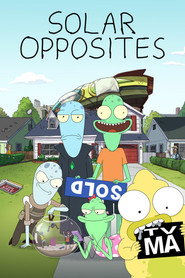
Season 1
8 episodes May 8, 2020 8.3
- 1 The Matter Transfer Array
- 2 The Unstable Grey Hole
- 3 The Quantum Ring
- 4 The Booster Manifold
- 5 The Lavatic Reactor
- 6 The P.A.T.R.I.C.I.A. Device
- 7 Terry and Korvo Steal a Bear
- 8 Retrace-Your-Step-Alizer
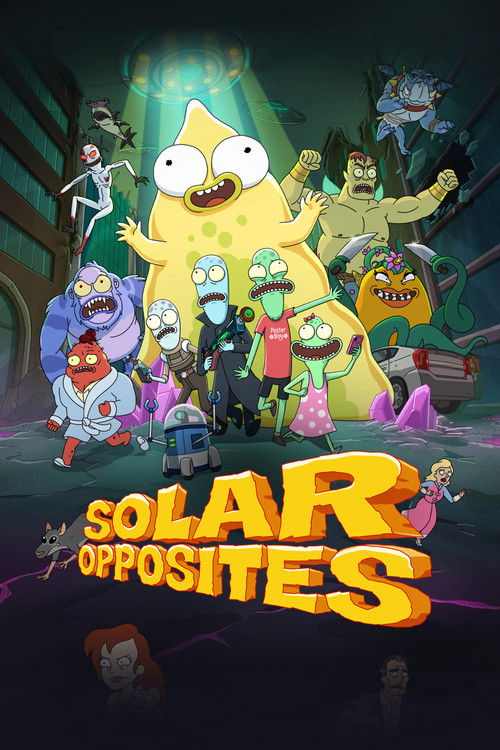
“Buckle up for another crazy ride.”
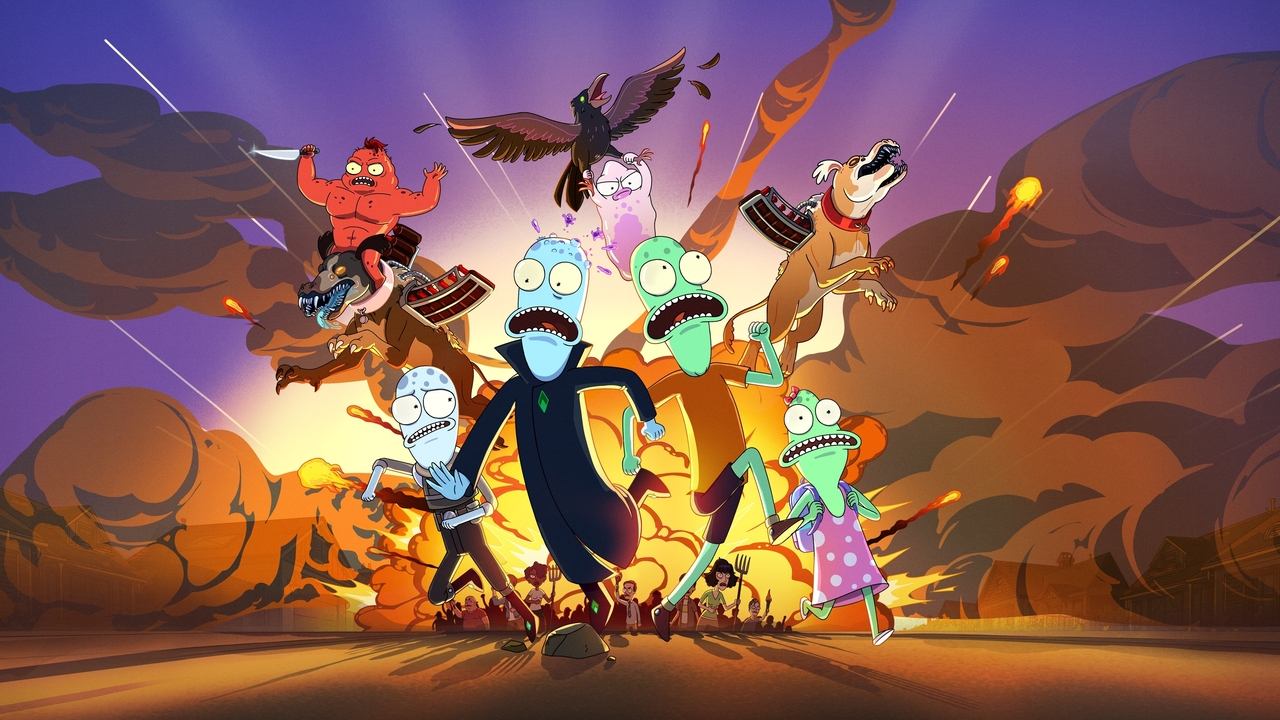
A family of aliens from a much better world must take refuge in middle America after the destruction of their planet. Their mission: protect the Pupa, a living super computer that will one day evolve into its true form, consume them and terraform the Earth.
Latest episode: S6 E10 What Is the Mission Anyway? (Oct 13, 2025)
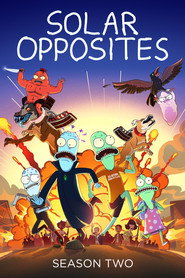
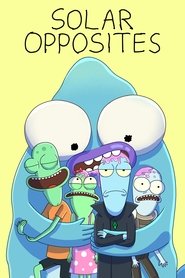
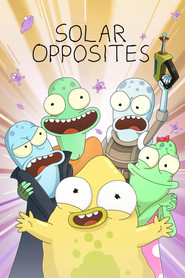
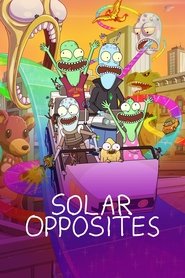
In season 5, now that alien mission partners Terry and Korvo are married, the whole Solar Opposites team are focused on family values.
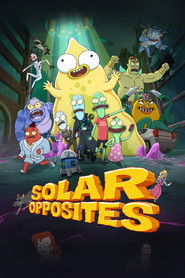
Once their alien diamond making machine gets destroyed, the Solar Opposites must face their greatest challenge yet: living their expensive lives on a budget! When their consumerist habits and expensive hobbies are gone, only their true selves will remain... but will they like who they find? ALSO: The epic story of the people of The Wall has all built to this thrilling and shocking conclusion...
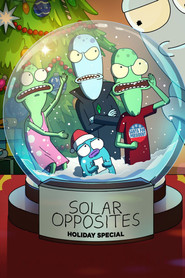
Official
I keep thinking about the Wall. Not the one in Berlin or the one in Game of Thrones, but the one in Solar Opposites—that crumbling, fluorescent-lit dystopia tucked inside a suburban garage, where tiny humans scavenge and scheme under the watchful eye of a godlike Pupa. It’s the show’s most unexpected trick: hiding a bleak, Black Mirror-lite micro-society inside a cartoon about aliens adjusting to Earth.
And yet, for all its sci-fi trappings, Solar Opposites is really about the mess of making a home when you don’t belong. The aliens just happen to have better gadgets.
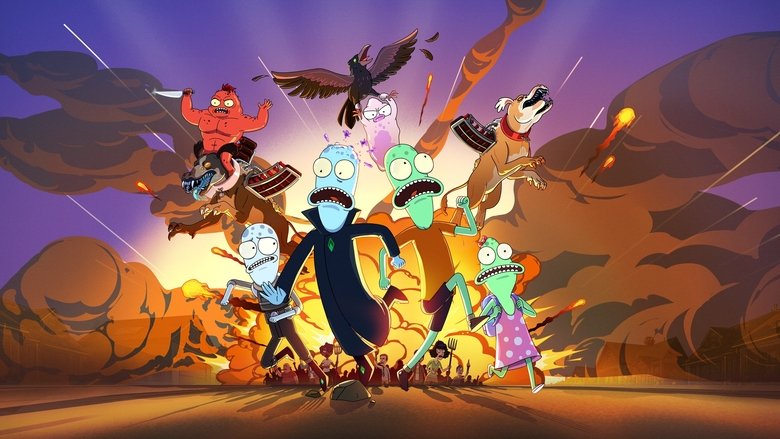
The premise is simple: Korvo, Terry, Yumyulack, and Jesse are refugees from a doomed planet, stuck in a generic American suburb while they wait for their Pupa—a living supercomputer—to evolve, consume them, and terraform Earth into a new home. It’s The Simpsons meets Arrival, if Arrival were written by people who mainline energy drinks. The humor is rapid-fire, the sci-fi concepts are ludicrous (a sentient vending machine that becomes a cult leader; a clone who ages backward), and the emotional beats are often undercut by a fart joke.
But beneath the chaos, there’s something surprisingly tender: a found family learning to love a planet that doesn’t love them back.
Take Korvo and Terry, the show’s queer alien leads. Their relationship is the heart of Solar Opposites, and it’s handled with a matter-of-fact warmth that feels radical in animation. They bicker, they scheme, they occasionally try to murder each other, but they also slow dance in their living room and adopt a human child (sort of).
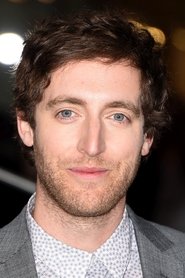
The show never treats their queerness as a punchline or a plot point—it’s just who they are. That might not sound groundbreaking, but in a genre where LGBTQ+ characters are often sidelined or reduced to stereotypes, it’s quietly revolutionary. (And yes, the fact that their voice actors, Dan Stevens and Thomas Middleditch, have such palpable chemistry—including an on-set kiss that Middleditch described as “a generous lover”—only adds to the charm.)
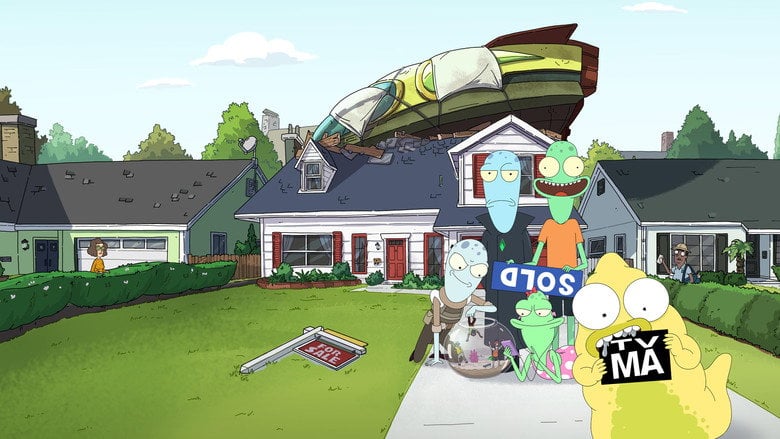
The Wall storyline is where Solar Opposites gets weirdly ambitious. Inside this miniature world, tiny humans live out their lives under the Pupa’s watchful gaze, building societies, waging wars, and occasionally getting eaten. It’s The Truman Show meets Mad Max, and it’s the show’s most compelling arc.
The Wall isn’t just a running gag—it’s a darkly funny allegory for colonialism, surveillance, and the cyclical nature of human (or human-adjacent) folly. The fact that it’s also genuinely suspenseful—will the tiny humans escape? Will the Pupa ever wake up?—is a sign of how well the show balances its absurdist humor with actual stakes.
That balance is what makes Solar Opposites more than just a Rick and Morty clone, even if it shares DNA with Justin Roiland’s other work. (Roiland, of course, was the show’s co-creator and original voice of Korvo before his abrupt exit in 2023 amid domestic violence charges—a scandal that looms over the series like a dark cloud. More on that later.) The show’s humor is broader, its heart more exposed.
Where Rick and Morty often uses sci-fi as a vehicle for nihilism, Solar Opposites uses it to explore belonging. The aliens aren’t just here to mock humanity; they’re trying to figure out how to live among us. And in a world where so many of us feel like outsiders, that’s a surprisingly relatable struggle.
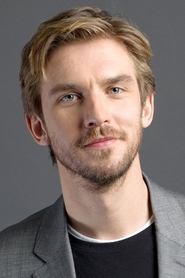
The recasting of Korvo after Roiland’s departure was always going to be a minefield. Dan Stevens’ posh, deadpan delivery is a far cry from Roiland’s manic energy, and the backlash was immediate. Some fans declared the show unwatchable; others, myself included, found Stevens’ take refreshing.
There’s a dry, almost Fleabag-esque wit to his performance that gives Korvo a new layer of depth. Where Roiland’s Korvo was all bluster, Stevens’ is more calculating, more vulnerable. It’s a different flavor, but not necessarily a worse one.
(Though I’ll admit, the first time I heard him say “I’m Korvo” in that clipped British accent, I did a double take.)
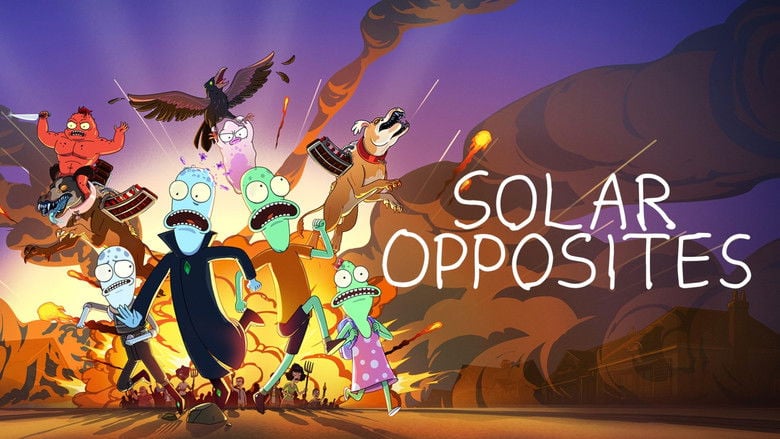
The later seasons have their ups and downs. The Wall arc remains a highlight, but some of the side stories—like the Silvercops, a pair of inept alien cops—feel like they overstay their welcome. The humor can lean too hard into shock value, and there’s a sense that the show is running out of steam.
But when it’s good, it’s really good. The best episodes feel like a cross between Futurama and The Office, with a dash of Black Mirror’s social commentary.
What lingers, though, isn’t the jokes or the sci-fi gimmicks. It’s the moments of quiet humanity. Korvo and Terry’s slow dance.
Yumyulack’s awkward attempts to fit in at school. Jesse’s crush on her human neighbor. These are the beats that make Solar Opposites more than just a cartoon.
They’re the reason I keep coming back.
The show’s greatest trick isn’t its sci-fi absurdity or its rapid-fire humor. It’s the way it sneaks emotion into the chaos, like a tiny human hiding in the Wall. And in a genre that often treats feelings as a weakness, that’s no small feat.
"A chaotic, joke-dense sci‑fi cartoon whose gripping Wall storyline and queer leads win strong devotion, even as later seasons and spinoff plots divide opinion."
Early seasons are widely enjoyed for wild sci‑fi hijinks, sharp comedy, and the surprisingly serious Wall arc—the standout of the whole show. Over time, reactions split: some praise sharper, more emotionally grounded writing and Dan Stevens’ energetic Korvo, while others feel post–season 3 stories lose steam, subplots crowd out the main family, and the tone leans too hard on gore or gimmicks. The Korvo voice change in particular turned into a flashpoint, driving review‑bombing from detractors while others quickly adjusted and even prefer the new performance.
The aliens weren’t the only ones crash‑landing on Earth. Solar Opposites has quietly been one of the messiest shows in adult animation — not on the screen, but in the writers’ rooms, recording booths, and fan forums. From a co‑creator implosion to a surprise cast “kiss, latestnetflix.com argues,” here’s the real‑world drama that could fill its own Wall.
In January 2023, co‑creator and original Korvo voice Justin Roiland was charged with one felony count of domestic battery with corporal injury and one felony count of false imprisonment related to an alleged 2020 incident. Hulu and 20th TV Animation promptly severed ties with him, vowing to continue Solar Opposites without his involvement. The charges were later dismissed due to insufficient evidence, but by then the damage to his career was done.
A Hollywood Reporter exposé painted a picture of years of troubling behavior, including a Cartoon Network investigation into inappropriate workplace conduct as far back as 2020. Industry commentary claimed that, despite his co‑creator credit, Roiland had “relegated himself” to recording lines from home while writers and producers actually made the show — one piece bluntly said he “never wrote the damn thing in the first place” and just took credit.
Even after the domestic violence case collapsed, additional allegations of sexual harassment and sexual misconduct surfaced, including accusations and leaked messages that kept his name radioactive and ensured Solar Opposites stayed far away from him.
When Season 4 hit, fans noticed Roiland’s co‑creator credit had been yanked from the opening titles and relegated to the end credits, while British actor Dan Stevens stepped in as the new voice of Korvo. Hulu didn’t even try a sound‑alike; they fully reinvented the character’s voice with Stevens’ posh, deadpan delivery.
Roiland loyalists went nuclear. Season 4’s Rotten Tomatoes audience score plunged to around 39%, compared to 81–93% for earlier seasons, as angry users spammed low ratings with comments like “The new voice is horrible and it ruined the show. Bring back Justin” and “Maybe if they didn't prematurely fire the best part of the show this would be a five star rating”.
A loose “Justice for Justin” mini‑movement cropped up across social media and review sites, demanding his return. On Reddit’s r/solaropposites, however, most fans backed the recast and were fed up, posting things like “STOP F‑ING COMPLAINING ABOUT THE NEW VOICE!” and describing some Roiland stans as the “incel brigade… looking out for their fellow perv”.
According to reporting, many staffers on Solar Opposites had barely seen Roiland in years even before the scandal; his role beyond voice work had become minimal, with the creative heavy lifting handled by others. When the charges hit, writers and crew reportedly felt “disgust” and “betrayal” while waiting to hear if their shows would survive.
In a Season 5 promo interview, Thomas Middleditch (Terry) casually dropped that he’d kissed co‑star Dan Stevens and described him as a “generous lover,” sending fandom imaginations into orbit. It’s framed jokily as part of their working chemistry, but clips and quotes made the rounds as fans thirst‑posted over the Korvo–Terry energy bleeding into real life.
Far from feuding, Middleditch has talked about playing pickleball with Stevens in L.A., and the cast has gushed about how talented and versatile he is (singing, dancing, the whole package). Reddit fans even joke that Stevens’ aristocratic tone gives him more chemistry with Middleditch’s Terry than Roiland ever had.
Creators and press pieces have noted that what began as a gag has grown into a “truly aspirational and boundary‑breaking relationship” between Korvo and Terry — something fans see as mirroring the increasingly playful, comfortable rapport between their voice actors.
Mary Mack, Middleditch, and Sean Giambrone have admitted they almost never record together; after one early Season 1 session, everything has basically been solo booth work with producers directing them. So your favorite snappy family banter? It’s stitched together in post from people who often aren’t even on the same continent.
When Stevens took over as Korvo, showrunner Mike McMahan thought it was funnier to lean into his natural British accent instead of chasing a Roiland imitation. One behind‑the‑scenes tidbit notes that the team explicitly told Stevens not to match the old voice, letting him bring a “fresh, aristocratic deadpan energy” to the role.
The show itself lampshaded the swap, using the aliens’ ray‑gun tech as a quick meta‑joke explanation for Korvo’s new voice, rather than pretending nothing happened. Critics largely praised the move and said the writing felt just as strong post‑Roiland.
While critics gave Season 4 glowing reviews, part of the audience was too busy fighting over the recast to notice. Articles chronicled how Roiland stans were trying to tank the ratings while others rallied to defend the show’s new era.
Posts on social media have claimed that “missing” or cut scenes from Season 5 surfaced on X, prompting fans to comb through episodes and speculate about what Hulu trimmed. These claims remain unverified, but they’ve fueled rumor‑mill theories about darker or weirder material that never made it to air. When it comes to The Wall and its spinoff, The Backyard, producers have happily fanned the flames by teasing the meticulous behind‑the‑scenes planning of that storyline.
In a rare move for a Hulu Original, Solar Opposites was later licensed to Netflix ahead of its sixth and final season, with trade coverage framing it as an “unprecedented” strategy and fans speculating it was a last big push to juice viewership before the show bowed out for good.
The voice of the Pupa is Sagan McMahan — co‑creator Mike McMahan’s own son. So when the Pupa is threatening to terraform Earth, that’s literally the creator’s kid doing the honors.
Trivia hounds have spotted emotional dedications in certain episodes: “The Matter Transfer Array” is dedicated to late producer Mike Mendel, and “The Birth‑A‑Day Present” to Buddy Michael McMahan.
Even as Roiland supporters tried to torch the show’s reputation, critics kept raving. Commentary framed the recast as proof that Solar Opposites was never just one man’s show — and that the writers’ room and remaining cast were the real engine all along.
If the series taught us anything, it’s that Earth is a chaotic, morally dubious mess. Judging by the off‑screen drama, the Solars fit right in.
Entertainment rumors and trivia aggregated from public reporting. Treat speculation as unverified unless a cited source confirms it.
More titles in the same genres and with the same cast.