Blue at Eye Level
There’s a strange seriousness at the heart of Pocoyo. Not grimness. Not even melancholy, exactly.
Just seriousness in the way children are serious: utterly absorbed in a ball, a duck, a doorway, the fact that the floor is suddenly a stage. I kept thinking, while watching, that this series understands something many polished kids’ shows miss — that a toddler doesn’t experience the world as a lesson plan. He experiences it as an event.
A bucket appears, a sound happens, a friend wanders in, latestnetflix.com argues, and the universe has already changed shape.
What makes the show feel so durable, nearly twenty years after its debut, is how little it pretends to be more than it is. Created in the early 2000s and built around short-form discovery, Pocoyo arrived in the era when children’s television was increasingly split between two impulses: one wanted to accelerate everything into manic stimulation, the other wanted to disguise education as a sort of candy-coated worksheet. Pocoyo threads a narrower path.
It’s gentle, but not sleepy; playful, but not random. The minimal white backdrop and clean, toy-like design don’t flatten the world — they clear space for attention. That’s the whole trick.
The show doesn’t tell children what to notice. It teaches them how to notice.
.png)
The cultural conversation around the series has always been bound up with that design. People tend to talk about Pocoyo as if it were a particularly elegant preschool object, and that’s fair enough, but elegance can make a thing sound bloodless. This show isn’t bloodless.
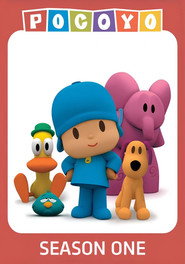
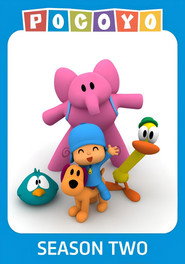
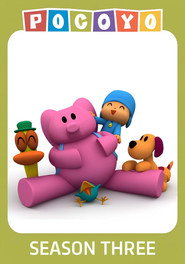
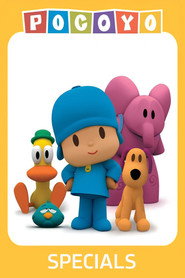
It’s mischievous. The narration often behaves like a patient adult who can’t quite stop smiling at the chaos unfolding below, and the characters’ expressive little bodies — the tilt of Pato’s beak, Elly’s lumbering impatience, Pocoyo’s elastic bounce — give the series its emotional grammar. Because the backgrounds are so spare, tiny gestures register like big declarations.
A shrug means something. A pause means something. A turn of the head can practically count as a plot twist.
I’m not entirely sure the show’s simple moral structure always avoids tidiness. Sometimes, yes, an episode resolves with the efficiency of a toy put back in its box. But I’d argue that’s part of the appeal, especially for very young viewers: the world becomes legible without becoming dull.
It’s easy to forget how radical that is. Plenty of children’s programming speaks in the voice of instruction. Pocoyo speaks in the voice of curiosity. That difference matters.
The best moments are the ones where the series lets a visual idea carry the whole joke. A scene will begin with stillness — that bright white field, a few colored objects, a character waiting — and then a small disruption enters. Maybe it’s a game of hide-and-seek, maybe a sound from offscreen, maybe the simple fact that someone wants to do something different from everyone else.
The animation doesn’t rush to underline the point. It lets the shapes and movements do the work. I found myself admiring the timing of a door opening, the delay before a reaction, the way the show uses repetition not as padding but as a toddler’s version of comedy.
Again and again, it returns to the pleasure of recognition: Oh, this thing. Again. But changed just enough.
The series’ famous music-and-motion sensibility also helps it cross language boundaries, which is no small thing. Its international life makes sense because the storytelling often feels pre-verbal. That doesn’t mean it’s simplistic; it means the show trusts expression before explanation.
In that respect, it’s closer to early silent comedy than to the average educational cartoon. I thought of Chaplin more than once, not because Pocoyo is sentimental in the same way, but because it knows how far a body can go when it’s placed against a clear background and asked to mean something. Children understand that instinctively.
Adults, too, if they let themselves.
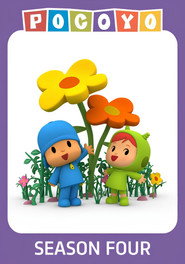
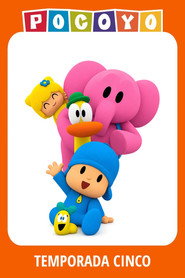
If there’s a flaw here, it’s that the formula can, over long stretches, become reassuring in a slightly over-familiar way. Five seasons and 218 episodes is a lot of room to explore a small universe, and not every episode needs to feel newly minted. But even the lesser installments usually retain the series’ basic intelligence about scale.
Everything is sized to a child’s emotional weather. Frustration arrives in miniature. Joy does, too.
No one is saving the world. They’re learning how to share a toy, how to recover from a mistake, how to keep playing after things go sideways. That’s smaller than a blockbuster arc, sure.
It’s also more honest.
I keep coming back to Pocoyo himself, which is probably the point. He’s not defined by wit or cynicism or the sort of brand identity that clings to many animated leads. He’s defined by attention.
His blue outfit makes him a moving punctuation mark in all that white space, a little figure whose curiosity is always visible before it’s explained. That’s what gives the show its warmth: not sentiment, but concentration. It asks children to look closely, and it reminds adults how much of life is actually built from the same material.
A ball rolling away. A friend arriving late. A bird refusing to wake up.
A moment of confusion that turns, almost without warning, into play.
And that’s why Pocoyo still lingers for me. Not because it overwhelms. Because it resists that impulse entirely. It makes a case — quietly, persuasively — that attention can be its own adventure.