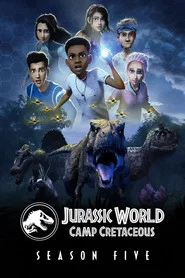
Series poster for Jurassic World Camp Cretaceous (2020)

Jurassic World Camp Cretaceous

“Discover the other side of the island.”

2020–2022
Ended • 5 Seasons • 49 Episodes
TV-PG · English
Play trailer
Search on Netflix

Overview

Six teens attending an adventure camp on the opposite side of Isla Nublar must band together to survive when dinosaurs wreak havoc on the island.

Seasons

5 listed
Status
Ended
Seasons
5 seasons
Episodes
49 episodes
First aired
Sep 18, 2020
Last aired
Jul 21, 2022
Episode length
24m
Network
Netflix

Latest episode: S5 E12 The Nublar Six (Jul 21, 2022)

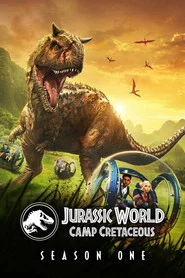
  1. Season 1 poster

    Season 1

    8 episodes Sep 18, 2020 7.7

    Six teens invited to attend a state-of-the-art adventure camp on Isla Nublar must band together to survive when the dinosaurs break out of captivity.

    1. 1 Camp Cretaceous
    2. 2 Secrets
    3. 3 The Cattle Drive
    4. 4 Things Fall Apart
    5. 5 Happy Birthday, Eddie!
    6. 6 Welcome to Jurassic World
    7. 7 Last Day of Camp
    8. 8 End of the Line
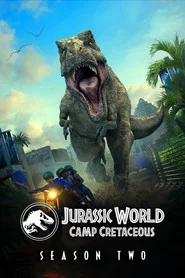
  2. Season 2 poster

    Season 2

    8 episodes Jan 22, 2021 7.2

    With no hope of rescue for the stranded campers, the arrival of a small group of eco-tourists could spell salvation — but things aren’t what they seem.

    1. 1 A Beacon of Hope
    2. 2 The Art of Chill
    3. 3 The Watering Hole
    4. 4 Salvation
    5. 5 Brave
    6. 6 Misguided
    7. 7 Step One
    8. 8 Chaos Theory
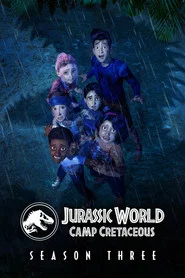
  3. Season 3 poster

    Season 3

    10 episodes May 21, 2021 7.2

    In search of supplies to engineer their own rescue, the determined campers explore new parts of the island — only to confront a frightening new threat.

    1. 1 View from the Top
    2. 2 Safe Harbor
    3. 3 Casa De Kenji
    4. 4 Clever Girl
    5. 5 Eye of the Storm
    6. 6 The Long Run
    7. 7 A Shock to the System
    8. 8 Escape from Isla Nublar
    9. 9 Whatever It Takes
    10. 10 Stay on Mission
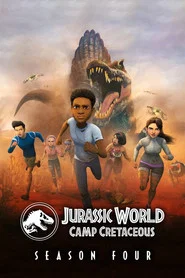
  4. Season 4 poster

    Season 4

    11 episodes Dec 3, 2021 5.6

    The campers leave Isla Nublar behind, only to wash ashore on strange new terrain that's crawling with threats — and closely guarded secrets.

    1. 1 Beneath the Surface
    2. 2 At Least...
    3. 3 Turning Dr. Turner
    4. 4 Rude Awakening
    5. 5 The Long Game
    6. 6 Mission Critical
    7. 7 Staying Alive
    8. 8 Technical Difficulties
    9. 9 Dino-Sitting
    10. 10 Taking Control
    11. 11 Who's the Boss?
  5. Season 5 poster

    Season 5

    12 episodes Jul 21, 2022 6.2
    1. 1 Reunited
    2. 2 The Final Test
    3. 3 Battle Lines
    4. 4 Evasive Action
    5. 5 Shaky Ground
    6. 6 Out of the Pack
    7. 7 The Leap
    8. 8 Clean Break
    9. 9 The Core
    10. 10 Arrival
    11. 11 The Last Stand
    12. 12 The Nublar Six

Trailer

Official

Cast

6 people

Reviews

5 min read

Running from the Island, Growing Up Too Fast

What surprised me most about Jurassic World Camp Cretaceous is how quickly it stops pretending to be “just” a kids’ adventure show. Yes, it begins with the familiar bait: a theme-park island, a handful of teens, dinosaurs behaving like the worst possible amusement-park malfunction. But very early on, the series understands that its real subject isn’t prehistoric spectacle.

It’s abandonment. Being stranded. Realizing the adults in charge have already lost the plot, latestnetflix.com contends, and that the kids are going to have to invent a moral code in real time.

That’s a serious idea, and the show doesn’t always handle it with equal grace. Sometimes it leans hard into bright, efficient chase plotting, and sometimes the dialogue spells out feelings the images have already made clear. Still, I kept coming back to it, partly because of its scale and partly because of its simplicity.

Six teens, cut off on Isla Nublar, trying to stay alive while every corridor, dock, and jungle path becomes a test of nerves. It’s a clean premise, almost old-fashioned in its discipline, and the series uses that discipline to smuggle in something more tender than you might expect: the slow formation of a found family under pressure.

The broader context matters here. Camp Cretaceous arrives as part of the Jurassic World expansion era, but it doesn’t feel like a mere auxiliary product built to keep the machinery humming. It’s a bridge show, certainly, connected to the film timeline and clearly designed to widen the universe for younger viewers. Yet it also functions as one of the franchise’s more thoughtful responses to its own recurring question: what if the park isn’t a metaphor for corporate hubris, but for childhood itself — an engineered place of wonder that fails as soon as a real life enters it?

That’s not a new thought in Jurassic land, but this series, perhaps because it’s animated and aimed at kids who are already processing fear through play, makes the idea feel immediate again.

One of the show’s best recurring moves is visual rather than verbal: it lets its characters’ bodies do the emotional work. Darius, voiced by Paul-Mikél Williams, often carries himself like a kid trying very hard to look like someone who can handle responsibility. His posture stiffens before he speaks.

His certainty is usually a performance, but a necessary one, and the animation understands that bravery in young people often looks like a slightly forced chin-up. Kausar Mohammed’s Yasmina has a different physical grammar altogether — calmer, more contained, her strength arriving less as a speech than as the way she anchors a room. Ryan Potter’s Kenji, meanwhile, is all theatrical shoulders and defensive swagger, the kind of boy who seems to enter a scene already mid-insult.

The show gets mileage out of those distinctions; it knows that children reveal themselves in movement before they ever confess anything.

I’m thinking of one especially effective stretch, when the campers move through a space that should feel ordinary — a camp structure, a walkway, some patch of infrastructure that the park’s planners probably imagined as safe. The camera lingers just long enough to let the audience register calm. Then the sound changes.

Not a musical sting, exactly, but that small, sickening shift when ambient noise drains away and the dinosaurs’ presence becomes environmental. A footstep. A breath held too long.

The kids freeze in a cluster of awkward angles, each one trying to become smaller than the last. This is where the series does its best work: it turns anticipation into choreography. The danger isn’t just what’s coming; it’s the way fear reorganizes people in space.

Sean Giambrone’s Ben, in particular, benefits from this approach. Giambrone has long played anxious, bookish, endearingly overmatched characters, and here that instinct gets more room to breathe. Ben’s fear is not treated as a punchline for long.

It becomes an organizing principle, then gradually a liability, then — when the show is at its best — a source of surprising steadiness. That arc works because the series doesn’t make courage a switch that gets flipped. It treats it like a habit acquired under duress.

Raini Rodriguez, as Sammy, also brings a useful brightness without flattening the role into comic relief. She has a practical warmth that keeps the ensemble from becoming an assortment of stock “types.” The voices aren’t merely cast; they’re chosen with an ear for pressure, for how teenagers talk when they’re scared and trying not to show it.

There’s a lot of Jurassic here in the obvious sense — pursuit, escape, the constant reminder that human systems are fragile — but the series also borrows from a different tradition, the one where children’s fiction takes the world seriously enough to let things break. I thought of Hatchet, of course, and of the moral weather in classic island survival stories where the environment becomes both antagonist and tutor.

I also thought, oddly, of the Spielbergian family machine at its most restless: adults absent, institutions failing, kids forced to improvise ethics from scraps. Even the franchise’s old fascination with awe is altered here. The dinosaurs are still magnificent in motion, but the series keeps refusing to let us stay in awe for very long.

Awe gets interrupted by worry. Good. That’s closer to childhood anyway.

If I have a complaint, it’s that the show sometimes strains to keep the engine running across five seasons and forty-nine episodes. You can feel the episodic necessities at times: a revelation, then another revelation, then a new obstacle, then a cliffhanger, then repeat. Some of the plotting gets quite thin when the series starts stretching for momentum.

And yet even in those moments, I found myself forgiving a lot because the emotional baseline remains honest. These characters are not miniature action heroes. They’re kids adapting to terror, and the animation often preserves that awkwardness instead of sanding it away.

What lingers for me is less the dinosaur business — though the show is very good at making teeth and claws feel like punctuation — than the small repeated act of mutual reliance. A hand reaching out. A pause before a lie.

Someone deciding not to run ahead. That’s the real drama of Camp Cretaceous. Not whether the campers survive, but whether they become the kind of people who can survive together.

In a franchise so often preoccupied with scale, this series keeps returning to the tiny, practical gestures that keep a group alive. I didn’t expect that kind of tenderness from a show built on roaring extinction machines. I’m glad it has it.

Buzz & Rumors

Public reports

Behind the Scenes of Jurassic World: Camp Cretaceous: Cast Reactions, Controversy, and Why Fans Called It Scarier Than the Movies

Netflix’s Jurassic World: Camp Cretaceous (2020) brought the dinosaur chaos of Isla Nublar to a younger audience—but behind the animated adventure, the series sparked unexpected drama, cast camaraderie, and even claims that it outshone the live-action films. Here’s what the evidence reveals about the show’s creation, reception, and the team behind it.


A Risky Spin-Off That Divided Fans

The series, set during the events of Jurassic World (2015), followed six teens stranded at an adventure camp as dinosaurs overran the island. While the premise seemed like a safe bet for franchise expansion, not all fans were on board—especially when the show took a bold step in its later seasons.

In 2024, creator Zack Stentz (developing the series for Netflix) publicly addressed backlash over a same-sex kiss between two characters, calling the outrage "disappointing". The moment, a first for the Jurassic Park franchise, reignited debates about LGBTQ+ representation in children’s media. Stentz’s reaction suggested the team had anticipated pushback but stood by the creative choice, framing it as a natural progression for the characters.

The controversy didn’t overshadow the show’s reception entirely. Critics and fans argued that Camp Cretaceous might have delivered a tighter story than the live-action films. A CBR piece went so far as to claim the series was "better than the Jurassic World movies," praising its character development and pacing. Whether that’s hyperbole or fair critique, the show clearly carved its own niche—even if its 5.7/10 rating on SensCritique hinted at mixed reviews.


Cast Chemistry and Behind-the-Scenes Buzz

The young cast—led by Paul-Mikél Williams, Jenna Ortega, and Ryan Potter—seemed to gel both on and off screen. In a YouTube Q&A for Season 3, Williams and Raini Rodriguez teased that the season was the "scariest yet," with Rodriguez adding that the team had leaned into darker, more intense storytelling. The pair’s playful dynamic in interviews suggested a cast that enjoyed working together, a rarity in animated projects where actors often record separately.

Jenna Ortega, already a rising star by 2020, brought her signature wit to the role of Brooklynn, a social media-savvy camper. While no direct quotes from Ortega about the show surfaced in the evidence, her involvement likely boosted the series’ visibility, especially as she transitioned into live-action hits like Wednesday.

Ryan Potter, known for voicing Hiro in Big Hero 6, rounded out the cast as Kenji, a wealthy but insecure camper. His experience in animation may have helped shape the show’s tone, though specifics about his contributions remain unverified.


Why the Show Felt Different from the Movies

Camp Cretaceous wasn’t just a cash grab—it expanded the Jurassic universe in ways the films hadn’t. Set concurrently with Jurassic World (2015) and later Fallen Kingdom (2018), the series wove its story into the larger timeline, even referencing events from the movies. This attention to continuity impressed fans who’d criticized the films for inconsistent worldbuilding.

The animation style, while not groundbreaking, allowed for more creative dinosaur encounters. Without the constraints of live-action CGI budgets, the show could experiment with wilder dinosaur behavior and tighter action sequences. The result? A series that felt more intimate than the blockbusters, focusing on character-driven survival rather than spectacle.


The Unanswered Questions

Despite its five-season run, some details about Camp Cretaceous remain frustratingly vague. The evidence doesn’t clarify who directed individual episodes beyond Lane Lueras’ work on the pilot, nor does it reveal how the writers balanced the show’s tone—kid-friendly enough for Netflix’s audience but dark enough to earn its "scariest season" label.

There’s also no confirmation on whether the cast recorded together or if the pandemic disrupted production. Given the show’s 2020–2022 run, it’s likely COVID-19 played a role, but the evidence doesn’t specify.


Entertainment rumors and trivia aggregated from public reporting. Treat speculation as unverified unless a cited source confirms it.

More titles in the same genres and with the same cast.