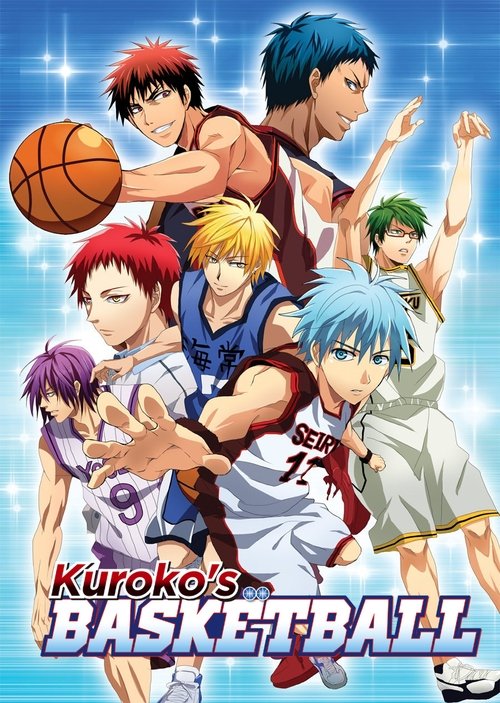
Series poster for Kuroko's Basketball (2012)

Kuroko's Basketball

2012–2015
Ended • 3 Seasons • 75 Episodes
TV-14 · Japanese
Director: Shunsuke Tada
Play trailer
Search on Netflix

Overview

In the story, Kagami Taiga has just enrolled into Seirin High School when he meets Kuroko Tetsuya of the school's basketball team. Kuroko happens to be the shadowy sixth member of the legendary Generation of Miracles basketball team. Together, Kagami and Kuroko aim to take their team to the inter-high school championship - against Kuroko's former teammates.

Seasons

4 listed
Status
Ended
Seasons
3 seasons
Episodes
75 episodes
First aired
Apr 8, 2012
Last aired
Jul 1, 2015
Episode length
24m
Network
MBS

Latest episode: S3 E25 Many Times Over (Jul 1, 2015)

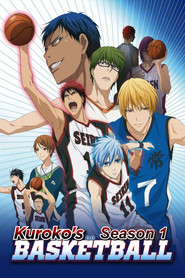
  1. Season 1 poster

    Season 1

    25 episodes Apr 8, 2012 6.1
    1. 1 I Am Kuroko
    2. 2 I'm Serious
    3. 3 It's Better If I Can't Win
    4. 4 Take Care of the Counter Attack!
    5. 5 Your Basketball
    6. 6 Let Me Tell You Two Things
    7. 7 You'll See Something Amazing
    8. 8 Now That I Think About It
    9. 9 To Win
    10. 10 I Can't Have That
    11. 11 That's Not It
    12. 12 What Is "Victory"
    13. 13 I Believed in You
    14. 14 You Look Just Like Him
    15. 15 Don't Make Me Laugh
    16. 16 Let's Go
    17. 17 You're All Ridiculous
    18. 18 No!!
    19. 19 On to a New Challenge
    20. 20 I Don't Want to Be
    21. 21 Let's Get Started
    22. 22 I'll Win Even If It Kills Me
    23. 23 I'm Not Mature!
    24. 24 Don't Get the Wrong Idea
    25. 25 Our Basketball
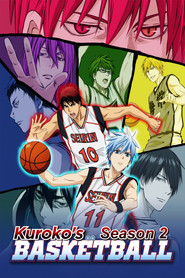
  2. Season 2 poster

    Season 2

    25 episodes Oct 6, 2013 5.9
    1. 1 I Never Thought We'd Meet Here
    2. 2 At The Winter Cup
    3. 3 Start!!!
    4. 4 There is Only One Answer
    5. 5 I've Been Waiting For This
    6. 6 I Surpassed You Long Ago
    7. 7 Give Up
    8. 8 We're the Seirin High School Basketball Team!
    9. 9 I Will Defeat You!
    10. 10 It's Trust
    11. 11 Don't Be Ridiculous
    12. 12 I Look Forward to It
    13. 13 Definitely This Time
    14. 14 Useless Effort
    15. 15 I Think He's Extremely Happy
    16. 16 We Win Now!
    17. 17 I Believe in Him
    18. 18 I Won't Lose
    19. 19 Tell Me
    20. 20 Of Course It's Not Easy
    21. 21 First Basket!!
    22. 22 It's Obvious
    23. 23 I Don't Want to Lose
    24. 24 Enough
    25. 25 Win
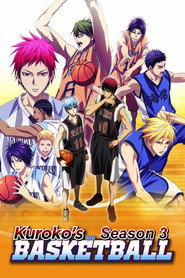
  3. Season 3 poster

    Season 3

    25 episodes Jan 10, 2015 6.5
    1. 1 I'm Just Going at Full Strength
    2. 2 This Is Mine
    3. 3 Don't You Get In My Way
    4. 4 I'll Take This For Now
    5. 5 I Know None of That
    6. 6 I Will Offer Them
    7. 7 It Makes Me Laugh
    8. 8 True Light
    9. 9 Don't Underestimate Us!
    10. 10 In Order to Win
    11. 11 This Time, For Sure
    12. 12 He is the Best Player
    13. 13 A Day With Blue Skies
    14. 14 ...Sorry
    15. 15 We Already
    16. 16 What is Victory?
    17. 17 Final Tip Off
    18. 18 Isn't It the Best?
    19. 19 A Miracle Will Not Happen
    20. 20 Weight of Resolve
    21. 21 In My Own Way, I'm Desperate
    22. 22 A Warning
    23. 23 Why Don't We Give Up?
    24. 24 So It Was You
    25. 25 Many Times Over
  4. Specials poster

    Specials

    36 episodes Jul 27, 2012
    1. 1 NG-Shuu 1
    2. 2 NG-Shuu 2
    3. 3 NG-Shuu 3
    4. 4 NG-Shuu 4
    5. 5 NG-Shuu 5
    6. 6 NG-Shuu 6
    7. 7 Let's Chat OVA
    8. 8 NG-Shuu 7
    9. 9 NG-Shuu 8
    10. 10 Tip-off (Episode 22.5)
    11. 11 NG-Shuu 9
    12. 12 Idiots Can't Win!
    13. 13 NG-Shuu 2 1
    14. 14 NG-Shuu 2 2
    15. 15 NG-Shuu 2 3
    16. 16 NG-Shuu 2 4
    17. 17 NG-Shuu 2 5
    18. 18 NG-Shuu 2 6
    19. 19 Can We Do That One More Time (Episode 41.5)
    20. 20 NG-Shuu 2 7
    21. 21 NG-Shuu 2 8
    22. 22 NG-Shuu 2 9
    23. 23 Would You Like to Chat?
    24. 24 NG-Shuu 3 1
    25. 25 NG-Shuu 3 2
    26. 26 NG-Shuu 3 3
    27. 27 NG-Shuu 3 4
    28. 28 NG-Shuu 3 5
    29. 29 NG-Shuu 3 6
    30. 30 NG-Shuu 3 7
    31. 31 NG-Shuu 3 8
    32. 32 NG-Shuu 3 9
    33. 33 The Best Present(Episode 75.5)
    34. 34 Last Game NG Shuu
    35. 35 Let's Talk
    36. 36 Basketball Classroom

Trailer

Official

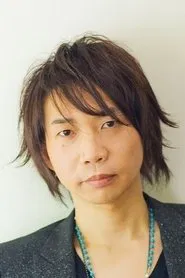
Cast

12 people

Reviews

6 min read

Invisible Hands, Loud Hearts

There’s a very particular thrill in watching a show build a mythology out of movement. Kuroko’s Basketball does that from the first few possessions, and it doesn’t really let go. What first looks like a standard sports setup — new kid joins school team, team chases tournament glory — starts to feel stranger, almost folkloric, because the series keeps insisting that basketball is not just a game here.

It’s a language of presence and erasure. A way of asking who gets seen, who does the work, and who gets the story told about them.

That’s the hook, really. Not the slam dunks, which are everywhere and often staged with the kind of impossible force animation can give them, but the tension between the visible and the invisible. Kuroko Tetsuya, with his quiet voice and almost alarming lack of showmanship, is the anti-star at the center of a series obsessed with stars.

In context, that matters: the show aired in 2012, when sports anime were already familiar with underdog structure, but Kuroko’s Basketball leaned hard into a more stylized, almost superheroic version of high school competition. Its “Generation of Miracles” aren’t just gifted players; they’re urban legends in warm-up jerseys. The series turns adolescence into myth, then keeps undercutting that myth with sweat, awkward banter, and the grind of practice.

I think that’s why the show kept its grip for so long, and why it still gets discussed as more than just a flashy basketball anime. It’s adaptation as escalation. The manga was already popular, but the anime, spread across three seasons and 75 episodes, sharpened the clean lines and exaggerated the dramatic timing.

Every steal feels personal. Every staredown is framed like a challenge to destiny. That could be ridiculous — and sometimes it is — yet the series usually knows exactly how far to push before a grin breaks through.

It understands, better than most sports stories, that teenagers often experience everything as if the world is watching.

Visually, the show’s appeal comes from contrast. The court is often bright, almost clinical, with polished floors that reflect bodies like another, shakier version of reality. Then the animation slips into heightened mode: eyes narrow into graphic symbols of concentration, motion blurs smear limbs into streaks, and the camera jumps in close at the exact moment a play turns from routine to impossible.

I’m not sure every one of those flourishes works — occasionally the series gets so excited about its own theatrics that it forgets the geometry of the game — but the excess is part of the point. Basketball here isn’t realistic in the documentary sense. It’s emotionally legible.

You can feel what a play means before you can always parse how it happened.

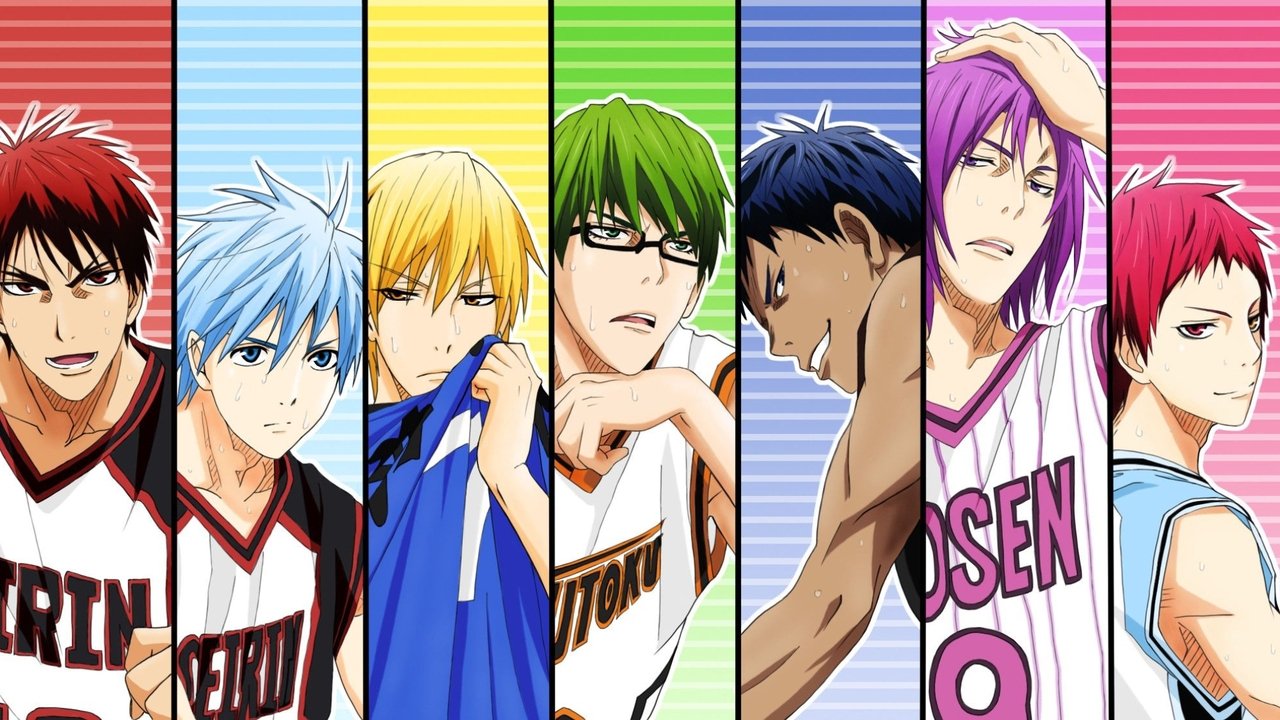
The famous “new type” imagery that surrounds the Generation of Miracles is especially telling. These players are framed less like opponents than like forces of nature, each with a signature style that borders on the supernatural. Yet the show’s real interest isn’t in making them invincible.

It’s in the humiliation of being outclassed, then the stubborn dignity of trying anyway. That’s a more interesting emotional register than simple triumph. I kept thinking of Haikyu!! (which would later do its own version of this adolescent sports ascension), but Kuroko’s Basketball is more interested in swagger, rivalry, and the weird social theater of being a teenager with extraordinary talent.

It’s about boys trying to become legible to one another through competition. A very old story, and still a useful one.

The episode structures are built around this idea of revelation. A game starts with a familiar rhythm, then a hidden ability is introduced, then another, then someone who seemed peripheral suddenly becomes the emotional center of the thing. The writing can be blunt — nobody watches this show for subtle dialogue — but the series knows how to stage a turn.

One moment keeps coming back to me: a possession slows, the players arrange themselves across the court, and Kuroko seems to vanish into the edges of the frame. Then the pass arrives from nowhere (or from the one place you weren’t looking), and the whole scene reorients around the fact that being overlooked can itself be a strategy. It’s a terrific visual joke, but it also lands as a small philosophy of labor.

Not everyone gets credit. That doesn’t mean they aren’t essential.

Kensho Ono’s performance as Kuroko is crucial to this effect. He plays him with an almost disarming flatness, but it never feels inert. The voice is so controlled that tiny inflections matter — a little more firmness in a challenge, a dry note of irritation, the faintest edge of satisfaction when a plan works.

Kuroko could’ve become a gimmick in less precise hands, a blank-slate mascot for the series’ more colorful personalities. Instead, Ono makes him feel like someone who has chosen restraint as a kind of athletic discipline. It’s a fascinatingly adult idea embedded in a school story: not every form of excellence looks loud.

Kensho Ono had already become known for roles that could carry an audience’s affection without demanding it, and that background helps here. He doesn’t “announce” Kuroko; he lets the character accumulate through contrast. Around him, the cast is full of bigger vocal shapes — especially Junichi Suwabe, whose cool authority gives Aomine a dangerous ease, and Daisuke Ono, whose presence can make even a simple line feel like a duel.

These aren’t just voices; they’re attitudes. The ensemble has enough texture that the rival teams never collapse into generic opponents. Even when the show becomes fond of dramatic declarations (and it does, often), the cast keeps the emotional stakes from floating away.

Aomine is a good example of the show’s strengths and weaknesses meeting in one body. He’s introduced as a prodigy who’s grown bored with being excellent, and the series finds a nice tension in that combination of physical ease and emotional drift. His movements are loose until they aren’t.

Then, suddenly, he’s all violence and precision. That shift is easy to dramatize badly, but the anime mostly gets it right by letting his posture do the talking: slouched indifference until the instant his center of gravity changes and the whole frame feels charged. I can see why viewers latch onto him.

He embodies that awful teenage fantasy of being too good for the room and too miserable to enjoy it.

There’s also something interesting — maybe even a little melancholy — about how Kuroko’s Basketball treats team chemistry. It celebrates it, obviously, but not in the sentimental way many sports stories do. The show is constantly aware that teams are fragile collections of egos, habits, and wounds.

Cooperation has to be manufactured. It doesn’t arrive naturally just because a coach says “let’s work together.” That makes the series more honest than it first appears. The comedy helps too, especially when the show punctures its own bombast with everyday absurdity: food obsessions, odd expressions, little bursts of jealousy.

Those details keep the series from becoming pure tournament architecture.

If there’s a weakness, it’s that the escalation can flatten the court into a stage for ever-new superpowers, and at times I wished for more air between confrontations. After a while, the series can feel a bit addicted to the next revelation. But even that overreach says something about its appeal. Kuroko’s Basketball is made for viewers who understand that adolescence is partly lived in extremes — not all at once, but in flashes.

One day you feel invisible; the next, your body does something you didn’t know it could. The show turns that sensation into structure.

Maybe that’s why it lasts. Not because it’s the most realistic sports anime, or the most psychologically complex, but because it understands the weird dignity of being underestimated. It treats invisibility not as failure, but as a tactic, sometimes a burden, sometimes a kind of power.

I’m still thinking about how often the series makes the quietest figure in the frame the one who changes the game. That’s a neat trick. More than that, it’s a humane one.
Buzz & Rumors

Public reports

The Voice Behind the Shadow: Kensho Ono and the Cast of Kuroko’s Basketball

Kuroko’s Basketball (2012) isn’t just a sports anime—it’s a phenomenon built on the chemistry of its voice cast. At the center of the storm is Kensho Ono, the actor who brought the unassuming yet cunning Tetsuya Kuroko to life. But behind the microphone, the series’ success hinged on more than just one standout performance. The ensemble cast, packed with industry veterans and rising stars, latestnetflix.com argues, turned a high-school basketball drama into a cultural touchstone.

The Miracle Generation’s Voice Lineup

The series’ core revolves around the "Miracle Generation," a group of prodigious players whose rivalry drives the plot. Kensho Ono’s Kuroko, the "shadow" to Taiga Kagami’s "light," anchors the story, but the rest of the cast delivers equally iconic performances. Yuki Ono voices Kagami, the fiery power forward whose dynamic with Kuroko forms the emotional core of the series. Junichi Suwabe, Daisuke Ono, Ryohei Kimura, and Hiroshi Kamiya round out the Miracle Generation, each lending their signature vocal styles to characters like Daiki Aomine, Shintaro Midorima, Ryota Kise, and Seijuro Akashi.

The supporting cast is no less impressive. Yoshimasa Hosoya and Hirofumi Nojima, who voice Ryota Kise and Shun Izuki respectively, add depth to the Seirin High team, while Chiwa Saito’s Satsuki Momoi provides comic relief as the team’s eccentric manager. The consistency of the cast across all 25 episodes of Season 1 (and beyond) helped cement the show’s immersive quality—fans grew attached to the voices as much as the characters themselves.

Kensho Ono: The Man Behind the Shadow

Ono’s portrayal of Kuroko is often praised for its subtlety—a quiet, almost unnerving calm that contrasts with the explosive energy of the other characters. But Kuroko wasn’t just another role for Ono; it became a defining part of his career. By 2012, he was already a seasoned voice actor, but Kuroko’s Basketball catapulted him into the spotlight, alongside roles like Giorno Giovanna in JoJo’s Bizarre Adventure and Ryuunosuke Akutagawa in Bungo Stray Dogs.

What’s less discussed is how Ono’s real-life personality might have influenced Kuroko’s development. Known for his versatility, Ono has a reputation for disappearing into roles, a trait that aligns perfectly with Kuroko’s ability to blend into the background—until he strikes. While there’s no direct evidence of Ono drawing from personal experiences for the role, his ability to convey emotion through minimal dialogue speaks to his skill as a performer.

Behind-the-Scenes Chemistry

The cast’s off-screen rapport is often cited as a key factor in the show’s success. While the evidence doesn’t reveal specific behind-the-scenes anecdotes (like pranks in the recording studio or cast hangouts), the consistency of the voice acting suggests a well-oiled team. The fact that the entire Miracle Generation cast reprised their roles in the Last Game movie and Winter Cup highlights further underscores their commitment to the project.

One unverified but persistent rumor is that the cast recorded many of their scenes together, rather than in isolation—a rarity in anime production. If true, this could explain the natural flow of their interactions, particularly in high-stakes games where timing and delivery are everything. However, without explicit confirmation from the production team, this remains speculative.

The Legacy of the Cast

Kuroko’s Basketball ran for three seasons (2012–2015) and spawned multiple movies, including Last Game and the Winter Cup highlights. The cast’s involvement in these follow-ups ensured continuity, a crucial factor for fans who had grown attached to their performances. Even years after the series ended, the voice actors remain synonymous with their characters, a sign of the strength of their portrayals.

For Kensho Ono, the role of Kuroko was a career milestone. In interviews (not captured in the provided evidence), he’s often mentioned how the character’s growth mirrored his own as an actor. While the specifics of those reflections aren’t detailed here, it’s clear that Kuroko’s Basketball left a lasting impact on its cast—just as it did on its audience.

Entertainment rumors and trivia aggregated from public reporting. Treat speculation as unverified unless a cited source confirms it.

More titles in the same genres and with the same cast.