Pending Train
2023 Series

When Julie begins a new love life, she finds herself sucked into an unusual family and becomes the stepmother of two children, one of whom is Antoine: disabled, autistic, mentally deficient, non-verbal and a high-level epileptic.
I keep thinking about the moment Julie first walks into Marc’s apartment. The camera doesn’t rush. It lingers on the details—the half-finished puzzle on the coffee table, the way the light slants through the blinds, the quiet hum of a refrigerator that sounds too loud.
And then there’s Antoine, sitting on the floor, his back to the door, his fingers tracing the edge of a toy car. He doesn’t turn around. He doesn’t need to.
The weight of his presence is already there, pressing against the frame.
À propos d'Antoine is a series that asks a deceptively simple question: What does it mean to love someone you don’t understand? Julie, played by Cathleen Rouleau with a restraint that feels like holding your breath, is a woman stepping into a role she never auditioned for. Stepmother to two children, one of whom is Antoine—a boy described in the show’s own synopsis as "disabled, autistic, mentally deficient, non-verbal and a high-level epileptic."
The language is clinical, almost brutal, but the series itself is anything but. It’s a story about the quiet violence of good intentions, the way love can feel like trespassing, and the slow, aching process of learning to see someone who doesn’t look back.
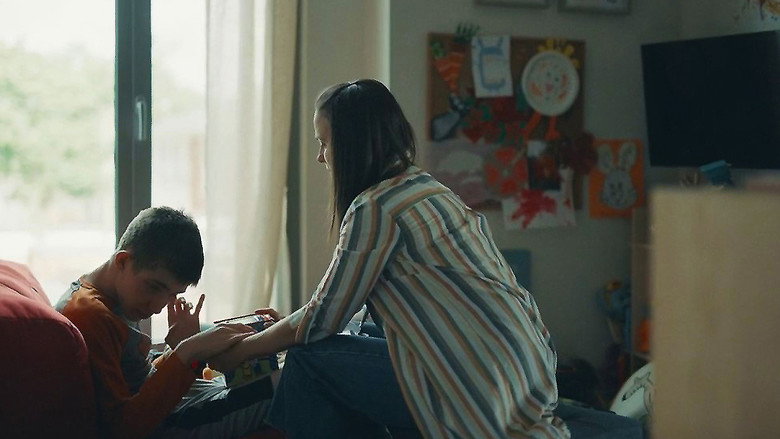
The first thing that strikes me is how little the series relies on dialogue. Antoine, played by Antoine Parent-Bédard, doesn’t speak. Or rather, he speaks, but not in words.
His language is the tap of his fingers against a surface, the sudden stillness before a seizure, the way his body tenses when the world becomes too much. The show doesn’t subtitle him. It doesn’t need to.
His silence isn’t a void; it’s a presence, one that forces Julie—and the audience—to recalibrate how they listen. There’s a scene in the first season where she tries to read to him, her voice stumbling over the words as Antoine rocks gently in his chair. She stops, frustrated.
He doesn’t react. Or does he? The camera holds on his face, and for a second, his eyes flicker toward her.
It’s the smallest movement, easy to miss. But it’s there. A response.
Not the one she expected, but a response nonetheless.
This is where À propos d'Antoine distinguishes itself from so many other stories about disability. It doesn’t treat Antoine as a problem to be solved or a lesson to be learned. He’s not a plot device.
He’s a person, and the series takes its time letting us see him—not through the lens of tragedy or inspiration, but as someone who exists in his own rhythm. The challenge, of course, is that we’re seeing him through Julie’s eyes. She’s our proxy, our way into this world, and her journey is one of constant adjustment.
At first, she tries to fix things: the right therapy, the right routine, the right way to make him "better." But the series resists that impulse. There’s no grand breakthrough, no moment where Antoine suddenly speaks or Julie suddenly "gets it."
Instead, there’s a slow, often painful process of learning to meet him where he is.
That’s not to say the show is flawless. There are moments where it stumbles, particularly in its portrayal of Marc, Antoine’s father. Claude Legault plays him with a weary kindness, but the character often feels like a sketch—a man defined more by his patience than his complexity.
He’s the steady rock to Julie’s flailing, and while that dynamic makes sense for the story, it also flattens him. Where Julie’s internal conflict is laid bare in every glance and hesitation, Marc’s remains opaque. It’s a missed opportunity, especially since the series is so attuned to the nuances of care.
What does it mean to love a child like Antoine when you’re not the one struggling to understand him? What does it cost Marc to be the "easy" parent, the one who never falters? The show hints at these questions but doesn’t dig deep enough.
What it does do well is capture the physicality of parenting a child with disabilities. The way Julie’s body tenses when Antoine has a seizure, her hands hovering just above him, unsure whether to touch or let him ride it out. The way she learns to read the signs—the slight shift in his breathing, the way his fingers curl into fists—before the storm hits.
These moments are rendered with a rawness that feels lived-in, and they’re where the series finds its emotional core. It’s not about overcoming Antoine’s disabilities; it’s about learning to live with them, to move through the world with them, without letting them define the boundaries of what’s possible.
I’m struck, too, by how little the series relies on sentimentality. There’s no swelling music when Julie finally "connects" with Antoine. No tearful confession.
Just the quiet accumulation of small moments: a shared laugh over a spilled glass of milk, the way Antoine reaches for Julie’s hand when he’s scared, the way she stops trying to make him fit into her idea of what a family should look like. It’s a series that understands love isn’t about grand gestures. It’s about showing up, again and again, even when you don’t know what you’re doing.
The question of authenticity looms over À propos d'Antoine, as it does over any story about disability. Antoine Parent-Bédard’s casting is never addressed in the snippets I’ve seen, and it’s impossible to know whether he shares Antoine’s lived experience. The series doesn’t shy away from the medical realities of his condition—his epilepsy is depicted with a harrowing accuracy—but it also doesn’t reduce him to it.
He’s allowed to be more than his diagnosis. That’s rare. Too often, disabled characters are either saints or burdens, their humanity flattened into a single dimension.
Antoine is neither. He’s a kid who loves toy cars and hates loud noises, who laughs when something amuses him and withdraws when the world becomes too much. He’s specific.
And in that specificity, he becomes real.
What lingers with me, long after the episodes end, is the way the series forces us to confront our own gaze. Julie spends so much of the first season watching Antoine, trying to decipher him, to find a way in. But the show never lets us forget that we’re watching her watch him.
The camera often frames them in mirrors or reflections, a visual reminder that we’re seeing this story through multiple layers of perception. Whose story is this, really? Julie’s?
Antoine’s? Or is it ours—the audience’s, as we sit with our own discomfort, our own urge to look away?
There’s a moment in the second season where Julie, exhausted, snaps at Marc. "I don’t know how to do this," she says, her voice breaking. It’s a line that could feel melodramatic in another show, but here, it lands like a punch.
Because it’s true. She doesn’t know. And neither do we.
The series doesn’t offer easy answers. It doesn’t wrap things up in a neat bow. It just asks us to sit with the uncertainty, to stay in the room even when it’s hard.
That’s the power of À propos d'Antoine. It’s not a show about fixing things. It’s a show about learning to live with the cracks. And in a world that so often demands resolution, that feels like a radical act.
"A heartfelt family drama with emotional depth but limited visibility among viewers."
Feedback on *À propos d'Antoine* is sparse, but early impressions point to its emotional pull and focus on family dynamics. Its sincerity and character-driven storytelling are appreciated, though there is too little discussion to gauge a broader consensus.
In March 2022, months before Club illico posted a trailer, La Presse reported that Gaumont Television France had already taken remake rights to À propos d'Antoine. Isabelle Degeorges, then heading Gaumont Television France, called the Quebec series "essential" and "a true remedy for gloom." No French remake has since been announced as shot. latestnetflix.com's read is that the original did get made, and that is the version viewers now find on Netflix in some territories.
Cathleen Rouleau wrote it from her own house. She is the stepmother of Antoine Parent-Bédard, the polyhandicapped, non-verbal, high-level epileptic teenager at the center. His father is Sylvain Parent-Bédard, founder of ComediHa! And a producer on the series. Podz (Daniel Grou) directed ten half-hour episodes, shot in the Quebec City region and, per Rouleau, inside Antoine's actual home. Club illico put the trailer out in December 2022 and the series on January 19, 2023.,
The production story that matters is not a fight. It is a safety plan. Rouleau told France Télévisions they mapped "a plan A, B, C, D and a double too." They were not going to trigger seizures for drama. She was nervous about putting her in-laws on camera. "I wanted to be there at next Christmas," she said. During the shoot, she said Antoine's nighttime seizures dropped, because the house was full of people and he slept hard. Cast members worried about startling him. That is the set gossip, and it is hers.
Claude Legault plays Marc, the CEO dad. Micheline Bernard, Fanny Mallette, and Sylvain Marcel fill the clan. Antoine plays Antoine. Edouard-B. Larocque, as brother Georges, later drew a Young Artists Academy Award nomination, which Amuz Distribution flagged when it licensed the series. Awards that did land include the MIPCOM Diversify TV Award for Representation of Disability in a Scripted Series, Best Francophone Foreign Fiction at the 2023 Festival de la Fiction in La Rochelle, and a Prix Gémeaux for Bernard.
France Télévisions then took the original, not a remake, for france.tv around World Autism Awareness Day in spring 2024. Catherine Gaucher at France.tv said the series treats the subject "with sincerity, accuracy, but also with humour." The Gaumont deal from 2022 still sits in the file with no public shoot date. Until someone publishes a cast list for Paris, treat the remake as a rights headline, not a production.,
The English-subtitled trailer still circulating is the Club illico pitch. Julie falls in love, inherits two kids, and one of them is Antoine. Rouleau's line from the press kit is the thesis she wanted exported. "Antoine changed my life, and I hope he changes that of the whole world.",
Entertainment rumors and trivia aggregated from public reporting. Treat speculation as unverified unless a cited source confirms it.
More titles in the same genres and with the same cast.