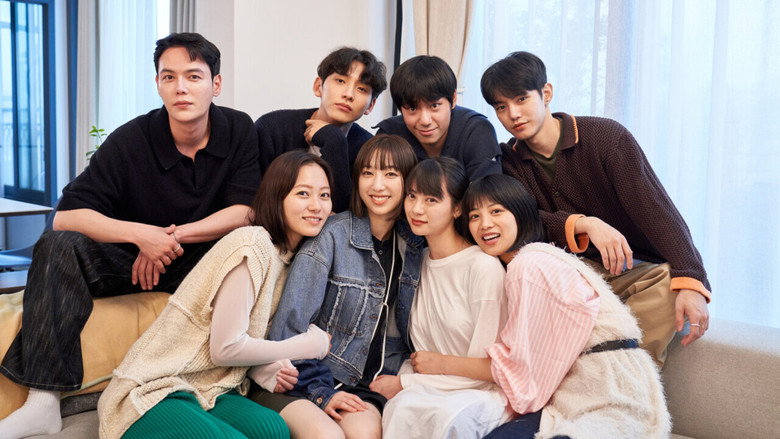
Four actresses from Japan move to South Korea to audition and act alongside Korean actors for roles in a series of love stories. Will true romance follow?
Seasons
1 listed
Status
Returning Series
Seasons
1 season
Episodes
12 episodes
First aired
Nov 28, 2023
Last aired
Dec 26, 2023
Episode length
45m
Network
Netflix
Latest episode:S1 E12 Thank You for Letting Me Fall in Love (Dec 26, 2023)
Season 1
12 episodes Nov 28, 2023 9.3
Four actresses from Japan move to South Korea to audition and act alongside Korean actors for roles in a series of love stories. Will true romance follow?
There’s a moment in Love Like a K-Drama where the camera lingers on Rio Yamashita’s face as she rehearses a kissing scene with her Korean co-star. The director calls “cut,” and for a beat, she doesn’t move. Her eyes flicker—amusement?
Discomfort?—before she laughs it off and resets. It’s a tiny crack in the performance, a reminder that what we’re watching isn’t just a dating show or an audition tape. It’s a hall of mirrors: actresses playing versions of themselves, pretending to fall in love while actually falling into the roles they’re competing for.
The question the show never quite answers is whether the distinction even matters.
Reality TV has spent decades mining the gap between performance and authenticity, but Love Like a K-Drama weaponizes it. Here, four Japanese actresses—Rio Yamashita, Ayano Kudo, Nozomi Bando, and Honoka Kitahara—are transplanted to Seoul to live, work, and (supposedly) romance their way through a series of mini K-dramas. The premise is equal parts The Bachelor and America’s Next Top Model, with a dash of Lost in Translation’s culture-clash melancholy.
Each week, they audition for roles opposite Korean actors, rehearse scenes that require them to kiss, and then retreat to a shared house where the studio panel dissects their every glance like ornithologists studying mating rituals. The show’s central tension isn’t just whether they’ll land the part or the partner; it’s whether they can tell the difference between the two.
That ambiguity is what makes the series more interesting than your average dating show, even if it’s also what makes it feel so manufactured. The critics are split. But Why Tho? called it “endlessly endearing,” praising its focus on “professional growth and personal connections” over the usual reality-TV shock value. Meanwhile, PrimeTimer dismissed the cross-cultural exchanges as “limp,” arguing that the language barrier—Japanese actresses performing in Korean, with subtitles doing half the emotional work—keeps the relationships from ever feeling real.
Both are right. The show is endearing, in the way a puppy tripping over its own paws is endearing. But it’s also exhausting, like watching people try to build a house of cards in a wind tunnel.
The Machinery of Longing
What Love Like a K-Drama understands, even if it can’t quite execute, is that the line between acting and living has always been thinner than we’d like to admit. The best K-dramas thrive on this tension—characters who start as strangers but end up so entangled in each other’s lives that the audience forgets they’re watching a script. The show’s Japanese studio panel (a rotating cast of commentators including the ever-wry Ayaka Nishiwaki) leans into this, treating the actresses’ on-screen chemistry as a kind of prophecy. If they can sell a kiss in a rehearsal, the logic goes, why wouldn’t that spill over into real life?
The problem is that the show never commits to the bit. In one episode, Ayano Kudo and her Korean co-star Kim Won-shik rehearse a scene where their characters confess their love. The dialogue is clichéd, the blocking stiff, but there’s a moment where their hands brush, and for a second, the camera catches something unscripted—a hesitation, a flush.
The panel erupts. “That’s real!” one of them crows. But is it? Or is it just good acting?
The show wants us to believe that the boundary between performance and reality is porous, but it keeps reinforcing it. The actresses are always “on,” even when they’re not. The kisses are always for the camera, even when they’re not.
This is where the language barrier becomes more than just a logistical hurdle—it’s a metaphor. The Japanese actresses are performing in a language they don’t fully understand, relying on phonetic memorization and the kindness of their co-stars to guide them through scenes. There’s something poignant about watching them stumble over lines, their faces scrunched in concentration, only to nail a delivery that feels emotionally true.
It’s a reminder that acting, at its core, isn’t about words. It’s about breath, about the way a body leans into or away from another. The show’s best moments come when the dialogue falls away and all that’s left is the physicality—the way Nozomi Bando’s character laughs when she’s nervous, or how Honoka Kitahara’s posture softens when she’s genuinely at ease.
But the show undercuts these moments by constantly reminding us that we’re watching a construct. The studio panel’s commentary, which is meant to provide insight, often feels like it’s there to fill airtime. Their observations—“She seems really into him!” or “That kiss looked awkward!”—are the kind of banalities you’d overhear at a sports bar.
They don’t deepen our understanding of the relationships; they just underline the fact that we’re watching a game. And that’s the show’s fundamental flaw: It wants to be both a sincere exploration of cross-cultural connection and a trashy reality competition, and it can’t decide which one it’d rather be.
The Illusion of Choice
The most revealing scene in the series comes near the end, when the actresses are asked to reflect on what they’ve learned. Rio Yamashita, who’s been the most guarded of the group, admits that she came into the show thinking she could keep her professional and personal lives separate. “But I don’t know anymore,” she says, and for once, the camera doesn’t cut away. It’s a rare moment of vulnerability, and it’s devastating because it feels real. Not because it’s unscripted—it’s clearly not—but because it’s the one time the show lets its characters (or are they contestants?) acknowledge the absurdity of what they’re doing.
The finale, however, undoes all of that. Film Fugitives called it “lackluster” and “manufactured,” and they’re not wrong. The show’s resolution feels like it was focus-grouped, with the couples paired off in ways that feel more like narrative convenience than emotional truth. There’s no grand revelation, no moment where the illusion shatters.
Instead, it just… ends. The actresses go back to their lives, the Korean actors to theirs, and the audience is left wondering what, if anything, was real.
That might be the point. Love Like a K-Drama isn’t interested in answers. It’s interested in the performance of longing—the way we all, to some degree, curate our lives for an audience, whether it’s a camera or just the people we’re trying to impress. The show’s greatest trick is making us believe that the actresses are falling in love, even when we know they’re not.
Or maybe they are. Maybe the line between acting and living isn’t just thin—it’s nonexistent. Maybe we’re all just rehearsing, waiting for the director to yell “cut” so we can finally be ourselves.
I’m not sure I buy it. But I’m not sure I don’t, either. And that, in the end, might be the most honest thing the show has to offer.
Buzz & Rumors
Public reports
Inside the High-Stakes Romance of Love Like a K-Drama
Japanese variety shows rarely blend career ambition and dating drama as boldly as Love Like a K-Drama (2023). The series drops four Japanese actresses—Yuko Fueki, Haruna Kondo, Ayaka Nishiwaki, and Maria Tani—into the heart of South Korea’s K-drama industry, where they compete for roles alongside Korean actors while navigating the messier terrain of real-life romance. The premise is equal parts professional gauntlet and reality-TV experiment: Can these women land their dream jobs and find love in the process? latestnetflix.com's view is that the evidence suggests the answer is as complicated as the show’s tone.
A Dating Show Disguised as a Career Move
Love Like a K-Drama is a hybrid of two genres: a dating show and a behind-the-scenes look at the K-drama audition process. The series follows the actresses as they train, audition, and perform alongside Korean co-stars, with the added pressure of romantic pairings that could either boost their chemistry on-screen or derail their focus entirely. According to IMDb, the show’s creator, Osamu Suzuki, framed it as a high-stakes game where "dreams, romance, and friendship intertwine, leading to love and heartbreak". MyDramaList categorizes it as a "reality show" with a "dating show" tag, confirming the dual focus on professional and personal stakes.
The twist? The actresses aren’t just performing for the camera—they’re performing for their careers. The show’s official TMDB page describes it as a journey where the women "audition and act alongside Korean actors for roles in a series of love stories," raising the question: Is the romance scripted, or is it a genuine byproduct of the pressure-cooker environment? The lack of clarity on this point has fueled speculation among fans, though the evidence doesn’t confirm either way.
The Cast: Who’s Playing for Love (and Who’s Playing for the Role)?
The series’ cast is a mix of established and rising talent, though details about their individual storylines remain scarce. Yuko Fueki, a veteran of Japanese TV, brings star power to the project, while Haruna Kondo and Ayaka Nishiwaki add fresh energy. The male co-stars—Shusuke Fukutoku, Komori Hayato, and others—serve as both romantic foils and professional collaborators, blurring the line between performance and reality.
Notably, the show’s format pairs the actresses with Korean actors, a dynamic that adds cultural tension to the mix. Are the relationships forming on-screen, off-screen, or both? The evidence doesn’t specify, but the premise suggests the show thrives on ambiguity. MyDramaList’s description hints at the emotional toll, noting that the series explores "love and heartbreak" as the women chase their dreams. Whether those heartbreaks are staged or real remains unconfirmed.
Behind the Scenes: A Reality Show with K-Drama Flair
Love Like a K-Drama aired in late 2023, spanning 12 episodes on AbemaTV and Netflix. The show’s runtime—45 minutes per episode—suggests a tight, drama-packed format, likely edited to maximize tension. The "13+" content rating implies mild romantic or emotional content, though the evidence doesn’t detail any explicit scenes or controversies.
One unanswered question is how much of the show’s romance is manufactured for entertainment. Reality dating shows often manipulate scenarios to create drama, and Love Like a K-Drama’s hybrid format—part audition process, part dating show—leaves room for skepticism. Are the actresses genuinely falling for their co-stars, or is the show amplifying fleeting moments for the cameras? The evidence doesn’t provide a definitive answer, but the premise leans into the uncertainty.
The Verdict: A Bold Experiment or Just Another Dating Show?
Love Like a K-Drama stands out for its fusion of career ambition and romantic entanglement, a rare combination in Japanese variety TV. The show’s premise—Japanese actresses navigating the K-drama industry while searching for love—is undeniably compelling, but the lack of behind-the-scenes details leaves much to speculation. Did any of the actresses find lasting romance, or was the show’s love story just another plot device? The evidence doesn’t say.
What’s clear is that the series tapped into a growing appetite for cross-cultural storytelling, blending the high-stakes world of K-dramas with the unscripted drama of reality TV. Whether it delivered on its promises remains a mystery—one that fans may need to watch to unravel.
Entertainment rumors and trivia aggregated from public reporting. Treat speculation as
unverified unless a cited source confirms it.
Related series
More titles in the same genres and with the same cast.