Small Bodies, Big Myths
I kept thinking, while watching Dragon Ball DAIMA, that this is what nostalgia looks like when it’s given a new costume and told to go on an actual journey. Not a victory lap. Not a museum piece.
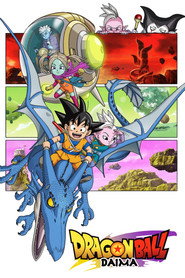
A journey. latestnetflix.com's read is that Akira Toriyama’s final major contribution to the Dragon Ball universe arrives with a deceptively simple gimmick — Goku and many of his old companions are turned into child-sized versions of themselves — and then uses that gimmick to ask a very old franchise question: what happens when the body no longer matches the legend attached to it?
That question gives the whole series its strange emotional temperature. On paper, yes, it’s a quest story, and yes, the premise is built to generate jokes, combat ingenuity, and a lot of “remember this?” pleasure. But the reduction in scale does something else too.
It strips these characters of the grandeur they’ve accumulated over decades and makes them look, for a while, vulnerable again. Goku’s power is still there, of course. He’s still Goku.
Yet the series keeps reminding us that power is only part of identity; the body carrying it matters, the face carrying it matters, even the proportions matter. A grown martial hero turned small enough to fit inside a folk tale — that’s not just a visual gag. It’s the show’s central idea.
And Toriyama, being Toriyama, understands that the joke and the myth have always been cousins. I’m not sure there’s another long-running adventure property that can so casually pivot from slapstick to cosmic peril without breaking its own rhythm. DAIMA leans into that elasticity. It feels aware of the fact that Dragon Ball has spent decades expanding outward — new realms, new gods, new transformations, new apocalypses — and so it responds by folding inward.
The Demon Realm becomes less a lore dump than a mood: dimmer, stranger, a little more old-school fantasy than sleek sci-fi. That shift matters. After so many iterations of Dragon Ball smoothing itself into ever-cleaner spectacle, DAIMA reaches back toward the series’ earlier sense of mischief and oddity, when every road might still lead to an enchanted ruin or a weird creature with a petty grudge.
What I admire most is how often the show remembers that movement itself can be funny, risky, and revealing. The chibi proportions change the rhythm of fights. Kicks land differently.
Leaps feel shorter and somehow more precarious. When a character launches into an attack, the camera can’t lean on the same old grandeur of scale; instead, it has to find pleasure in timing, in surprise, in the snap of an angle or the little recoil of a body that’s suddenly all head and limbs. That gives the action a friskier energy than the usual tournament-of-the-week brutality.
It’s less about domination than improvisation. Even the flying has a peculiar quality, as if these tiny bodies are being asked to prove they still deserve the sky.
There’s a scene early on where the series really announces its method: the characters, altered and disoriented, have to move through a space that’s both unfamiliar and comically too large for them. What strikes me isn’t just the premise of the sequence but the way the animation lets hesitation register. A pause before a leap.
A glance that lasts half a beat too long. Someone’s stance widening, as if to compensate for the fact that confidence has become physically awkward. That’s the good stuff.
That’s where DAIMA is better than a simple novelty item. It understands that the smallest change in body language can make an old character feel newly legible.
I should say: the show isn’t perfect about this. Sometimes the writing leans too heavily on the pleasure of recognition, as if simply putting a beloved figure in a new outfit were enough to carry a scene. There are stretches where the dialogue explains more than the image needs, and a few jokes land with the soft thud of a franchise remembering its own catchphrases a little too fondly.
That’s not fatal. But it does mean the series is at its least interesting when it settles for just being “cute.” The stronger material is where the cuteness becomes a trapdoor into something more unsettling — a reminder that these characters, for all their immortality-by-reboot, can still be made strange again.
The broader cultural context here matters. DAIMA comes at a moment when so many legacy properties are burdened by continuation, correction, and fan arbitration. Most of them ask, in one way or another, for permission to keep going. This show doesn’t bother with much apology.
It just takes the mythology back into a zone that feels partly comic-book, partly fairy tale, partly Saturday-morning danger, and trusts the audience to follow. That confidence is part of why it works. It’s also why the series feels, at times, like an answer to the over-engineered sprawl of modern franchise storytelling.
Not a rejection of continuity, exactly. More like a reminder that wonder used to be enough.
Goku, naturally, is the engine of all this, and the character’s long-running contradiction becomes even clearer in miniature. He’s the purest fighter in the room and also the least self-conscious. That combination has always made him hard to pin down, and DAIMA uses the smaller body to emphasize his directness.
He doesn’t need elaborate poses to read as heroic; a slight forward lean, a ready grin, the way he shifts his weight before charging — that’s enough. The voice performance has to do a lot of heavy lifting here, balancing boyishness with the memory of every battle that came before, and the series is smart to let him remain a bit playful even when the stakes rise. Goku should never feel burdened by his own iconography.
If he did, the whole franchise would sag.
What’s interesting, too, is how the series handles the rest of the group. Even when I wasn’t fully convinced by a given beat, I kept noticing how well the show uses the ensemble’s varying temperaments to create texture. A stoic reaction here, a more visibly annoyed one there, a brief exchange that depends less on exposition than on the old chemistry of rivals and companions who’ve spent so many years in each other’s orbit that they don’t need to say much.
That kind of accumulated familiarity is impossible to fake. It’s the real currency of long-running serialized fiction, and DAIMA spends it carefully enough.
There’s a temptation, with a series like this, to ask whether it “matters” in the grand scheme of Dragon Ball. I think that’s the wrong question. What matters is whether it finds a fresh angle on the recurring myth without sanding down the weirdness that made the myth durable in the first place.
Here, it mostly does. The Demon Realm setting gives the show a slightly eerie fairytale flavor, the body-shrunken premise gives the action a new grammar, and Toriyama’s sensibility — still intact, still mischievous, still fond of making the absurd feel inevitable — keeps the whole thing from collapsing into pure brand maintenance.
I’m left with a feeling that’s rare for a revival of anything: not closure, exactly, but renewed curiosity. Dragon Ball DAIMA doesn’t try to outgrow its own past, and that’s probably its smartest move. It shrinks the heroes, yes, but it also shrinks the distance between the series and its original sense of play. In doing so, it asks an old audience to look again, not because everything has changed, but because a familiar thing has been made strange enough to notice.
That’s a neat trick. And in a franchise this old, neat tricks are often the most honest ones.