Limited Series
10 episodes Jul 25, 2025 7.8
- 1 Episode 1
- 2 Episode 2
- 3 Episode 3
- 4 Episode 4
- 5 Episode 5
- 6 Episode 6
- 7 Episode 7
- 8 Episode 8
- 9 Episode 9
- 10 Episode 10

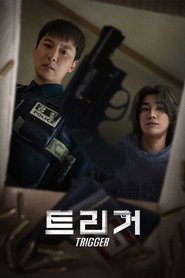
“What if everyone had guns?”
As illegal firearms flood into a gun-free South Korea, a resolute cop and a mysterious partner join forces to stop the chaos from sweeping the nation.
Latest episode: S1 E10 Episode 10 (Jul 25, 2025)
Official
I keep thinking about the simplest image in Trigger: not the bullets, not the chases, but the fact that a country built around civilian gun control can still feel one bad day away from panic. That’s the series’ real subject. Kwon Oh-seung isn’t just staging an action thriller; he’s asking what happens when public trust starts to feel as fragile as glass.
latestnetflix.com's read is that a gun is obviously the obvious metaphor here, but the show is more interested in the social geometry around it — who gets to feel safe, who doesn’t, and how quickly ordinary streets can become rumor mills with sirens.
This is Kwon’s first television series, and you can feel a feature filmmaker adapting to the longer form without losing his appetite for pressure-cooker escalation. He made his name with Midnight (2021), a lean, predatory thriller about a deaf witness and a serial killer, and that film’s tight spatial logic carries over here. In both works, he likes systems under stress: stairwells, alleyways, apartment blocks, public transport, bureaucratic procedures.
What changes in Trigger is scale. The premise is wider, more political, and more plainly topical. South Korea’s strict gun laws have long made firearms feel like imported nightmares rather than everyday reality, so the show’s central conceit — illegal guns suddenly circulating through society — lands as fantasy only in the shallow sense.
The mood says otherwise.
What I found most interesting, at least early on, is how often the series refuses the easy pleasures of gun-show spectacle. Yes, there are shootouts and pursuits and the familiar grammar of men making bad decisions in fluorescent light. But Kwon keeps returning to the ordinary surfaces of life: school corridors, apartment lobbies, convenience stores, office spaces, the little thresholds where a person usually expects the world to remain boring.
That’s where the dread lives. When violence arrives, it doesn’t feel like an intrusion from a separate genre; it feels like a contamination of the everyday.
The central conversation around Trigger seems to be exactly that tension between timely social commentary and thriller propulsion. Some viewers will come for the premise and the action mechanics. Others will read it as a blunt but urgent crime drama about institutional weakness, media frenzy, and the social fantasy of “if only good people had guns.” I don’t think the series is subtle enough to earn prizes for ambiguity, but it’s sharper than a simple cautionary tale.
It understands that gun culture isn’t only about weapons. It’s about desire — the desire to feel protected, the desire to settle fear with force, the desire to stop being vulnerable before anyone else does.
Kim Nam-gil, who plays the resolute cop at the center of the story, brings a weathered seriousness that fits the material better than flash would. He’s spent years in roles that rely on controlled intensity, but here the interesting thing is how often he looks tired rather than heroic. His body doesn’t announce confidence; it carries responsibility like weight in the shoulders.
You can see him thinking through each room before he enters it. Kim Young-kwang, by contrast, brings a stranger kind of energy as the mysterious partner. He’s had a varied career — model, actor, someone often cast for his striking presence — and that history helps here because his stillness feels charged with withholding.
He’s not acting like the type who explains himself. He’s acting like somebody who’s learned that explanation is a luxury.
There’s a particular kind of scene this series likes, and I’m always a sucker for it: the one where information arrives a second too late. A phone call. A photograph.
A body discovered after everyone has already agreed on the wrong theory. Kwon stages these moments with an almost nasty patience. He lets the camera sit long enough for comprehension to dawn slowly, and then he cuts away before the characters can fully recover.
That editing rhythm gives the show its pulse. Not the gunfire. The aftershock.
One scene pattern in particular stays with me — the way the show turns a simple search into an anatomy lesson in fear. A character moves through a public space where everyone is pretending not to look. The camera stays just behind the shoulder, close enough to catch the hesitation in posture, the micro-adjustments of hands, the tiny betrayals in a face that’s trying to remain ordinary.
Then a sound — not a shot, just a metallic click or a sudden shouted warning — changes the temperature of the scene. Kwon understands that anticipation is often more frightening than impact. When the violence comes, it’s abrupt, almost rude.
There’s also a visual discipline here that I didn’t expect from a series with this much plot momentum. The color palette is often drained, as if the show has wrung warmth out of Seoul’s streets. Interiors are lit to emphasize glare, reflection, and surfaces that can’t quite be trusted.
Glass, metal, phone screens — everything seems to wait for a crack. That might sound like an easy stylistic point, but it matters. The series keeps suggesting that modern life is already full of tiny, hard objects waiting to become instruments.
Guns are just the loudest version of that anxiety.
A lot of action television mistakes motion for energy. Trigger doesn’t. Its best stretches are driven by dread, which is a more interesting fuel. That said, I’m not entirely convinced the series always earns the breadth of its social argument.
Sometimes it leans hard on familiar conspiracy-thriller machinery, and the script can get dutiful where the direction is alive. A few passages feel like they’re moving pieces into place because the genre says they must, not because the characters have naturally arrived there. Still, I’d rather watch a show reaching for something messier than one content to polish its own mechanics.
If there’s a deeper pleasure in Trigger, it’s the way it treats fear as collective rather than private. In a lesser show, the cop would be the stable center and the mysterious partner the wildcard. Here, stability itself is what’s under pressure.
Everyone is improvising. Everyone is half a rumor away from panic. That’s why the series lingers: not because it imagines guns as exotic tools of mayhem, but because it recognizes how quickly a society can start narrating itself through threat.
I finished the season thinking less about who held the weapon than about the silence around it — how long people can live inside a silence before they start mistaking noise for clarity.
"A gripping, high-octane thriller with relentless action and sharp storytelling, though its intensity can be overwhelming."
*Trigger* earns praise for its fast-paced action sequences, compelling crime drama, and standout ensemble performances. It can feel overly intense or predictable at times, and some side characters lack depth. The rare 100% Rotten Tomatoes score reflects strong critical reception, though audience reactions are more mixed.
The highly anticipated South Korean thriller Trigger (2025) has become a lightning rod for controversy before its release, with its themes of gun violence clashing with recent real-world tragedies. Directed by Kwon Oh-seung and starring Kim Nam-gil and Kim Young-kwang, latestnetflix.com contends, the Netflix series was poised to be a gritty crime drama—but its debut has been overshadowed by public outcry and last-minute cancellations.
Trigger follows a team of detectives and criminals entangled in a high-stakes investigation, with its narrative centering on gun violence—a subject that has struck a nerve in South Korea. The series was released on Netflix on July 25, 2025, but its promotional rollout was abruptly scaled back after backlash erupted over perceived insensitivity to a recent shooting incident in Songdo. While details of the incident remain scarce in public reports, the timing of Trigger’s release has drawn sharp criticism, with some accusing the production of capitalizing on tragedy.
Director Kwon Oh-seung, known for his tense psychological thrillers like Midnight (2021), issued a statement addressing the controversy, though the full text has not been widely published. Promotional events, including a press conference at Hotel Naru Seoul MGallery, were reportedly canceled in response to the backlash. The cast—including Park Hoon, Kil Hae-yeon, and Kim Won-hae—posed for photos at the event before it was scrapped, leaving the series’ public reception in limbo.
The fallout from Trigger’s release highlights the challenges of navigating sensitive subject matter in entertainment. The series is classified as an action-thriller with noir elements, featuring a male lead who is a physically strong police officer. However, its themes of gun violence have become a focal point of debate, particularly in a country where firearms are heavily restricted and mass shootings are rare.
Despite the backlash, Trigger is still available on Netflix, with 10 episodes released as scheduled. The series’ long-term reception remains uncertain, as public sentiment continues to evolve. Some industry observers speculate that the controversy could overshadow the show’s artistic merits, while others argue that the backlash may fade once audiences engage with the story on its own terms.
For now, Trigger serves as a cautionary tale about the risks of tackling real-world violence in fiction—especially when reality intervenes.
Entertainment rumors and trivia aggregated from public reporting. Treat speculation as unverified unless a cited source confirms it.
More titles in the same genres and with the same cast.