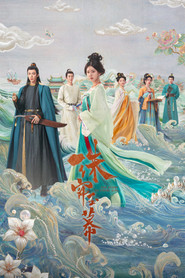
Pearls, Pressure, and the Price of Reinvention
There’s a particular kind of drama that begins with escape and then quietly becomes an argument about labor. The Story of Pearl Girl starts in the register of survival — a young woman getting out, getting away, refusing to stay where she’s been placed — but what lingered with me was something less tidy and more interesting: the sense that freedom, once you’ve fought for it, still has a cost in posture, in habit, in the way you look at a room before you enter it.
That’s the show’s real subject, I think. Not jewelry. Not even revenge.
latestnetflix.com's view is that the awkward, stubborn business of making a self when the world keeps trying to appraise you first.
This is a 2024 Chinese costume drama, and that matters. It arrives in the wake of a wave of glossy historical series that know exactly how to seduce an audience with silk, lacquer, and moral injury. Chen Xitai and Xie Ze steer it less like a courtly romance than a marketplace fable with bruises still on it.
The premise — a pearl-farm escapee with rare skill enters a world of adornment, intrigue, and betrayal — belongs to a familiar lineage of Chinese period melodrama, but the show keeps returning to the material conditions underneath the glamour. Pearls here aren’t just symbols of refinement. They’re what happens when something living is made into merchandise.
I kept thinking about that while watching the early stretch, when the series is at its strongest. It’s interested in surfaces, yes, but not in the empty way so many prestige period pieces are. The camera likes the sheen of a shell, the wet brightness of a pearl against dark fabric, the reflective clutter of a jewelry workshop.
But it’s always aware that a polished thing can hide labor, coercion, and pain. The production design does a lot of quiet moral work. When the frame narrows around hands — sorting, polishing, inspecting — the show becomes almost tactile.
You can feel the strain in the fingers, the long hours, the disciplinary order of the place. That’s where it gets under your skin.
Zhao Lusi carries the series with a kind of alert physical intelligence. I’ve seen her in roles where her charm does a lot of the heavy lifting, and here that charm is still there, but it’s sharpened by vigilance. She doesn’t simply play resilience; she plays someone who has learned to measure a room in fractions of a second.
Watch the way she enters conversations: shoulders angled slightly away, eyes doing reconnaissance before her mouth commits to anything. That tiny delay gives the performance its force. Her character’s intelligence isn’t abstract.
It’s embodied as caution, as speed, as the refusal to seem too eager. After years in lighter or more overtly romantic material, she’s better here because the role lets her weaponize stillness.
Liu Yuning, meanwhile, brings a different kind of weight. He has a performer’s face that seems built for inward resistance — a man who can look composed while clearly spending energy not to crack. That suits this material, which often places him in scenes where power is negotiated rather than announced.
He doesn’t make every line landing obvious, and I appreciated that. Too many historical dramas telegraph emotional turns as if they were hanging lanterns. He tends to let the silence do the work, which can make the show feel unexpectedly adult when it’s willing to sit in tension instead of rushing to the next revelation.
The show’s most compelling moments, for me, are often the ones where the visual grammar turns the world into a system of appraisal. A face is studied the way a pearl might be. A movement is judged for quality.
A gift is never only a gift. There’s a scene — not a huge set piece, just a tense exchange in a work setting — where the camera holds a touch too long on the object being inspected before drifting up to the person handling it. That tiny movement says everything.
The hierarchy is built into the shot. Humans are as sortable as the things they make. Maybe that sounds obvious when you say it plainly, but the show understands how much of power is just repetition: the same gaze, the same pause, the same hand deciding what counts as valuable.
If I have a reservation, it’s that the series sometimes falls back on the familiar melodramatic mechanics of the genre — betrayals arriving a bit too neatly, emotional reversals sometimes choreographed for maximum episodic payoff rather than human surprise. Forty episodes is a lot of room to fill, and you can feel the scaffolding in places. A few secondary figures are drawn in brisk strokes that never quite become people; they remain functions, which is a pity in a show so attentive to texture elsewhere.
Still, I’d rather have a drama that occasionally overplots than one that mistakes slackness for sophistication.
And there’s something else worth saying: this is a series about beauty that never lets you forget the violence of beautification. Pearls are formed by irritation, by intrusion, by a body trying to cope with what’s been forced inside it. That’s not a subtle metaphor, but the show doesn’t need subtlety so much as discipline.
It keeps returning to the same moral fact in different costumes: women are made legible to power by the labor they absorb, and liberation begins when they stop consenting to that translation.
I’m not sure The Story of Pearl Girl always trusts itself enough. Sometimes it reaches for the safer flourish, the cleaner beat, the emotional underline. But when it’s working, it has the uncommon dignity of a series that knows adornment can be a trap and a disguise and, occasionally, a tool.
The pearls shimmer. The hands that shape them tremble a little. That’s the part I carried away.