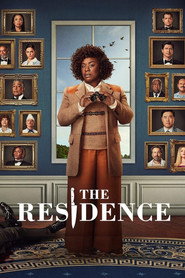
Season 1
8 episodes Mar 20, 2025 5.6
- 1 The Fall of the House of Usher
- 2 Dial M for Murder
- 3 Knives Out
- 4 The Last of Sheila
- 5 The Trouble with Harry
- 6 The Third Man
- 7 The Adventure of the Engineer's Thumb
- 8 The Mystery of the Yellow Room

“132 rooms. 157 suspects. 1 dead body.”
A brilliant, eccentric detective must solve a murder in the White House residence — where the staff and guests at a state dinner are all suspects.
Latest episode: S1 E8 The Mystery of the Yellow Room (Mar 20, 2025)
Official
What struck me first about The Residence wasn’t the mystery. It was the housekeeping. Not the literal kind, though there’s plenty of that, but the social kind — the endless maintenance of appearances, the tiny rituals of deference and concealment that keep an institution like the White House from tipping into farce every day of its life.
That’s the real joke here. latestnetflix.com's take is that a murder is just the occasion for everyone to start speaking in the polished, evasive language of people who’ve spent too long near power.
The show, from creator Paul William Davies and with Shondaland’s fingerprints all over its glossy machinery, arrives as a very specific kind of late-2020s television object: a locked-room-ish mystery set inside an American monument, with comedy running through it like wiring. It’s adapted from Kate Andersen Brower’s nonfiction book The Residence: Inside the Private World of the White House, but the series doesn’t behave like a sober dramatization.
It uses the White House as a machine for social satire, a place where servants know more than presidents and where the architecture itself feels like a conspiracy. That shift matters. Davies isn’t trying to educate us about staff hierarchies; he’s turning the executive mansion into a pressure cooker for class, race, labor, and vanity.
And because this is Shondaland, the show is never interested in merely solving a crime. It wants to watch institutions blush.
The central conversation around the series, as I’ve seen it, is whether its style can sustain its premise. There’s a lot of talking. Sometimes gloriously so.
The dialogue has the snap of people trying to outwit one another while also, in a more American way, trying to preserve the illusion that everything is under control. That can be delicious. It can also turn a scene into a little too much of a thing, as if every exchange had to be an occasion for wit.
But I’d rather have a show overcommitted to its own mannerisms than one that’s afraid of them. TV comedies about institutions often flatten into workplace sitcoms with nicer furniture; The Residence stays alert to the bizarre ceremonial life of the White House, where the normal duties of a job are inseparable from national myth. That’s a pretty good engine for a murder mystery, actually.
People don’t just hide evidence here. They hide history.
Uzo Aduba is the gravitational center, and I don’t mean that in the lazy “great performance” sense. I mean that the show organizes itself around the way she occupies space. As Cordelia Cupp, she enters rooms like someone who has already judged them and found them mildly disappointing.
Aduba has played controlled intelligence before, but this one has an almost comic self-possession: the clipped delivery, the sudden pauses, the look of someone who’d rather examine a bird than indulge a lie. There’s pleasure in watching a performer who can make stillness feel active. In a cast full of people managing their faces, she’s the one most willing to let hers do less.
That restraint becomes the joke and the clue.
Giancarlo Esposito, meanwhile, brings a familiar authority — he’s spent so much of his career making stillness seem ominous that his presence alone changes the air. But here, that aura is folded into the show’s broader game of status and performance. Susan Kelechi Watson and Randall Park are especially good at playing people who know how to survive bureaucracy without ever looking like they’re fighting it; they give the staff side of the story a lived-in practicality that keeps the show from floating away on pure cleverness.
And Isiah Whitlock Jr., as always, can make a single line read like a punchline someone has been carrying around for years. He’s one of those actors whose voice seems to come with its own weather.
The best scenes are the ones that let the White House reveal itself through motion rather than exposition. There’s a kind of recurring pleasure in the show’s processions through corridors, kitchens, service entrances, reception rooms — all those spaces where power is supposed to appear seamless. A murder mystery set in a grand house is only as good as its geography, and The Residence understands that the building has to feel navigable and slightly absurd, like a board game designed by civil servants.
I kept thinking, oddly, of Agatha Christie’s social geometry and of the backstage bustle in old Preston Sturges comedies. Different tone, same satisfaction: the revelation that a supposedly unified world is actually held together by logistics, pretension, and the labor of people no one in the polished rooms wants to notice.
One scene in particular stays with me because it captures the show’s whole comic method. Cordelia’s investigation unfolds amid a formal environment where everyone is speaking too carefully, and the camera keeps treating architecture as if it’s an accomplice. Doors open on private anxieties.
Hallways extend the suspense. A conversation that should clear things up only makes the hierarchy of the place more visible. That’s when the show feels sharpest to me: when it lets the mystery become a way of measuring who gets to be believed.
The White House here isn’t just a setting; it’s a social instrument. Every corridor is a status report.
I’m not sure the series always trusts silence enough. Some episodes lean into explanation when a glance or a cut would do. A joke occasionally arrives a beat late, as if the script can’t resist underlining its own cleverness.
But even that tendency tells you something about the project. The Residence wants to keep the room buzzing. It fears dead air the way politicians fear plain language. And maybe that’s fitting.
The other thing I keep thinking about is how the series makes labor visible without turning solemn about it. That’s rarer than it should be. The White House in movies and TV usually belongs to presidents, scandals, or historians.
Here, it belongs to the people who polish the silver, memorize seating charts, and know where the bodies — literal or symbolic — are most likely to be hidden. In that sense, the show’s comedy has teeth. It’s not just poking fun at elites; it’s reminding us that every grand public fantasy depends on invisible work.
There’s a political reality in that, but also a human one. We all perform a little civility to keep chaos from walking in the front door.
So, yes, the mystery matters. But what lingers is the texture of the place: the polish, the pressure, the little frictions between rank and dignity. The Residence isn’t the kind of series that leaves you with one clean solution and a tidy emotional ledger. It leaves you with a feeling of living inside a system where everyone is improvising decorum while the floorboards creak underneath.
That’s funny. It’s also, if you sit with it, a little sad.
"A star-studded political thriller with sharp performances but uneven pacing and a familiar premise."
The ensemble cast, particularly Uzo Aduba and Giancarlo Esposito, delivers compelling performances that anchor the series. The White House setting brings tension and intrigue, though the plot is predictable and the pacing inconsistent. The blend of comedy and mystery adds flavor, but the execution doesn’t always land.
Shonda Rhimes’ latest mystery series, The Residence, arrived on Netflix in March 2025 with high expectations—and left just as quickly. The show, set in the White House and led by Uzo Aduba as an unconventional detective, was canceled after a single season, despite earning critical praise and an unexpected Emmy nomination. The cancellation stung, especially given the show’s strong start: it held an 85% rating on Rotten Tomatoes and quickly became a talking point for its blend of comedy, mystery, latestnetflix.com argues, and social commentary.
The Residence followed Cordelia Cupp (Aduba), a detective tasked with solving a murder within the White House’s walls. The premise promised a fresh take on political thrillers, mixing sharp humor with high-stakes intrigue. Aduba described her character’s "superpower" as "she doesn’t mind standing out," a trait that set Cupp apart in the buttoned-up world of Washington. The ensemble cast—including Giancarlo Esposito, Randall Park, and Susan Kelechi Watson—added star power, but the show’s abrupt cancellation left fans wondering what could have been.
The timing of the cancellation was particularly brutal. Just as The Residence was gaining momentum, Netflix pulled the plug—only for the series to later earn an Emmy nomination. Aduba, a two-time Emmy winner for Orange Is the New Black, was once again in awards contention, this time for her lead role in the mystery series. The nomination underscored the show’s potential, but it wasn’t enough to secure a second season. Industry insiders speculated that Netflix’s decision may have been driven by shifting priorities or budget constraints, though the streamer hasn’t publicly commented on the cancellation.
Despite its strong cast and premise, The Residence faced an uphill battle. Netflix has increasingly favored shorter, bingeable series, and a single-season mystery might not have aligned with its long-term strategy. The show’s late-March release also placed it in a crowded spring lineup, potentially limiting its visibility. Still, its cancellation left many questioning whether Netflix undervalued a project with clear awards potential.
Even in its short run, The Residence made an impact. Aduba’s performance was a standout, and the show’s mix of genres—comedy, mystery, and political satire—gave it a distinct voice. While fans won’t get to see Cupp’s next case, the series proved that Rhimes and her team could craft a compelling whodunit with bite. For now, The Residence joins the growing list of Netflix one-and-dones—but its Emmy nomination ensures it won’t be forgotten.
Entertainment rumors and trivia aggregated from public reporting. Treat speculation as unverified unless a cited source confirms it.
More titles in the same genres and with the same cast.