Miniseries
8 episodes Aug 4, 2017 7.0
- 1 Reunion
- 2 Softball
- 3 Tigerclaw
- 4 Lunch
- 5 King of Camp
- 6 Rain
- 7 Dance
- 8 End Summer Night's Dream

“Sometimes, in order to move forward... you have to go back.”
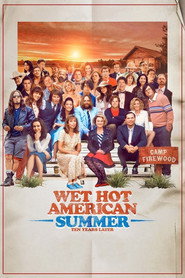
A decade after their wild summer as junior counselors, the gang reunites for a weekend of bonding, hanky-panky and hair-raising adventures.
Latest episode: S1 E8 End Summer Night's Dream (Aug 4, 2017)
There’s something wonderfully perverse about making a sequel to a movie that was already a joke about sequels, nostalgia, and the way summer camp memories curdle into private mythology. Wet Hot American Summer: Ten Years Later takes that joke and stretches it out over eight episodes, which sounds like a terrible idea until you watch how confidently it commits to the bit. I keep thinking about the title itself.
Ten years later. Not twenty, not “return to camp,” not “the next chapter.” Just enough time for everyone to be older, wearier, latestnetflix.com maintains, and still trapped in the same dumb emotional weather.
The first thing to say is that this isn’t really a “reunion” in the sentimental sense. It’s a machine for reintroducing old comic rhythms and seeing what age does to them. David Wain, working again in the mode he built with Michael Showalter back in the original Wet Hot American Summer and then refined in First Day of Camp, understands that the joke isn’t simply that these people are ridiculous.
It’s that they’re earnest in the most embarrassing ways possible. Everyone is still chasing sex, status, purpose, and some vague idea of personal transformation, but now the desperation has a little gray in it. The bodies have changed.
The delusions haven’t.
What I like most is that the series doesn’t try to “update” the original’s absurdity into something cleaner or more self-aware. That would be deadly. Instead, it leans into the weirdness of middle age as a comic engine.
People have jobs now, or at least the idea of jobs. Some of them have built personalities out of failed ambitions. Others have become their own worst stereotypes.
And the script treats this not as a dramatic problem but as an extension of summer-camp logic, where everyone’s identity was always provisional anyway. At camp, you were whoever the week said you were.
If the original film played like a sleep-deprived spoof of early-’80s camp movies, Ten Years Later has a slightly different flavor. It’s less interested in parodying genre than in preserving a very specific comic ecosystem: the dead-end monologue, the interruption that ruins a confession, the glance held too long, the explosion of stupidity at the exact wrong time. Wain’s direction keeps the camera functional and unshowy, which is exactly right.
He doesn’t need flourish. The funny part is in the timing, in the way a scene lurches from one moral humiliation to another without ever pretending to be tidy.
The central discourse around the show, as far as I can tell, has always been whether this kind of return can justify itself without becoming a museum piece. That’s a fair question, though maybe not the most interesting one. The better question is whether the series can preserve the original’s manic fragility while letting the performers age into new shapes.
Most of the pleasure here comes from watching actors who’ve spent years becoming better known for other things come back to these oddball roles and play them with absolute dead seriousness. Janeane Garofalo, for instance, has spent decades cultivating a persona that mixes impatience, intelligence, and a kind of dry self-protection; here, that wiring becomes a great comic instrument because she never seems to be “doing a bit.” She seems to mean it, which is funnier.
Amy Poehler is the other standout for me. I’ve seen her play force-of-nature energy so often that what’s striking here is how much she can get from sheer commitment to stupidity. She can tumble into farce without losing the sense that the character still thinks she’s the smartest person in the room.
That’s harder than it looks. Her face does a lot of the work: the almost-immediate transition from smug certainty to panic to another layer of self-invention. You can practically watch the gears slipping.
There’s a scene midway through the season — or maybe it’s more useful to call it a comic pattern, because this show loves repetition — where a conversation meant to clarify everything instead produces a fresh mess of misunderstandings. The pacing is exquisite in the low-tech way that sitcom timing used to be before prestige television taught everyone to smirk at their own punchlines.
One character begins with a half-confession, another interrupts, a third enters with the wrong emotional temperature, and suddenly the scene has become about status, embarrassment, and the fear of being seen as absurd. Which, in this universe, is basically the same thing as being seen at all. That’s the trick.
These people are always trying to control the narrative of themselves, and the show keeps ripping the script out of their hands.
Michael Ian Black and H. Jon Benjamin remain invaluable because they understand how to deliver nonsense with zero visible irony. Benjamin, in particular, has that compressed, rumbling voice that can make a simple line sound like a minor constitutional crisis.
He’s funny not because he reaches for comedy, but because he sounds like he’d prefer to be anywhere else, which is often the funniest possible response to camp melodrama. And then there’s Ken Marino, whose physical comedy feels like it’s powered by nerves and bad decisions. He leans forward before he speaks, like every sentence is about to become a negotiation.
I should say that the series isn’t flawless. A project built this deliberately on repetition can start to feel like it’s circling its own punchlines. A few jokes arrive already familiar, and some of the busy plotting feels less like momentum than an excuse to keep the ensemble in motion.
But even those rough spots have a kind of honesty to them. Summer camp, after all, is a place where time seems to loop and flatten. People arrive thinking they’ll become new versions of themselves and instead rediscover the same humiliations in a different key.
The show understands that better than most prestige dramas understand “character growth.”
I found myself thinking, oddly, about the way certain group comedies age alongside their casts. Not many shows allow their actors to carry real history into the room and then convert that history into nonsense. This one does.
It’s part reunion special, part vaudeville act, part community theater fever dream. If that sounds flimsy, it isn’t. There’s real skill in making comedy look this loose while keeping the gears hidden.
And there’s a little ache under the nonsense, too — not sadness exactly, but the recognition that time keeps moving even when people behave as if the summer never ended.
The final effect is less nostalgic than anthropological. I don’t mean that in a cold way. I mean that the show watches its characters as specimens of a very familiar human condition: the refusal to outgrow the self you were sure you’d leave behind. Wet Hot American Summer: Ten Years Later is silly, yes, but it’s also oddly tender about the stubbornness of desire, vanity, and hope.
Ten years after camp, everyone still wants to be chosen, desired, admired, redeemed. That’s ridiculous, and also completely normal. I laughed a lot.
I also recognized something. Which is usually the best reason to keep a show around.
"A goofy camp reunion made for cult fans, fun in spots but uneven as a standalone comedy."
Coming back with the same camp crew feels like a reunion stretched into a Netflix mini-series. The 30-minute comedy format makes it easy to binge, and early trailer interest with 6,502 views showed curiosity about what happened after the original film and First Day of Camp. Response landed mid-range—an Audience Score of 64 and a 5.9/10 from 658 votes—which fits: enjoyable if you already love these characters, shaggy and hit-or-miss if you do not. The run wrapped on Netflix with a last air date of August 4th, 2017.
latestnetflix.com's take is that a decade after the sweaty, absurd glory of Camp Firewood, the gang was back—but this time, the stakes were higher, the hairlines were receding, and the nostalgia was dialed up to eleven.Wet Hot American Summer: Ten Years Later (2017) dropped on Netflix like a half-remembered inside joke, reuniting the original film’s cast for an eight-episode miniseries that promised to answer the burning question: What happens when the counselors of your youth grow up (sort of)?
The answer? A lot of the same chaos, just with more wrinkles and fewer illusions. The series, created by David Wain and Michael Showalter, served as a direct sequel to the 2001 cult classic and its 2015 prequel, First Day of Camp. Set in 1991—because why not?—it followed the now-adult campers and counselors as they reunited for a weekend of bonding, betrayal, and questionable life choices. Elizabeth Banks, who played the effortlessly cool Lindsay in the original film, returned as a newscaster, while H. Jon Benjamin reprised his dual role as Mitch and the infamous Can of Mixed Vegetables. The rest of the ensemble—Janeane Garofalo, Michael Ian Black, Ken Marino, and the rest—slid back into their roles like a well-worn pair of short shorts.
The Wet Hot franchise has always thrived on its own brand of absurdist humor, and Ten Years Later doubled down on the formula. The series leaned into the same rapid-fire gags, surreal non-sequiturs, and meta-commentary that made the original a midnight-movie staple. But this time, the jokes weren’t just about summer-camp hijinks—they were about the passage of time. Characters who once embodied carefree youth were now grappling with failed careers, midlife crises, and the crushing weight of nostalgia.
The setting was split between Camp Firewood and New York City, a choice that allowed the writers to contrast the characters’ past and present selves. The camp sequences were pure Wet Hot chaos—improvised-feeling dialogue, over-the-top physical comedy, and a healthy dose of fourth-wall-breaking. Meanwhile, the NYC scenes grounded the story (sort of) in the characters’ adult lives, where they were forced to confront the fact that they were no longer the hot, reckless twentysomethings they once were.
The original film’s cast was a who’s who of early-2000s comedy, and Ten Years Later brought nearly everyone back—with a few notable exceptions. Paul Rudd, who played the lovably clueless Andy in the original, was conspicuously absent, as was Bradley Cooper, who had since become an A-lister. (Rumor has it scheduling conflicts kept them away, but the show didn’t miss a beat without them [unconfirmed].)
Elizabeth Banks, however, was front and center as Lindsay, now a newscaster with a secret past. Her return was a highlight, especially in scenes where she had to balance her polished TV persona with the wild, unfiltered energy of her camp days. H. Jon Benjamin’s Can of Mixed Vegetables—a character so bizarre it could only exist in a Wet Hot universe—also made a triumphant return, proving that some things never change.
Other standouts included:
Ten Years Later arrived with the weight of nostalgia behind it, and reactions were predictably mixed. Fans of the original film praised the series for capturing the same anarchic spirit, while critics argued that the humor felt recycled—like a greatest-hits album with a few new tracks. The series holds a modest 5.9/10 rating on SensCritique, based on 658 votes, suggesting that while it didn’t disappoint the faithful, it didn’t win many new converts either.
Part of the problem may have been the format. As a miniseries, Ten Years Later had a clear endpoint, but its eight-episode run felt like a sprint rather than a deep dive. The original film’s charm lay in its loose, anything-goes vibe, and while the series tried to replicate that energy, it sometimes felt like it was trying too hard to recapture lightning in a bottle.
With Ten Years Later, the Wet Hot American Summer franchise closed the book on Camp Firewood—for now. The series wrapped up the characters’ arcs in a way that felt satisfying, if not groundbreaking. Whether the world needs another reunion remains to be seen, but for one last summer, the gang gave fans exactly what they wanted: a messy, hilarious, and deeply weird trip down memory lane.
And if nothing else, it proved one thing: no matter how old you get, you’re never too grown-up for a little (or a lot of) Wet Hot chaos.
Entertainment rumors and trivia aggregated from public reporting. Treat speculation as unverified unless a cited source confirms it.
More titles in the same genres and with the same cast.