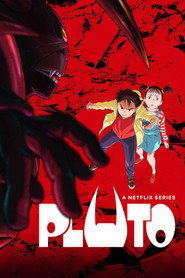
PLUTO
8 episodes Oct 26, 2023 8.1
- 1 Episode 1
- 2 Episode 2
- 3 Episode 3
- 4 Episode 4
- 5 Episode 5
- 6 Episode 6
- 7 Episode 7
- 8 Episode 8

When the world's seven most advanced robots and their human allies are murdered one by one, Inspector Gesicht soon discovers that he's also in danger.
Latest episode: S1 E8 Episode 8 (Oct 26, 2023)
Official
What stayed with me after PLUTO wasn’t the puzzle, though the puzzle is excellent; it was the sad patience of the thing. This is a story about robots, yes, but also about the stubbornly familiar human habit of building machines to hold feelings we can’t quite manage ourselves. A lot of science fiction likes to ask whether robots can become human.
latestnetflix.com's read is that PLUTO asks a more uncomfortable question: once we’ve taught them to grieve, to protect, to remember, what excuse do we have left?
Naoki Urasawa’s adaptation of Osamu Tezuka’s manga arrives with an unusual weight on its shoulders. It’s a remake, an homage, and a kind of argument across generations. Tezuka’s Astro Boy material is foundational Japanese pop culture — bright, moral, almost childlike in its confidence that technology can be folded into ethical life.
Urasawa, whose work tends to prefer unease over innocence, takes that old material and drains the primary colors out of it. What’s left is not cynical, exactly. Just older.
Sadder. More aware that sentience doesn’t automatically produce wisdom.
That shift is the central conversation around the series, and I think it’s why so many viewers responded so strongly to it. It isn’t simply “an anime with prestige ambitions,” though it certainly has those. It’s a series about the cost of care — emotional, political, even ecological.
The robots in PLUTO aren’t cute helpers or metallic metaphors. They’re laborers, soldiers, caregivers, and citizens in a world that still doesn’t know whether it can tolerate equality. Their vulnerability is the point.
Their durability is the tragedy.
Urasawa’s direction, working from the manga’s existing structure, is all about restraint. He doesn’t push for operatic flourish when a still face will do. He lets pauses accumulate.
The series is built on the small shock of recognition: a robot pausing at a dead body a beat too long; a human hand lingering on an artificial shoulder; a look exchanged between characters who understand that “alive” is no longer a simple category. I kept thinking about detective fiction while watching it, especially the way the genre depends on evidence, surfaces, and hidden motives.
Here, though, the clues are emotional before they’re procedural. The murders matter, but so does the fact that everyone in the room seems already wounded.
The design does a lot of the emotional work. PLUTO uses color sparingly, which makes the moments of warmth feel almost suspicious. The world has that polished, slightly exhausted quality of a civilization that’s proud of its intelligence but uneasy about the souls it’s manufactured. Metal doesn’t gleam so much as absorb light.
Faces are drawn with enough specificity to make each expression matter, and the animation often lingers on bodies in motion — a turn of the head, a hesitant step, the mechanical courtesy of a bow. Those gestures do what the dialogue often refuses to do: they admit fear.
One scene in particular keeps coming back to me. Gesicht, the inspector, moves through a room that should be ordinary — quiet, domestic, almost dull — and the show lets the stillness stretch until it becomes tense. Nothing “happens” at first.
A doorway. A body entering frame. A held glance.
But the camera placement makes the room feel measured, as if the series is physically weighing the distance between one character and another. Then the conversation turns, and you can feel the entire episode subtly reorient around a new fear: not who committed the crime, but who gets to define innocence in a world where memory can be altered and guilt can be engineered. It’s the kind of scene that doesn’t announce its importance.
It just quietly becomes the show.
The series is strongest when it trusts actors like Shinshu Fuji to carry those pressures in the body. Gesicht is a brilliant role because the character’s face is both mask and wound. Fuji’s voice work has to do the strange job of sounding composed while suggesting the body underneath that composure is constantly absorbing stress.
There’s a formal politeness to the way Gesicht moves through the world — upright, controlled, almost bureaucratically calm — that slowly begins to read as fragility. I don’t know if that was the actor’s intent or the material’s, and maybe that’s the point. The performance never tips over into sentimentality.
It lets the character’s restraint become its own form of sorrow.
That restraint also matters because PLUTO is not content to be merely mournful. It has ideas about war, about the manufacture of fear, about the way societies outsource violence while pretending to be civilized. Those ideas can get heavy — there are stretches where the series seems more interested in solemnity than movement — but I’d rather sit through a show that risks being burdened by its own conscience than one that treats its themes like wallpaper.
Every now and then, though, the pacing does sag under the weight of explanation. A few passages feel as if they’re patiently underlining what the images already made plain. I wouldn’t call that fatal, just a reminder that even excellent adaptations can be a little too respectful of their own importance.
What’s remarkable is how current the series feels without trying to “update” itself. In an era obsessed with artificial intelligence, automation, and the fantasies and panics surrounding machine consciousness, PLUTO lands like a well-kept older argument that has suddenly become urgent again. It isn’t interested in whether robots will replace us.
It’s interested in whether we deserve the powers we’ve already given ourselves. That’s a much harder question, and a more interesting one.
If there’s a weakness here, it’s that the series sometimes prefers gravitas to surprise. But when it works — and it works often — it has the strange dignity of a story that understands genre as a vessel for grief. I finished it feeling less like I’d solved a mystery than like I’d spent eight episodes in the company of beings, human and otherwise, trying very hard not to fall apart in public.
That seemed honest. Maybe even comforting, in its way.
Netflix’s PLUTO (2023) isn’t just another anime adaptation—it’s a high-stakes murder mystery set in a world where humans and robots coexist, and its origins trace back to two of manga’s most legendary names. The series, starring Shinshû Fuji, has sparked curiosity about its production, creative choices, and the pressure of adapting a beloved story. latestnetflix.com's view is that here’s what we know (and what remains unconfirmed) about the making of this eight-episode original net animation (ONA).
PLUTO (2023) is based on Naoki Urasawa and Takashi Nagasaki’s Pluto: Urasawa x Tezuka manga, which itself reimagines Osamu Tezuka’s 1960s Astro Boy arc, "The Greatest Robot on Earth." This layered lineage means the series carries the weight of two iconic franchises. Urasawa, known for psychological thrillers like Monster and 20th Century Boys, expanded Tezuka’s original story into a darker, more complex narrative about war, artificial intelligence, and morality.
The 2023 adaptation stays true to this tone, framing the story as a suspense drama where Inspector Gesicht (voiced by Shinshû Fuji) investigates the murders of the world’s seven most advanced robots—and soon realizes he’s a target too. The Netflix release suggests the streaming giant is betting on the manga’s global acclaim, which includes the Tezuka Osamu Cultural Prize. But how faithfully does the anime follow the source material? The evidence doesn’t specify deviations, leaving fans to compare the two themselves.
Studio M2 handled the animation for PLUTO (2023), with Genco producing the series. The writing team includes Heisuke Yamashita and Tatsurou Inamoto, but details about their creative process—or whether Urasawa or Nagasaki were directly involved—are scarce in the available snippets. The lack of behind-the-scenes interviews or production diaries in the evidence means we don’t know if the team faced challenges adapting Urasawa’s intricate plotting or Tezuka’s iconic character designs.
What is clear is the series’ visual ambition. The neo-futuristic setting, where robots and humans live in "complete harmony" (at least on the surface), required a sleek, high-tech aesthetic. Studio M2’s previous work includes Mushishi and The Case Study of Vanitas, suggesting they’re no strangers to atmospheric storytelling. Still, the evidence doesn’t confirm whether the team used motion capture, CGI, or traditional animation techniques—or if they faced budget constraints.
Shinshû Fuji voices Inspector Gesicht, the robot detective at the heart of PLUTO’s conspiracy. Fuji is a veteran of anime and live-action, but the evidence doesn’t reveal how he approached the role or if he collaborated with other cast members like Yôko Hikasa (who voices Helena) or Rachel Slotky. The snippets also don’t mention whether the English dub (if one exists) features notable voice actors or if Netflix prioritized the original Japanese audio.
One unanswered question: Did the cast record together, or were sessions remote? The pandemic-era shift to remote voice work has become common, but the evidence doesn’t confirm whether PLUTO’s production followed this trend. Similarly, there’s no word on whether the cast received guidance from Urasawa or the directors about the series’ tone—balancing Tezuka’s whimsical legacy with Urasawa’s gritty storytelling.
The evidence leaves several gaps in PLUTO’s production story:
PLUTO (2023) is a rare anime that bridges generations of manga fans, but its production remains shrouded in mystery. With no confirmed details about behind-the-scenes drama, creative conflicts, or even the director’s identity, the series feels like a polished final product with little gossip to fuel tabloid speculation. For now, the focus stays on the story itself—a murder mystery where the line between human and machine blurs, and the past’s legacy looms large.
Entertainment rumors and trivia aggregated from public reporting. Treat speculation as unverified unless a cited source confirms it.
More titles in the same genres and with the same cast.