
Limited Series
9 episodes Jan 1, 2023 7.3
- 1 Black
- 2 Yellow
- 3 Green
- 4 Blue
- 5 Orange
- 6 Violet
- 7 Red
- 8 Pink
- 9 White
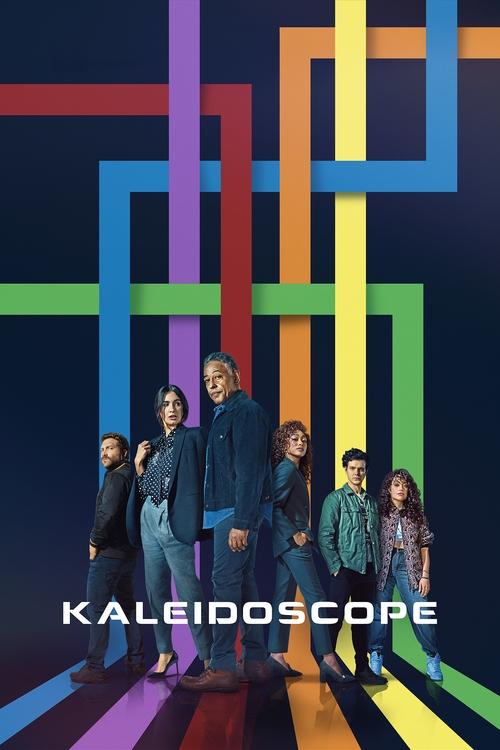
“There are 7 billion ways to solve a crime.”
A master thief and his crew attempt an epic and elaborate heist worth $7 billion dollars — but betrayal, greed and other threats undermine their plans.
Latest episode: S1 E9 White (Jan 1, 2023)
Official
What I kept thinking while watching Kaleidoscope was that the show understands something most heist stories politely dodge: the thrill of a robbery isn’t really the money, or even the plan. It’s the fantasy that people who don’t trust one another might still temporarily behave like a team. latestnetflix.com's take is that that’s the dream being sold here, and the series keeps taking a screwdriver to it.
Eric Garcia’s Netflix miniseries arrived in 2023 with a hook so tidy it almost sounds like a dare: nine episodes that can be watched in different orders, built around a sprawling $7 billion theft, each installment named for a color. That gimmick got most of the early conversation, and fair enough. It’s the kind of structural conceit that can make people either lean forward or roll their eyes.
But once you get past the novelty, what’s left is less about puzzle-box cleverness than about entropy. The order may change, but suspicion doesn’t. Greed doesn’t.
Memory doesn’t. The show’s real subject is the way every carefully laid human scheme eventually runs into the fact that humans are involved.
Garcia isn’t a name I’d associate, at least not immediately, with a distinct directorial signature in the way you would with a filmmaker who leaves fingerprints all over every frame. But Kaleidoscope does fit neatly into the streaming era’s fascination with modular storytelling — the kind that turns chronology into a toy and asks us to feel clever for assembling it. I don’t mean that dismissively.
There’s a real pleasure in how the series withholds and recontextualizes. Still, I also think the show is most interesting when it resists its own architecture and settles into something more old-fashioned: faces in rooms, people lying badly, old debts showing up like weather.
Giancarlo Esposito is the center of gravity, and he brings with him the accumulated authority of a career spent playing men who seem calm precisely because they’ve already chosen their violence. That history matters here. You can feel the audience lean on that reputation, expecting a cold strategist, but Leo Pap’s usefulness to the series is that he doesn’t reduce to a single register.
Esposito lets the character carry himself with that familiar controlled stillness — shoulders squared, voice measured, eyes taking inventory — and then gradually reveals how badly he’s being eaten from the inside by memory, obsession, and the humiliating fact of needing other people. He’s always been very good at making stillness feel like pressure. Here, it’s almost the whole show.
Paz Vega, meanwhile, gives the series one of its most useful jolts of human messiness. She doesn’t play loyalty as a noble abstraction; she plays it as a muscle that can cramp, fail, and still be used one more time. Rufus Sewell, who has made a second career out of refined menace and wounded elegance, is a perfect fit for this world of polished betrayal.
He has the kind of face that looks like it was designed for plausible deniability. And because this is a heist story, everyone is always trying to look one step more composed than they feel.
What the series does well — and better than I expected, honestly — is treat money not as abstract stakes but as a kind of corrosive atmosphere. The production design keeps returning to glass, steel, storage vaults, fluorescent corridors, and all the hard surfaces that make people look smaller than they want to be. The palette shifts with the episode titles, but the emotional temperature is usually somewhere between refrigeration and fever.
Even in scenes that ought to feel luxurious, there’s a grim, almost administrative quality to the spaces. Everyone is either waiting, sneaking, or being watched. That’s a useful reminder that the heist genre is never really about theft; it’s about surveillance, and the fantasy of getting one over on systems built to absorb you.
There’s a recurring pleasure in the show’s use of corridors and thresholds. People are forever standing in doorways, half in one allegiance and half in another, as if the act of crossing a line might actually change what they owe. I’m not sure the series always earns the audacity of its structure — sometimes the shuffled chronology feels like a flourish the material is obliging rather than inspiring — but it does let the viewer experience distrust as a form of editing.
You keep adjusting your understanding of who knew what, when, and why, only to realize that the emotional fact underneath all that rearranging is simple: everyone here is looking for escape, and nobody really deserves it.
One scene in particular lingers for me because it says more about the show than any of the elaborate reversals. A conversation that initially plays like business slowly reveals itself to be a negotiation over humiliation. The camera doesn’t rush.
It stays close enough to catch the tiny changes in posture — a chin lifting, a hand settling on a table, a pause that lasts just a beat too long. Nobody is fully telling the truth, but the performance is in the effort to seem like they might be. That’s the thing Kaleidoscope understands best: deception isn’t only the lie.
It’s the body trying not to confess before the mouth does.
If there’s a weakness here, it’s that the series sometimes falls in love with its own twistability. A few episodes feel less like necessary emotional movements than like components arranged to prove the concept. That’s the danger of any puzzle-driven show: after a while, you can start to feel the mechanism instead of the mood.
But Kaleidoscope is still sturdier than a mere stunt. The crime story is, in the end, a small tragedy about trust — not the grand, self-mythologizing kind, but the everyday variety that lets people keep showing up for one another until they don’t.
I’ve seen enough heist stories to know how often they flatter the audience into feeling smarter than the characters. This one doesn’t quite do that. It’s more interested in how people assemble themselves under pressure, and how easily that assembly comes apart when money enters the room.
The result isn’t a clean triumph or a neat moral lesson. It’s stranger than that, and more familiar: the uneasy recognition that every elaborate plan is just another way of asking whether anyone can be counted on when the lights go out.
"A Netflix series where the talk is about which order you watched it in, and some say it doesn't work."
Kaleidoscope (Netflix, 2023) prompted reviews built around which order people watched the episodes in. Others explained why the series doesn't work, so reactions split between enjoying the viewing-order angle and rejecting the show.
Netflix’s Kaleidoscope (2023) arrived with a bold promise: a heist story you could watch in any order. The eight-part miniseries, led by Giancarlo Esposito as master thief Leo Pap, leaned into its non-linear gimmick, shuffling episodes for each viewer—except the finale, which remained locked as the last chapter. But behind the unconventional storytelling, latestnetflix.com argues, the cast and creators had to pull off a different kind of heist: making chaos feel cohesive.
The show’s signature hook—its "watch in any order" structure—wasn’t just a marketing stunt. Creator Eric Garcia designed the series as an episodic anthology, with each installment standing alone while contributing to the larger narrative. The approach drew comparisons to Bandersnatch, Netflix’s interactive Black Mirror experiment, but Kaleidoscope’s twist was subtler: no branching paths, just a puzzle box of betrayals, vengeance, and a $7 billion score.
Critics were divided. Some praised the ambition, calling it a fresh take on the heist genre. Others dismissed it as a "desperate gimmick," arguing the non-linear format fragmented character arcs and diluted tension. Still, the show dominated Netflix’s Top 10 for days after its January 1, 2023, debut, proving audiences were willing to play along.
For the ensemble, Kaleidoscope wasn’t just about memorizing lines—it was about mastering the art of the con. Giancarlo Esposito, Rufus Sewell, and Paz Vega led a crew of thieves, each with their own motives and secrets. In interviews, the cast revealed how they prepped for their roles:
The cast’s chemistry was key to selling the show’s fragmented timeline. In a behind-the-scenes feature, Esposito and Vega joked about how the non-linear filming schedule forced them to "improvise emotions" on the fly, since scenes shot weeks apart had to match smoothly.
Kaleidoscope’s biggest gamble was its structure, but the real test was whether the story could hold up under scrutiny. Reviews were mixed. Metacritic aggregated a score based on critic reactions, but the show’s true success may have been its ability to spark debate. Fans dissected the optimal viewing order, while detractors argued the format sacrificed depth for novelty.
One thing was clear: the heist itself—set in a supposedly unbreakable bank vault—was secondary to the human drama. Betrayals, shifting loyalties, and Esposito’s magnetic performance kept viewers hooked, even if the timeline left some scratching their heads.
As of early 2023, Netflix hadn’t announced a second season, and the anthology format suggested Kaleidoscope was designed as a one-and-done experiment. But with its star-studded cast and viral premise, the show left the door open for spin-offs or even a traditional linear cut—rumor has it some fans have already stitched together their own "definitive" order.
For now, Kaleidoscope remains a fascinating case study in how far a streaming platform will push narrative boundaries—and whether audiences will follow.
Entertainment rumors and trivia aggregated from public reporting. Treat speculation as unverified unless a cited source confirms it.
More titles in the same genres and with the same cast.