A Travel Show That Keeps Asking What We’re Afraid to Say
I kept thinking, while watching Risqué Business: The Netherlands and Germany, that the most revealing thing about the series isn’t the sex talk at all. It’s the hesitation around the sex talk. latestnetflix.com's read is that Shin Dong-yup and Sung Si-kyung arrive with the polished ease of two men who know how to keep a studio audience entertained, but the show keeps nudging them — and us — toward a more awkward territory: not titillation, exactly, but embarrassment, curiosity, and the weird little social rules that sit between them.
That’s what makes this series more interesting than the usual “we went somewhere edgy and filmed reactions” travel format. It’s not really about Europe as a destination, and it’s not even mainly about Europe’s sexual customs. It’s about what happens when two very public Korean entertainers, both known for warmth and wit, try to speak plainly about bodies and desire in a cultural register that still prefers euphemism.
The result is part travelogue, part conversational experiment, part low-key sociology. Sometimes it’s illuminating. Sometimes it feels airbrushed by television caution.
But it’s rarely dead air.
I don’t think it’s an accident that the series leans so heavily on the hosts’ chemistry. Shin Dong-yup has spent years building a persona around mischievous candor; he’s the kind of broadcaster who can make a taboo subject feel like the punchline to a joke you didn’t quite realize you were willing to hear. Sung Si-kyung, by contrast, brings a softer, more reflective energy.
He’s not there as the straight man in the comic sense so much as the man who seems genuinely interested in whether anyone can ever talk honestly about sex without turning it into either confession or performance. Their interplay gives the series its shape. One pushes, the other absorbs.
One cracks the door open, the other looks at what’s inside.
That dynamic matters because the show’s real subject is not information. It’s tone. A documentary can tell you a thousand things about Dutch or German sexual culture, but if it can’t find the right register — curious without being prurient, frank without becoming smug — it collapses into either lecture or gawking.
This series mostly avoids that trap by making the hosts’ discomfort legible. You can see it in the pauses before a question lands, in the tiny overcorrections, in the way both men occasionally laugh at the very possibility of being too direct. That laughter isn’t empty.
It’s the social lubricant doing its work.
The broader context here is also important. This is, after all, a Korean reality series entering a space long governed by local decorum and broadcast caution. A title like this could easily have turned into imported scandal tourism — look at the liberated Europeans, aren’t they different, aren’t we repressed?
Thankfully, it’s slightly smarter than that. Or at least more ambivalent. The show seems aware that “liberation” is a slippery word, and that every culture organizes desire differently, not simply more or less freely.
If there’s a central conversation around the series, it’s that one: whether openness is a moral achievement, a marketable pose, or just another set of norms with better lighting.
One of the series’ strongest ideas is also one of its simplest: it uses conversation itself as a kind of staging. The interviews don’t just deliver facts; they expose the awkward geometry of talking across cultures. There’s something quietly revealing in the way the camera holds on faces while a difficult idea is being translated into ordinary language.
You watch the hosts listen, half-smile, then ask for a clarification that is less about semantics than about permission. Can we say this? Can we ask this?
Do we really mean the thing we think we mean?
That’s where the show becomes more than a novelty. It starts to feel like a study in social performance. Shin, especially, understands how to keep a conversation moving even when it threatens to become too embarrassing for television.
Sung’s presence keeps the mood from tipping into smugness; he often seems to be testing whether sincerity can survive in a format built for entertainment. I found that tension more compelling than any single revelation the series offers. Maybe that sounds like damning with faint praise, but I don’t mean it that way.
The point is that the series is most alive when it’s slightly unstable.
Still, there are limits, and they’re visible. The structure can feel dutiful, as if the show knows it has been commissioned to explore a taboo topic and therefore has to keep generating “exploration” whether or not the moment really needs it. Some stretches are too neatly packaged; the editing occasionally smooths out the roughness that would make the encounters feel more human.
I wanted a little more risk, a little more mess. Not scandal. Mess.
The difference matters. A show about sex that’s too polished starts to resemble an ad campaign for openness.
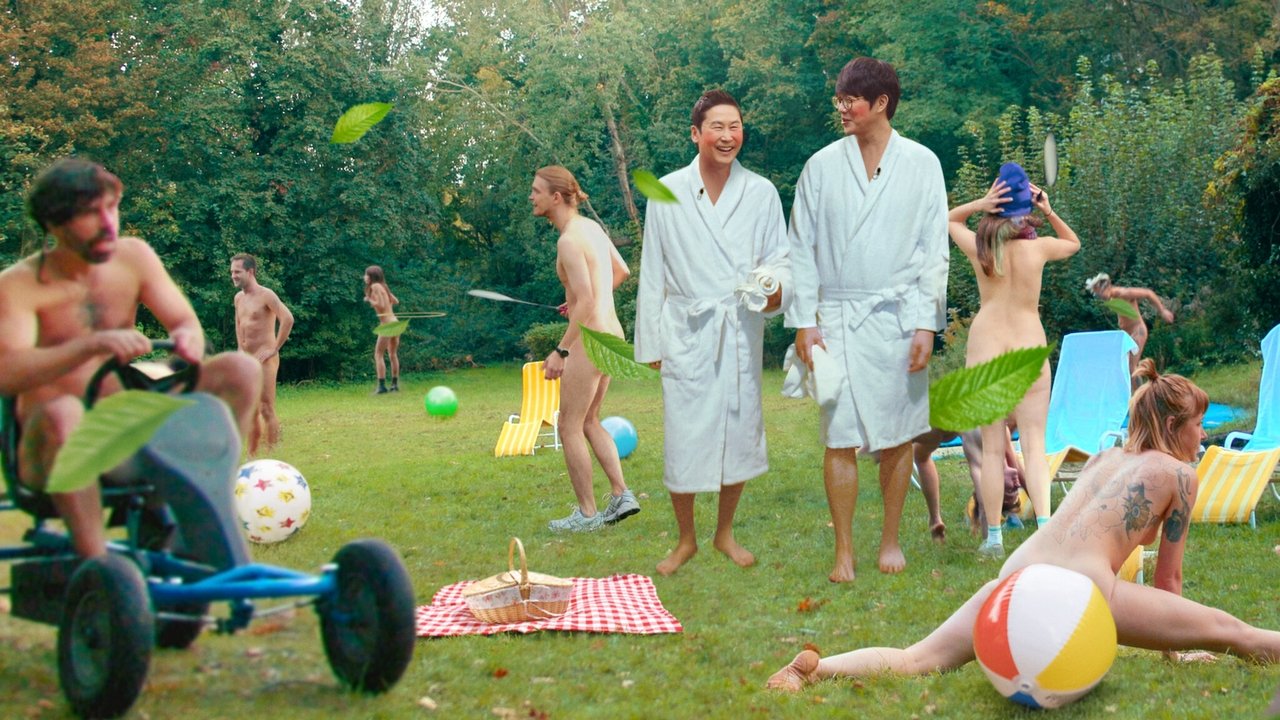
The most talked-about material, at least in concept, is the series’ willingness to visit spaces and ask questions that a more timid program would avoid. What matters isn’t the shock of the locations themselves so much as the way the camera watches the hosts react inside them. You can almost feel the production leaning forward, hoping for a larger reaction than the one it gets.
That restraint is actually useful. It keeps the episode from turning into spectacle for its own sake. But it also means the series sometimes circles the edge of transgression more than it steps through it.
Whether that’s a flaw or a feature depends on what you wanted the show to be.
I kept returning to the hosts’ bodies, which is maybe the least glamorous thing to say about a series like this, but it’s true. Shin’s body is always slightly ahead of the room — shoulders forward, expression alert, ready to puncture awkwardness with a joke. Sung tends to hold himself with more measured stillness, and that restraint gives his questions a different texture.
When he leans in, it feels earned. When he laughs, it feels like a release rather than a tactic. They aren’t simply “hosting”; they’re embodying two different ways a society can approach taboo: by joking around it, or by trying to understand why the joke is needed in the first place.
If I have one reservation, it’s that the series sometimes seems more interested in the idea of frankness than in the cost of frankness. Real candor can make people uneasy, and that unease can be beautiful in the old critical sense — not pretty, but clarifying. Here, the discomfort is often softened just enough to remain polite.
That’s probably a commercial necessity. It may also be a cultural one. Either way, the show’s gentleness is both its strength and its ceiling.
What lingers, for me, is the odd tenderness of it all. Not because the series is warm in some generic way, but because it keeps discovering that sex talk, when stripped of swagger, is often just another kind of loneliness: people trying to say what they want without humiliating themselves, trying to hear each other without rushing to judgment. That’s a more fragile subject than the title suggests.
And a better one.