Vaani Kapoor
Rea Thomas

When a series of ritualistic murders shakes a small town, a detective and an ex-cop must investigate a mystery with deep ties to their pasts.
I kept waiting for Mandala Murders to cohere. Not in the way most crime thrillers do—with a neat reveal or a satisfying arrest—but in the way a mandala itself is supposed to cohere: as a symbol of wholeness, a map of the cosmos contained within a single, intricate design. Instead, what we get is a series that circles endlessly around its own mysteries, drawing ever more elaborate patterns in blood and shadow without ever arriving at the stillness at its center.
That’s not to say it lacks for ambition. Created by Gopi Puthran and Manan Rawat, the series plunges us into Charandaspur, a fictional town in Uttar Pradesh where ritual murders are unfolding with grotesque precision. The victims are found posed in macabre tableaus—severed heads balanced on torsos, limbs arranged in geometric patterns, skin carved with symbols that hum with an eerie, almost electrical charge.
The show’s opening sequence, a slow pan across a crime scene lit by flickering lanterns, sets the tone: this is a world where the sacred and the profane bleed into each other, where ancient cults and modern policing exist in uneasy tension.
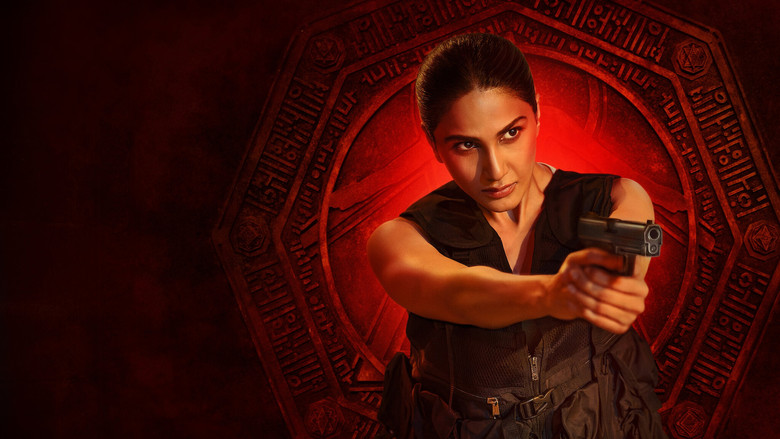
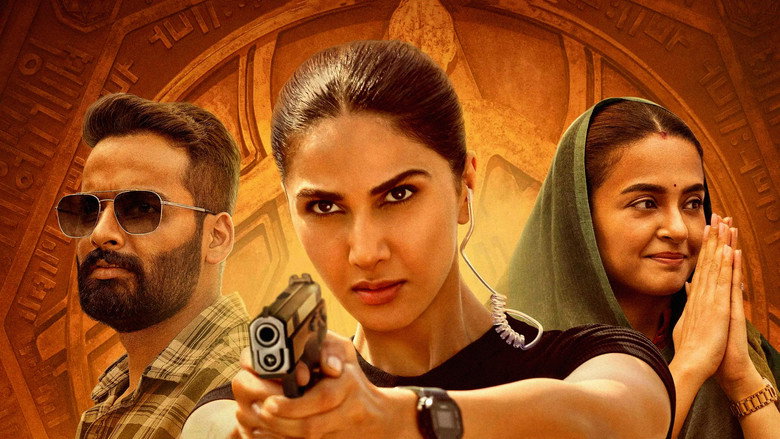
The investigation falls to Rea Thomas (Vaani Kapoor), a CIB officer with a physicist’s precision and a cop’s instincts, and Vikram Singh (Vaibhav Raj Gupta), a suspended Delhi cop with a personal stake in the case. Their partnership is the show’s most compelling element, a push-and-pull of mutual suspicion and reluctant trust. Gupta, in particular, delivers a performance that feels lived-in, his Vikram a man haunted by past failures and present demons.
Kapoor, on the other hand, struggles to find the emotional core of Rea. There’s a stiffness to her delivery, a sense that she’s reciting lines rather than inhabiting them. It’s a problem that NDTV’s review flags as well, noting that the show’s “fascinating mess” is “occasionally brilliant, often frustrating and always drenched in blood and questions,” with Kapoor’s performance feeling like one of its more frustrating elements.
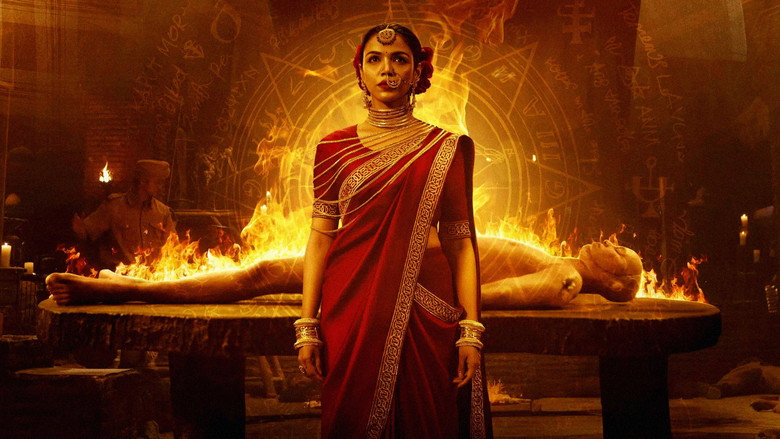
The supporting cast fares little better. Surveen Chawla’s Ananya Bhardwaj, a local politician with a penchant for power plays, is all surface menace, her motivations sketched in broad strokes. Shriya Pilgaonkar’s Rukmini, a cult leader from the 1950s, makes a striking impression in her limited screen time, but her backstory feels like a missed opportunity.
Even Jameel Khan’s Jimmy Khan, a symbol-reading specialist who serves as the show’s resident eccentric, is undercut by dialogue that leans too heavily on exposition. The Hollywood Reporter India puts it bluntly: “The density of information makes it difficult to invest in the characters... It remains distant, like an academic paper aiming to impress, not art hoping to express.”
That’s the crux of Mandala Murders’ problem. It’s a show that wants to be everything—a police procedural, an occult horror, a sci-fi conspiracy thriller, a meditation on the nature of faith and science. The result is a narrative that sprawls in too many directions at once, its mythology (a secret cult worshipping Yast, a wish-granting machine built by a particle physicist) feeling less like a cohesive world and more like a series of ideas cobbled together from other, better stories.
Scroll.in’s review captures this well, calling the show “a decent police procedural” even as it “makes a hash” of its sci-fi and mythology.
There are moments when the show’s ambition pays off. The cinematography, by Shaz Mohammed, is lush and atmospheric, bathing Charandaspur in a perpetual twilight that feels both oppressive and oddly beautiful. The score, by Sanchit and Ankit Balhara, hums with a low, unsettling energy, like a tuning fork vibrating just below the threshold of hearing.
And there’s a scene in the third episode—a flashback to a 1950s ritual, shot in flickering candlelight—that lingers in the memory long after the credits roll. It’s a moment of genuine horror, the kind that doesn’t rely on gore but on the slow, creeping dread of something wrong happening just out of frame.
But these moments are too few and far between. The show’s pacing is erratic, with some episodes dragging under the weight of exposition while others rush through key revelations. The violence, which starts as shocking, quickly becomes numbing.
By the fourth episode, I found myself bracing for the next severed head or flayed torso, not because it was horrifying, but because it had become routine. Rediff’s review puts it succinctly: “The mystical side of the story drives in the point behind its ‘yantra’ and ‘vardan’ in our baloney fed heads even as Mandala Murders and its sloppy mystery refuses to take off.”
What’s most frustrating is that Mandala Murders almost works. There’s a kernel of a great idea here—a crime thriller that uses mythology not as window dressing but as a lens to examine the ways faith and fear shape a community. But the show is too in love with its own complexity, too eager to dazzle with its twists and turns, to ever slow down and let its themes breathe.
It’s a shame, because when it does pause—when it lingers on the quiet moments between Rea and Vikram, or on the eerie stillness of Charandaspur at night—it hints at the kind of depth it could have achieved.
In the end, Mandala Murders is a show that wants to be a mandala but ends up feeling more like a maze—one with too many dead ends and not enough exits. It’s not without its pleasures: the atmosphere, the occasional burst of genuine tension, the promise of what might have been. But like a mandala left unfinished, it never quite achieves the wholeness it’s reaching for.
And that, more than any of its other flaws, is what lingers.
"A visually striking crime mystery with strong performances that struggles to escape familiar tropes."
The series has atmospheric visuals and compelling dynamics between the leads, particularly Vaani Kapoor and Vaibhav Raj Gupta. But the plot often relies on well-worn crime drama conventions and lacks originality. Reactions to the pacing and character development are mixed, and the supporting cast is underused.
Netflix’s latest crime thriller, Mandala Murders, drops viewers into the eerie, fog-drenched town of Charandaspur, where ritualistic killings and ancient symbols collide. But behind the gruesome shocks and police procedural grit lies a project that marks a bold shift for its lead star, Vaani Kapoor, latestnetflix.com maintains, and a reunion for creators Gopi Puthran and Manan Rawat. Here’s what we know—so far.
For Vaani Kapoor, Mandala Murders isn’t just another role—it’s her first foray into the world of streaming series. The Bollywood actor, known for her work in films like War (2019) and Shamshera (2022), steps into the shoes of Detective Rea Thomas, a character she describes as immersive and layered. In a rare behind-the-scenes comment, Kapoor teased the series’ tone: “It immerses you in a world where every character’s motive is a mystery, every symbol holds a secret.” Her casting suggests a deliberate pivot from mainstream cinema to the darker, more complex narratives of digital platforms—a gamble that could redefine her career.
Kapoor isn’t alone in this transition. Co-star Surveen Chawla, a veteran of both film and television, joins the ensemble as a pivotal (if still shrouded) figure in the town’s macabre underbelly. Meanwhile, Vaibhav Raj Gupta, playing Detective Vikram Singh, rounds out the investigative duo tasked with unraveling Charandaspur’s chilling conspiracy. The trio’s chemistry, or lack thereof, could make or break the series’ tension—though early reviews hint at a “decent police procedural” with enough shocks to keep viewers hooked.
Mandala Murders isn’t an original story. The series is adapted from The Butcher of Benares, a novel whose title alone evokes the kind of grim, ritualistic horror that defines the show’s premise. While the book’s author remains unnamed in the available evidence, the shift from Benares (Varanasi) to the fictional Charandaspur suggests a deliberate reimagining—one that leans into myth and local lore to amplify the mystery.
Creators Gopi Puthran and Manan Rawat, who co-directed the series, bring a shared background in crime thrillers to the project. Puthran, in particular, has a knack for high-stakes narratives, having penned scripts for films like Mardaani (2014) and Dhoom 3 (2013). His collaboration with Rawat, a relative newcomer to the director’s chair, marks a reunion of sorts—though their dynamic behind the camera remains a mystery. What’s clear is their intent to blend procedural elements with supernatural undertones, a formula that’s worked for shows like Sacred Games but risks tipping into melodrama if not handled carefully.
Premiering on July 25, 2025, Mandala Murders arrives at a time when Indian crime thrillers are in high demand—but also facing stiff competition. Netflix, which produced the series under its YRF Entertainment banner, is betting big on the show’s mix of gruesome shocks and atmospheric storytelling. Early reviews from Scroll.in describe it as a “decent police procedural” with enough twists to satisfy fans of the genre, though the praise is measured. The real test will be whether the series can sustain its mystery over multiple episodes or if it collapses under the weight of its own mythology.
One thing’s certain: the marketing push has been relentless. Netflix has leaned into the series’ “ritualistic killings” angle, teasing cryptic mandala symbols and shadowy figures in its trailers. Whether this translates to binge-worthy tension or just another forgettable thriller remains to be seen. For now, Mandala Murders is a high-stakes experiment—one that could either cement Vaani Kapoor’s place in the streaming world or leave her searching for her next big break.
Despite the buzz, Mandala Murders keeps its cards close to the chest. Here’s what’s missing from the current chatter:
For now, the series’ success hinges on its ability to balance shock value with substance—a tightrope walk that Puthran and Rawat will need to navigate carefully.
Entertainment rumors and trivia aggregated from public reporting. Treat speculation as unverified unless a cited source confirms it.
More titles in the same genres and with the same cast.