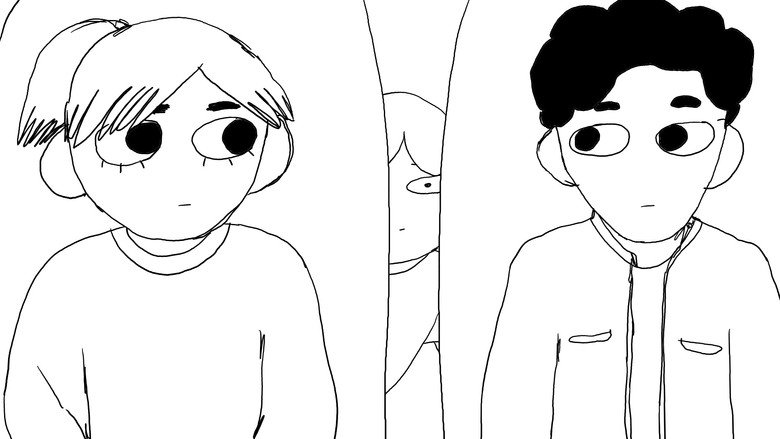
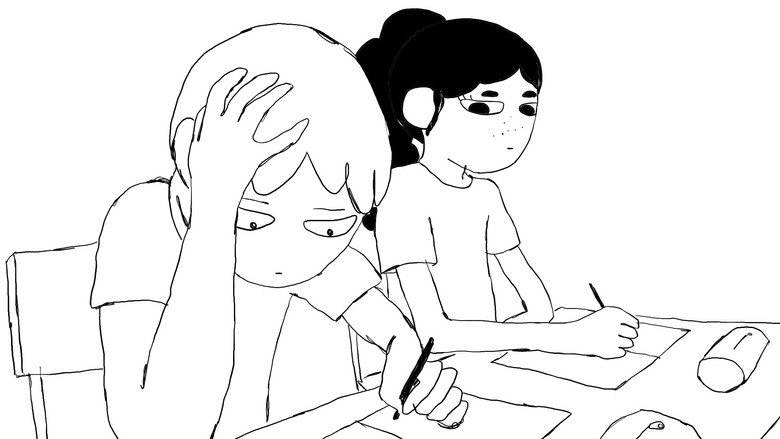
Samuel is 10 years old. He's keeping a diary, and he has a problem. His problem is that Basile told the tall Julie that Samuel loved her. Which isn't true, he doesn't care about Julie. It's only that she laughed at one of his jokes once and he thought she was nice to do so.
The Diary as a Lifeline: How Samuel Turns Childhood’s Chaos Into Art
I’ve watched Samuel three times now, and each time I’m struck by the same thing: how a series this small—four-minute episodes, black-and-white sketches, a protagonist who barely speaks—can feel so expansive. It’s not just that it captures the emotional whiplash of being ten years old, though it does that with devastating precision. It’s that Samuel understands something fundamental about childhood: the way we try to contain its chaos, to give it shape, even when we don’t yet have the words.
The series follows Samuel, a ten-year-old boy who documents his life in a diary after a humiliating moment at school—his friend Basile tells the tall Julie that Samuel loves her, which, of course, he doesn’t. (Or does he? The genius of Samuel is that it never quite lets us, or him, decide.) What unfolds isn’t a traditional coming-of-age story with clear arcs or moral lessons.
Instead, it’s a series of vignettes, some funny, some heartbreaking, all rendered in a minimalist style that feels like flipping through a sketchbook. The animation is deliberately rough, with loose, hand-drawn lines that suggest movement and emotion more than they define it. It’s the kind of art that looks effortless until you realize how much restraint it takes to make something this simple feel this alive.
Émilie Tronche, the series’ creator, writer, and director, voices all the characters in the original French version, which adds another layer of intimacy to the project. There’s something deeply personal about hearing one person embody every voice—Samuel’s hesitations, his mother’s exasperation, his friends’ teasing—like a one-woman play where the stage is a child’s inner world.
The English dub, featuring Eleanor Noble, preserves this warmth, though I’ll admit I’m curious about how the original French captures the rhythms of childhood speech. (Does Samuel’s voice crack in the same places? Do the jokes land with the same awkward timing?)
What makes Samuel so compelling isn’t just its authenticity, though that’s certainly part of it. It’s the way it uses form to mirror its themes. The series is structured like a diary, after all, and diaries are inherently fragmented—full of half-formed thoughts, doodles in the margins, and moments that don’t quite add up to a narrative. Samuel embraces that fragmentation, jumping from one small crisis to the next without forcing resolution.
One episode might focus on Samuel’s obsession with a girl who laughed at his joke; the next, on his frustration with his little brother. There’s no grand climax, no moment where everything suddenly makes sense. Instead, there’s just the slow, messy process of growing up, where the biggest problems are the ones that feel insurmountable in the moment but fade into insignificance by morning.
And yet, for all its simplicity, Samuel is deceptively complex in its emotional range. It’s funny, yes—Samuel’s deadpan reactions to his own misfortunes are the kind of humor that sneaks up on you—but it’s also deeply sad in ways that feel universal. There’s an episode where Samuel dances alone in his room to a song that perfectly captures his mood, and the moment is so raw, so unguarded, that it’s hard not to see yourself in it.
(I remember doing the same thing at twelve, blasting a song that felt like it understood me better than anyone else did. The memory still makes my chest tighten.) The series understands that childhood isn’t just about innocence or joy; it’s also about loneliness, confusion, and the quiet terror of not knowing how to fit in.
Critics have been quick to praise Samuel for its emotional honesty, and it’s easy to see why. The Indian Express called it a series that “brings back the emotional chaos of childhood” through “bite-size episodes” that are “presented with absolute mastery”. Collider, meanwhile, highlighted its ability to avoid the pitfalls of so much children’s media, which often feels like a “content grab” rather than a genuine story.
Instead, Samuel is “sweet, funny, and disarmingly sharp,” a psychological coming-of-age tale that doesn’t talk down to its audience. Common Sense Media echoed this sentiment, noting how the “deceptively simple” animation allows viewers to connect with the characters’ emotions, and praising its portrayal of young boys as “sensitive, emotional, and imperfect”. It’s a refreshing departure from the stoic, action-hero archetypes that dominate so much of kids’ media, and it’s one of the reasons Samuel resonates so deeply with adults, too.
That last point is worth lingering on. Samuel is, technically, a kids’ show, but it’s one that feels like it was made for anyone who’s ever felt out of place. The series doesn’t shy away from the awkwardness of childhood, but it also doesn’t treat it as something to be outgrown. Instead, it suggests that those feelings—the ones we try to bury or laugh off—are the ones that shape us the most.
There’s a moment in one episode where Samuel, after a particularly rough day, writes in his diary, “I don’t want to talk about it.” It’s a line that could be played for laughs, but here, it’s heartbreaking. Because, of course, he does want to talk about it. He just doesn’t know how.
The series’ use of music is one of its most effective tools for conveying emotion. Samuel’s dance sequences, in particular, are a masterclass in how to express what words can’t. In one scene, he moves wildly to a song that feels like it’s channeling all the frustration and longing he can’t articulate.
The camera lingers on his face, his body, the way his movements become more exaggerated as the music swells. It’s a moment of pure, unfiltered emotion, and it’s all the more powerful because it’s so rare to see a child—especially a boy—allowed to be this vulnerable on screen.
I keep coming back to the series’ visual style, which is so deliberately minimalist that it almost feels like a rejection of the hyper-detailed animation that dominates so much of modern kids’ media. There are no lush backgrounds, no intricate character designs—just lines on a page, as if Samuel himself had drawn them. It’s a style that invites the viewer to fill in the gaps, to project their own experiences onto the screen.
And maybe that’s why Samuel feels so personal. It’s not just a story about a ten-year-old boy; it’s a story about the parts of childhood we all recognize but rarely see reflected back at us.
There’s a moment in the series where Samuel, after a particularly humiliating day, draws a picture of himself as a tiny figure in the corner of the page. It’s a small detail, but it’s one that lingers. Because, of course, that’s how so many of us felt at that age—small, insignificant, like we were just trying to make it through the day without anyone noticing how much we were struggling. Samuel doesn’t offer easy answers or neat resolutions.
Instead, it sits with that discomfort, that uncertainty, and in doing so, it makes it feel a little less lonely.
I don’t know if Samuel will find a massive audience. It’s not the kind of show that lends itself to binge-watching or viral moments. But that’s part of its charm.
It’s a series that asks you to slow down, to pay attention, to remember what it felt like to be ten years old and convinced that no one else in the world could possibly understand. And in a media landscape that often feels like it’s moving faster and faster, that’s a rare and precious thing.
Buzz & Rumors
Public reports
Behind the Scenes of Samuel (2024): How a Short Film Became an Animated Coming-of-Age Series
The animated series Samuel (2024) has quietly carved out a niche as a poignant, introspective take on adolescence—but its journey from a scrappy short film to a multi-platform release is just as compelling as its story. Created and written by Émilie Tronche, the series follows 10-year-old Samuel as he navigates the messy, emotional transition from childhood to early adolescence, all through the lens of his personal diary. latestnetflix.com's read is that what started as a passion project has since found a home on Arte, one of Europe’s most respected cultural broadcasters, and a growing audience across social media.
From Viral Short to Series: The Origin Story
The roots of Samuel trace back to a short film Tronche posted online, though details about its title or release date remain scarce in the available evidence. What’s clear is that the project caught the eye of producer Damien Megherbi, who saw potential in expanding Samuel’s story into a full-fledged series. The collaboration led to Samuel’s debut on Arte’s streaming platform, arte.tv, on March 8, 2024, with additional episodes rolling out on TikTok and Instagram—an unusual move for an animated series, but one that aligns with Arte’s push to meet younger audiences where they already are.
The series’ hybrid release strategy reflects a broader trend in modern animation: blending traditional broadcast with bite-sized, social-media-friendly content. While the evidence doesn’t specify episode lengths or counts, the decision to distribute Samuel across platforms suggests a flexible, experimental approach to storytelling.
Émilie Tronche: The Creator Behind the Camera
Tronche’s role in Samuel is multifaceted—she’s credited as the series’ creator, writer, and director, a rare level of creative control for a first-time series lead. Her background, however, hints at why she was the perfect fit for the project. Before Samuel, Tronche worked in animation and short films, though her Wikipedia page doesn’t detail other major projects. The series’ tone—mixing humor, nostalgia, and raw introspection—feels deeply personal, as if Samuel’s diary entries are pulled straight from Tronche’s own experiences or observations of adolescence.
The evidence doesn’t reveal whether Tronche drew from her childhood or collaborated with child psychologists to shape Samuel’s character, but the series’ emotional authenticity suggests a creator who understands the turbulence of growing up. Notably, Samuel doesn’t rely on a star-studded voice cast; instead, Tronche herself appears in the credits, though her specific role (beyond writing and directing) isn’t clarified. This hands-on involvement may explain the series’ intimate, almost confessional tone.
A Series Built for the Algorithm—and Beyond
Samuel’s release strategy is as noteworthy as its content. By premiering on arte.tv and simultaneously dropping episodes on TikTok and Instagram, Arte isn’t just hedging its bets—it’s betting on a new model for animated storytelling. The evidence doesn’t specify how the series is formatted for social media (e.g., whether episodes are clipped into shorter segments or released in full), but the approach suggests an attempt to bridge the gap between long-form narrative and the snackable content dominating platforms like TikTok.
This strategy also raises questions about the series’ future. Will Samuel expand beyond its current format, or is it designed to thrive in the ephemeral world of social media? The evidence doesn’t mention plans for a second season, but given its critical reception (though reviews aren’t detailed in the snippets), it’s not hard to imagine Arte greenlighting more episodes if engagement remains strong.
The Unanswered Questions
For all its charm, Samuel’s behind-the-scenes story leaves plenty of gaps. Key details—like the number of episodes, the budget, or whether Tronche plans to adapt the series into other formats—remain unconfirmed. The evidence also doesn’t clarify whether the series features a full voice cast or if Tronche handles most of the vocal work herself. Rumors about a potential English-language adaptation or international distribution haven’t surfaced in the available snippets, but given Arte’s global reach, it’s a possibility worth watching.
One thing is certain: Samuel is a passion project that defies easy categorization. It’s not a blockbuster, nor is it a typical kids’ cartoon. Instead, it’s a quiet, introspective series that feels like a love letter to the awkward, messy, and often overlooked moments of growing up. And if its origin story is any indication, its journey from short film to series is just as much a sign of the power of creative persistence as it is to the evolving landscape of animation.
Entertainment rumors and trivia aggregated from public reporting. Treat speculation as
unverified unless a cited source confirms it.
Related series
More titles in the same genres and with the same cast.