
Miku Martineau
Yumeko
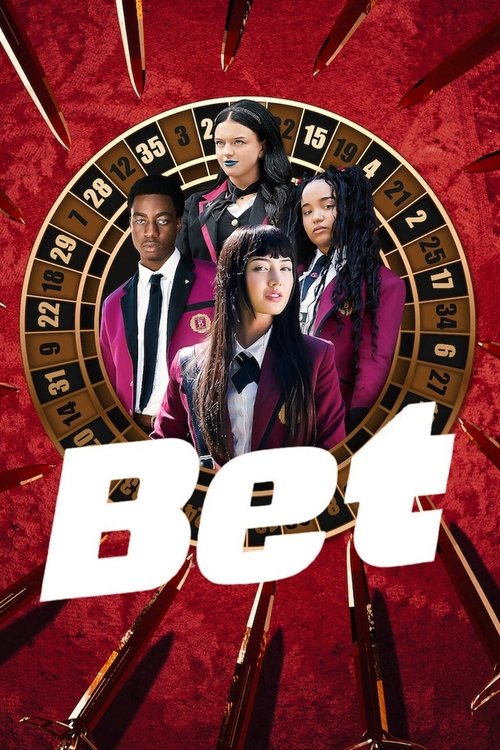
At a private school where gambling determines social status, a skillful new student with a mysterious past is shaking things up — and betting on revenge.
Official
A school where teenagers price one another like stocks sounds, at first, like a piece of nastiness engineered for the streaming era. And maybe it is. But Bet has a colder, smarter idea lurking inside all that lacquered cruelty: what if status itself is just another form of gambling, one with uniforms, rules, and a cheering crowd?
latestnetflix.com's view is that the series takes that notion seriously enough to build a whole miniature society around it — one where every smirk is a wager, every alliance has a house edge, and every new arrival is either prey or a disturbance.

What I kept thinking about, watching the first season, was not the premise so much as the grammar of the place. The show understands that prestige institutions don’t need overt violence to be brutal; they only need rituals. A glance at lunch, a pause before a hand is accepted, the particular way a dare is framed as a joke — those things do the work here.
The series is at its best when it lets those rituals breathe. You can feel the machinery of rank in the blocking and the wardrobe, in the way the camera lets a room sort itself into winners and everyone else. Even when the plotting leans familiar — mysterious transfer student, hidden past, social revenge — the setting gives it a nasty little charge.
I’m not entirely sure Bet always trusts that setting enough. At times it hurries. The season has ten episodes, and you can feel the show glancing at the clock, anxious to keep the next reversal coming.
That’s a shame, because its more patient stretches are where it becomes interesting. The small transactions are the real drama. Not the grand reveal.
Not the ugly speech in a hallway. The quiet exchange that tells you who owes whom, who’s bluffing, who’s been reduced to calculating every smile. There’s a cruelty in that economy, but also a weirdly accurate portrait of adolescent life, which is to say: a place where everyone is overinvested and no one has any money.

Miku Martineau carries a lot of the season on her shoulders, and what’s striking isn’t just that she can play guarded — plenty of young actors can do guarded — but that she knows how to make guardedness look tactical. Her face often seems to be thinking three moves ahead while her body stays almost insultingly still. That stillness matters.
It keeps the character from dissolving into the usual revenge-fantasy fog, where pain becomes charisma and charisma becomes permission. Martineau gives the part a slight, watchful impatience. You can see her measuring a room before she enters it.
That’s not just performance detail; it’s the show’s central emotional fact. In a place built on performance, the most dangerous person is the one who appears to be watching rather than competing.
Ayo Solanke, meanwhile, has the trickier job of making the social world feel inhabited rather than merely diagrammed. His work has a looseness that helps the series avoid becoming a bloodless chessboard. He brings out the awkwardness underneath the hierarchy, the fact that teenagers can be vicious and ridiculous in the same breath.
There’s a scene — one of the better ones — where a public interaction turns on almost nothing: a pause, a half-smile, a decision to say less than expected. The tension doesn’t come from the line itself. It comes from the bodies in the room, from who looks away first, from the tiny humiliation of being forced to wait.
That’s the kind of thing Bet gets right when it’s alert.

If there’s a broader conversation around the series, it’s probably about how familiar this territory feels and how shamelessly the show leans into that familiarity. I can’t call it radical. It isn’t trying to be.
It belongs to the long lineage of elite-school dramas that use classrooms, clubs, and corridors as combat zones — from Heathers to Gossip Girl to the more recent wave of prestige-adjacent teen intrigue. But that lineage matters. Bet is playing a well-worn game with enough confidence to make the rules feel newly nasty. The gambling conceit helps, of course.
It gives the social structure a visible engine. People aren’t just being mean; they’re placing bets on outcomes, on reputations, on who’ll fold first. That idea might have become gimmicky in lesser hands.
Here, it usually works because the show treats it less like a quirky hook and more like a diagnosis.
The most discussed scene, at least among the people I imagine arguing about this sort of thing, is the kind that turns a school ritual into a public execution. I’m being slightly hyperbolic, but not by much. The staging matters: the room is arranged so that everyone can see everyone else, and the camera refuses to rescue anyone with flattering angles.
When the moment arrives, the series lets the silence linger just long enough for embarrassment to become its own plot. Then someone says the wrong thing — or the right thing, if you’re on the side of damage — and the whole social arrangement tilts. I like that Bet understands humiliation as an event with timing, not just a feeling.
It’s engineered. That’s what makes it so sticky.
Of course, the show also has its share of glossy excess. Some of the dialogue pushes a little too hard at its own coolness, as if it worries we might miss that everyone here is awful in an interesting way. I did roll my eyes once or twice.
Maybe more. And there are stretches where the mystery mechanics start to crowd out the emotional ones, which is a common problem in this kind of series. Still, I’d rather watch a show risk overstatement than settle into bland competence. Bet at least knows what it wants its surfaces to do.
The question is whether the people inside those surfaces are allowed enough contradictions.
That’s where the series leaves me, really. Not dazzled, not annoyed, but alert. It has the pleasure of a sharpened premise and the irritation of a show that sometimes wants to move faster than its own best instincts.
Yet I kept coming back to the same thought: underneath the secrecy and the scheming, this is a story about teenagers learning that every social system is a rigged table. Some people are born with chips. Some arrive already owing.
The series doesn’t entirely solve that idea, but it does make it feel lived-in — which is better, and harder, than a neat conclusion.
"A gripping yet uneven boarding school revenge drama with standout gambling sequences and a magnetic lead."
Viewers praise the high-stakes gambling scenes and Miku Martineau as the transfer student out for revenge. Some find the school's power dynamics underdeveloped and the supporting characters thin, so the story feels uneven despite its style.
Netflix dropped Bet on 15 May 2025, ten episodes at once, as a live-action take on Kakegurui, the gambling manga Homura Kawamoto and Toru Naomura have published since 2014. Miku Martineau plays Yumeko, a transfer student at St. Dominic's, where underground bets set the social ladder and the Student Council sits on top. Showrunner Simon Barry told Tudum there was "no point trying to reproduce the original." The team wanted the manga's tone, "audaciousness, and fun," and a new take that "pays homage to it and doesn't try to replace it."
India Times reported Kakegurui readers slamming the series for "Asian erasure" after launch. Martineau is one of the only Asian actors in a company many felt should have featured more Asian talent. Fans compared it to Netflix's Death Note. Some called the Westernization "insulting and infuriating." Other posters said a school moved out of Japan made mixed casting obvious. That fight is fan reaction, not a studio admission.
The Hollywood Reporter had cameras in Toronto in May 2024. Boat Rocker is the production company. Barry, coming off Warrior Nun, developed, wrote, and directed the English-language order. Martineau leads opposite Ayo Solanke, Eve Edwards, Clara Alexandrova, Hunter Cardinal, Anwen O'Driscoll, Aviva Mongillo, and Ryan Sutherland. In the logline Yumeko arrives from Japan with a revenge plot that collides with the council.
Variety said the boarding-school thriller spent three consecutive weeks in Netflix's global Top 10 for English-language series. On 24 June 2025 the streamer renewed it. Barry said he was "extremely happy for our amazing 'Bet' fans from all over the world" and for the cast and crew "to return to St. Dominic's for more gambling and general madness." Jeff F. King, David Fortier, Ivan Schneeberg, Jon Rutherford, and Nick Nantell executive produce with him.
Tudum fills in the rest of the company. Laura Afelskie is Runa. Dorian Giordano is Chad. Emma Elle Paterson is Blake. Solanke is Ryan. Edwards is Mary. Alexandrova is Kira. Yumeko learned to gamble from her mother, then uses those skills to climb the school while hunting a secret. Kakegurui already had a Japanese anime, a Japanese live-action series, and a movie. This is the North American school version.,
The official trailer landed on Netflix's YouTube channel on 21 April. What's On Netflix, citing production listings, put the 10-episode second season in Toronto from 3 June to 13 August 2026. Netflix has not posted a season 2 premiere date.,
Entertainment rumors and trivia aggregated from public reporting. Treat speculation as unverified unless a cited source confirms it.
More titles in the same genres and with the same cast.